by Prof. Plinio Corrêa de Oliveira
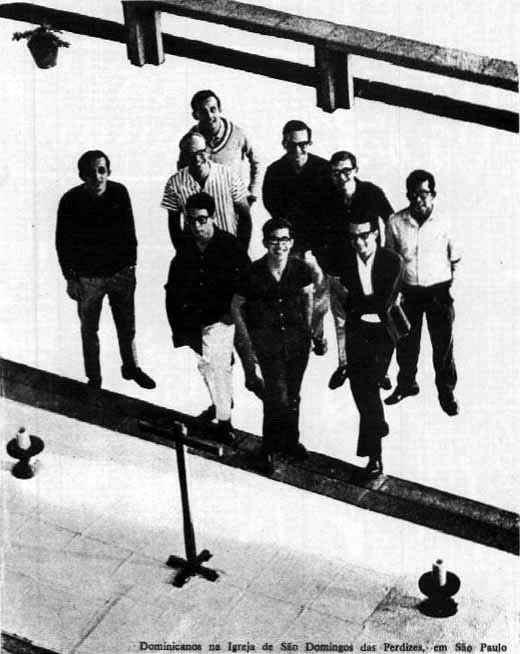 A happy group of young men. Who are they? Students? Businessman? Perhaps workers? One cannot tell by their clothing.
They are however Dominicans, photographed without their cassocks by a Rio de Janeiro magazine, in front of the Church of São Domingos das Perdizes, in São Paulo. Our readers are perhaps surprised. If it is natural for each person to dress in the clothing suitable to their profession, then it is difficult to understand why these religious allowed themselves to be photographed in secular clothing. It is true that the habit does not make the monk. But the good monk, who is really happy to be a monk, does not give up his habit.
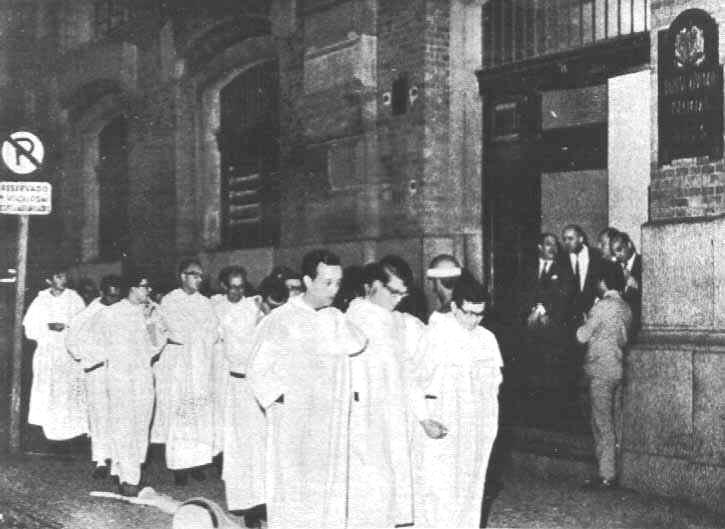 That ecclesiastical attire is losing its prestige in our times is the natural explanation for these young Dominicans’ incongruent attitude. And thus, this obliges the true apostle to relinquish his cassock, at least in many cases, if he wants to wield any influence with the public.
On August 2, 1967, the young Dominicans in the second picture marched in front of the building housing the Department of Political and Social Order (DPSO), in São Paulo. They were protesting the arrest of priests and students involved in a disturbance promoted by the UNE.
In the third photograph, two young men in cassocks, one of whom is a Dominican, is carrying a sign of protest.
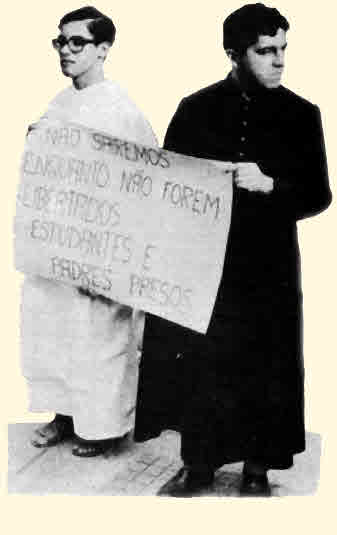 Why are they wearing their cassocks on these occasions? Isn’t it precisely because any action by the police against ecclesiastics wearing cassocks would outrage the people, while the effect would be much less if the ecclesiastics were in plain clothes? However, the effect would be much less if the clergymen were in civilian clothing.
How then, can one fail to recognize the enormous influence of the floor-length cassock holds? And why, then, abandon it? One more incongruence among the so many tragic incongruences characteristic of our times.

* DPSO: The Department of Political and Social Order was a secret police agency of the Brazilian government from 1924 to 1983.
Ambience Customs & Civilization, “Catolicismo” No. 201 – September 1967