Destruction of the Church of the Holy Sepulchre
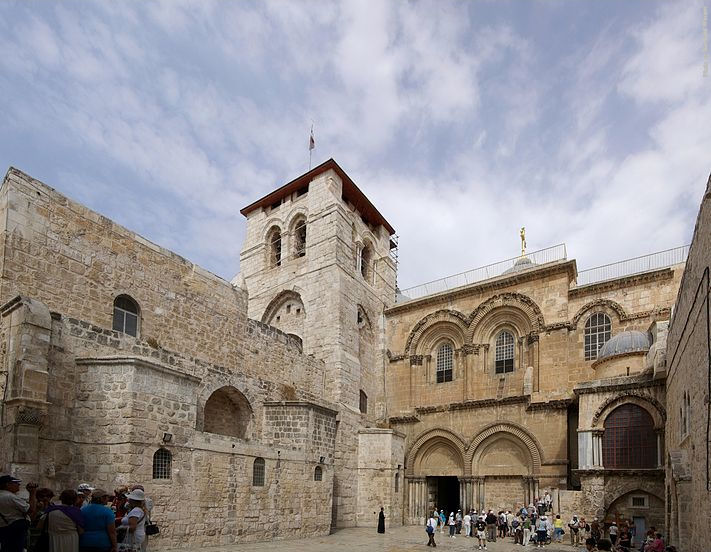
Main Entrance to the Church of the Holy Sepulchre
European reaction was of shock and dismay, with far-reaching and intense consequences. Ultimately, this destruction provided an impetus to the later Crusades.

It was for the deliverance of the Holy Sepulchre that the crusades were organized; it was for its defence that military orders were instituted. During the Middle Ages this memorable relic of Christ’s life on earth was looked upon as the mystical sovereign of the new Latin state. Godfrey of Bouillon desired no other title than that of Defender of the Holy Sepulchre, and different Latin princes, Bohemond of Antioch, and Tancred, acknowledged themselves its vassals.
Knights of the Holy Sepulchre
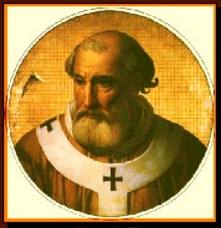
Pope Gregory IX
Neither the name of a founder nor a date of foundation can be assigned to the so-called Order of the Holy Sepulchre if we reject the legendary traditions which trace its origin back to the time of Godfrey of Bouillon, or Charlemagne, or indeed even to the days of St. James the Apostle, first Bishop of Jerusalem. It is in reality a secular confraternity which gradually grew up around the most august of the Holy Places.
It was natural that the Holy Sepulchre also had its special knights. In the broad acceptation of the word, every crusader who had taken the sword in its defense might assume the title from the very moment of being dubbed a knight. Those who were not knighted had the ambition of being decorated knights, preferably in this sanctuary, and of being thus enabled to style themselves Knights of the Holy Sepulchre par excellence. The fall of the Kingdom of Jerusalem did not suspend pilgrimages to the Tomb of Christ, or the custom of receiving knighthood there, and, when the custody of the Holy Land was entrusted to the Franciscans, they continued this pious custom and gave the order its first grand masters.
 The official arrival of the Friars Minor in Syria dates from the Bull addressed by Pope Gregory IX to the clergy of Palestine in 1230, charging them to welcome the Friars Minor, and to allow them to preach to the faithful and hold oratories and cemeteries of their own. Thanks to the ten years’ truce concluded during the preceding year between Frederick II of Sicily and the sultan, the Franciscans were enabled to enter Jerusalem, but they were also the first victims of the violent invasion of the Khorasmians in 1244, thus opening the long Franciscan martyrology of the Holy Land. Nevertheless, the Franciscan province of Syria continued to exist with Acco as its seat. The monks quickly resumed possession of their convent of Mount Sion at Jerusalem, to which they have demonstrated their claim with the blood of their martyrs and where they have obstinately retained their foothold in spite of numberless molestations and outrages for five hundred years.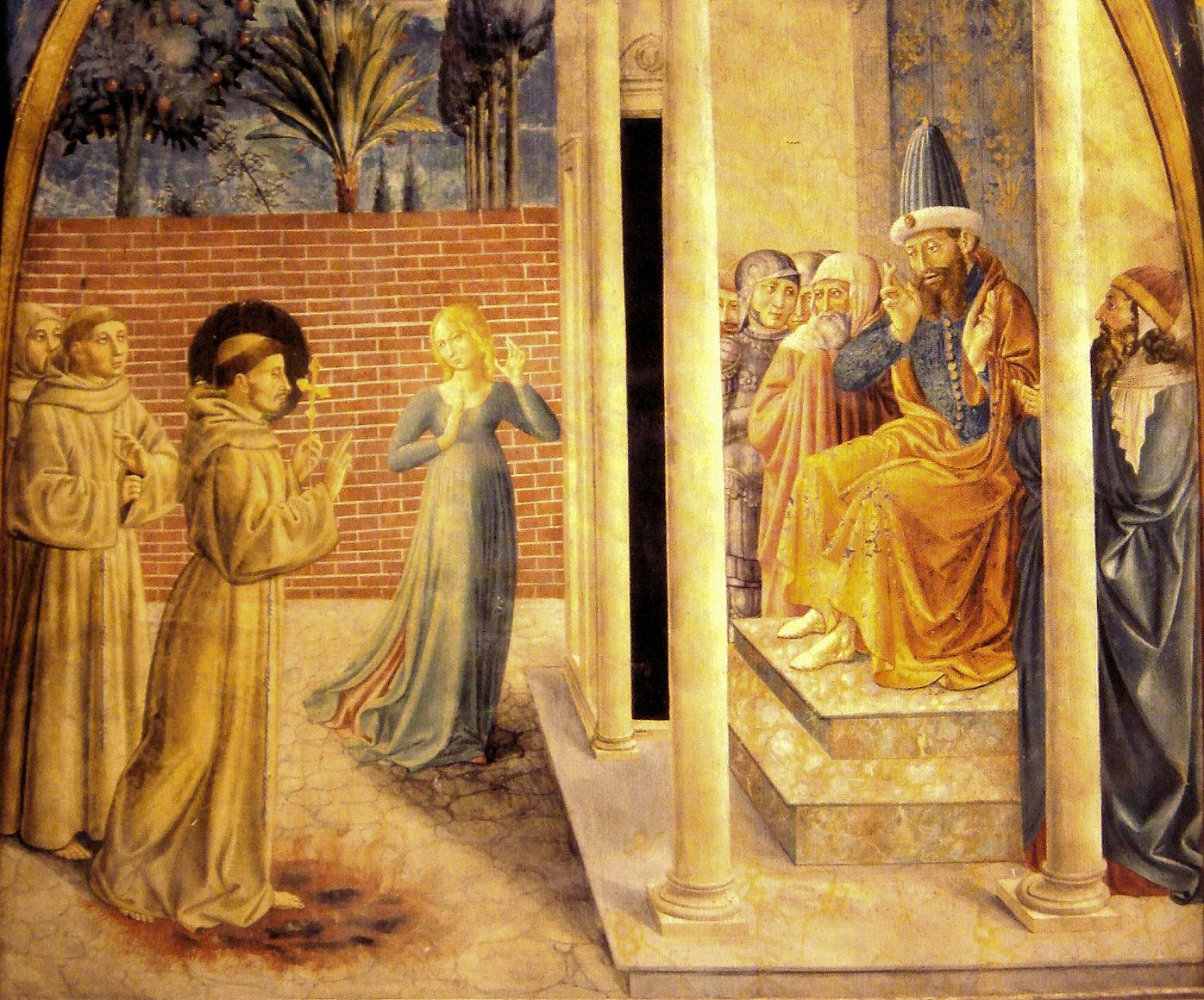
Saint Francis of Assisi with the Sultan Al-Kamil
The Turks, notwithstanding their fierce fanaticism, tolerated the veneration paid to the Tomb of Christ, because of the revenue they derived from the taxes levied upon pilgrims. In 1342, in his Bull “Gratiam agimus”, Pope Clement VI officially committed the care of the Holy Land to the Franciscans, who fulfilled this trust until the restoration of the Latin Patriarchate of Jerusalem by Pius IX. Consequently, after 1342, to be enrolled among the Knights of the Holy Sepulchre, it was necessary to apply to the Franciscans, and from this period the itineraries of pilgrims mention frequent receptions into this confraternity – improperly called an order, since it had no monastic rule, regular organization, or community of goods. Where mention is made of the possessions of the Holy Sepulchre, the allusion is to the Canons of the Holy Sepulchre, who had convents in various lands, and not to the knights, as some writers believe.
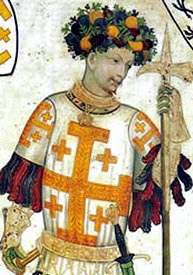
Godefrey of Bouillon
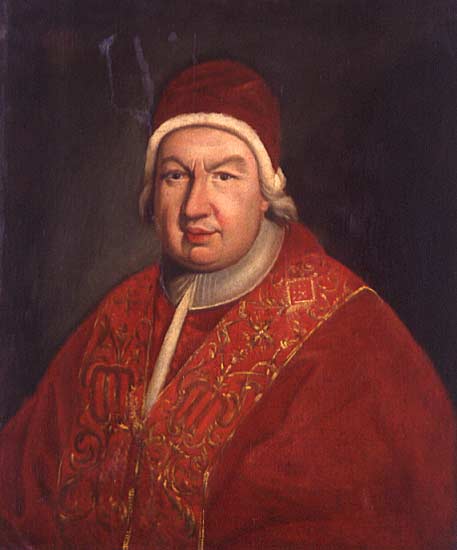
Pope Benedict XIV
QUARESMIUS, Historica Terrœ Sanctœ elucidatio (Antwerp, 1639); HODY, Notice sur les chevaliers du St-Sépulcre (Académie d’archéologie, Antwerp, 1855); HERMENS, Der Orden vom h. Grabe (Cologne, 1870); COURET, L’Ordre du St-Sépulcre de Jerusalem (Paris, 1905).
(cfr. Catholic Encyclopedia)
_________________
Also of interest: