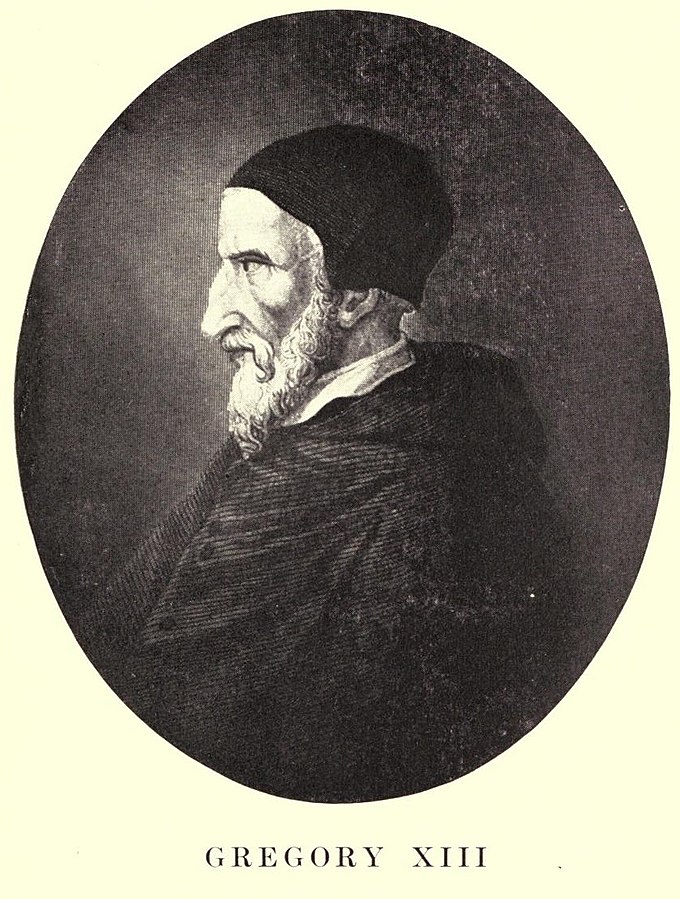
Pope Gregory XIII
(UGO BUONCOMPAGNI).
 Born at Bologna, 7 Jan., 1502; died at Rome, 10 April, 1585. He studied jurisprudence at the University of Bologna, from which he was graduated at an early age as doctor of canon and of civil law. Later, he taught jurisprudence at the same university, and had among his pupils the famous future cardinals, Alessandro Farnese, Cristoforo Madruzzi, Otto Truchsess von Waldburg, Reginald Pole, Carlo Borromeo, and Stanislaus Hosius. In 1539 he came to Rome at the request of Cardinal Parizzio, and Paul III appointed him judge of the Capitol, papal abbreviator, and referendary of both signatures. In 1545 the same pope sent him to the Council of Trent as one of his jurists. On his return to Rome he held various offices in the Roman Curia under Julius III (1550-1555), who also appointed him prolegate of the Campagna in 1555. Under Paul IV (1555-1559) he accompanied Cardinal Alfonso Caraffa on a papal mission to Philip II in Flanders, and upon his return was appointed Bishop of Viesti in 1558. Up to this time he had not been ordained a priest. In 1559 the newly-elected pope, Pius IV, sent him as his confidential deputy to the Council of Trent, where he remained till its conclusion in 1563. Shortly after his return to Rome, the same pope created him Cardinal Priest of San Sisto in 1564, and sent him as legate to Spain to investigate the case of Archbishop Bartolomé Carranza of Toledo, who had been suspected of heresy and imprisoned by the Inquisition. While in Spain he was appointed secretary of papal Briefs, and after the election of Pius V, 7 Jan., 1566, he returned to Rome to enter upon his new office. After the death of Pius V on 1 May, 1572, Ugo Buoncompagni was elected pope on 13 May, 1572, chiefly through the influence of Cardinal Antoine Granvella, and took the name of Gregory XIII. At his election to the papal throne he had already completed his seventieth year, but was still strong and full of energy.
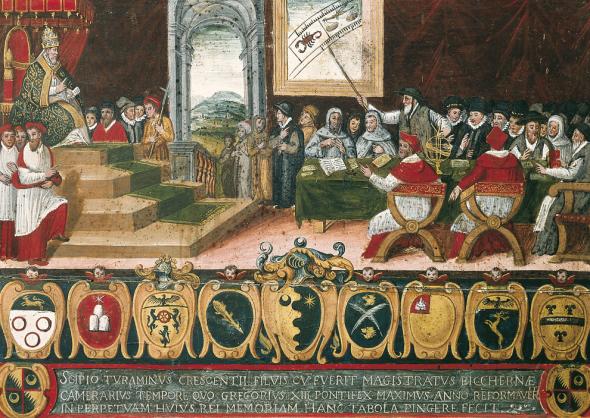 His youth was not stainless. While still at Bologna, a son, named Giacomo, was born to him of an unmarried woman. Even after entering the clerical state he was worldly-minded and fond of display. But from the time he became pope he followed in the footsteps of his holy predecessor, and was thoroughly imbued with the consciousness of the great responsibility connected with his exalted position. His election was greeted with joy by the Roman people, as well as by the foreign rulers. Emperor Maximilian II, the kings of France, Spain, Portugal, Hungary, Poland, the Italian and other princes sent their representatives to Rome to tender their obedience to the newly-elected pontiff. At the first consistory he ordered the Constitution of Pius V, which forbade the alienation of church property, to be read publicly, and pledged himself to carry into execution the decrees of the Council of Trent. He at once appointed a committee of cardinals, consisting of Borromeo, Palcotti, Aldobrandini, and Arezzo, with instructions to find out and abolish all ecclesiastical abuses; decided that the cardinals who were at the head of dioceses were not exempt from the Tridentine decree of episcopal residence; designated a committee of cardinals to complete the Index of Forbidden Books, and appointed one day in each week for a public audience during which everyone had access to him. In order that only the most worthy persons might be vested with ecclesiastical dignities, he kept a list of commendable men in and out of Rome, on which he noted their virtues and faults that came to his notice. The same care he exercised in the appointment of cardinals. Thirty-four cardinals were appointed during his pontificate, and in their appointment he always had the had the welfare of the Church in view. He cannot be charged with nepotism. Two of his nephews, Filippo Buoncompagni and Filippo Vastavillano, he created cardinals because he considered them worthy of the dignity; but when a third one aspired after the purple, he did not even grant him an audience. His son Giacomo he appointed castellan of St. Angelo and gonfalonier of the Church, but refused him every higher dignity, although Venice enrolled him among its nobili and the King of Spain appointed him general of his army.
Like his holy predecessor, Gregory XIII spared no efforts to further an expedition against the Turks. With this purpose in view he sent special legates to Spain, France, Germany, Poland, and other countries, but the discord of the Christian princes among themselves, the peace concluded by the Venetians with the Turks, and the treaty effected by Spain with the Sultan, frustrated all his exertions in this direction.
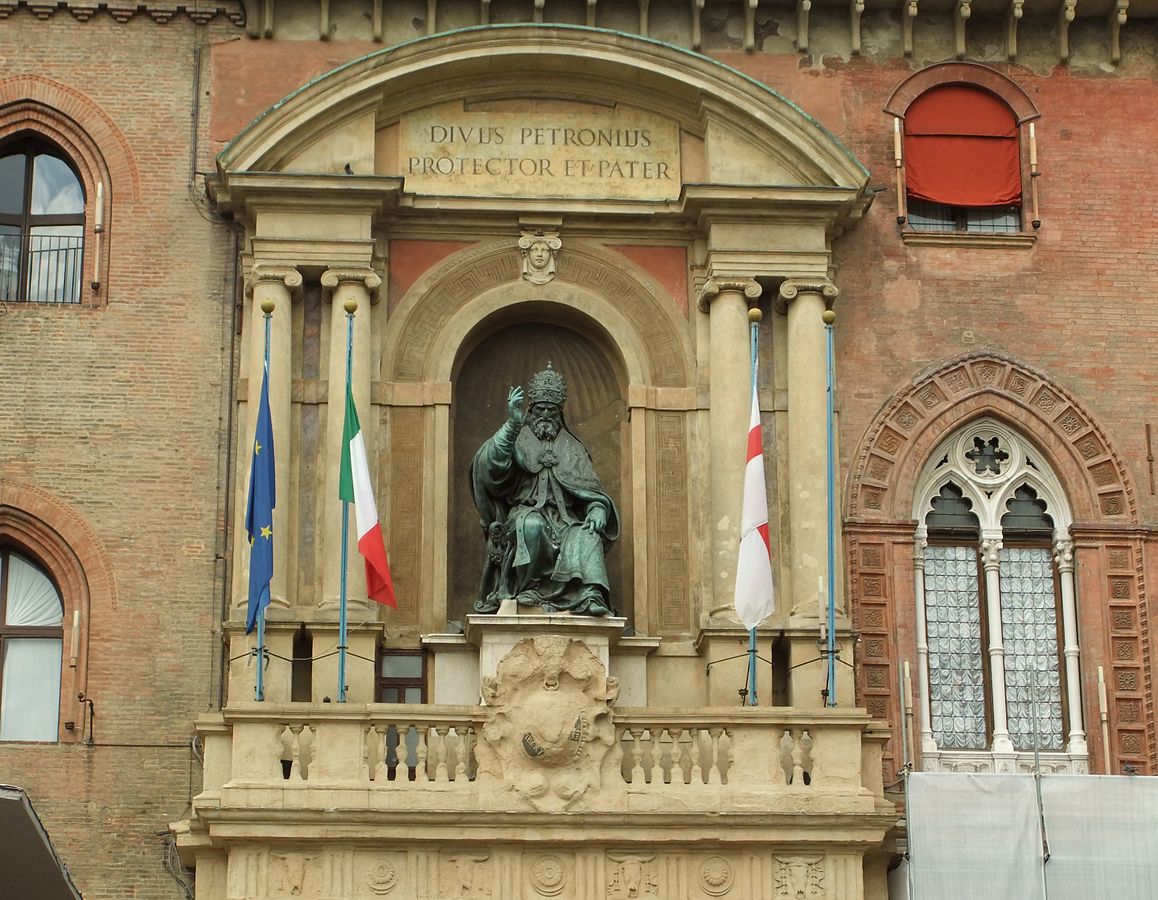
Statue of Pope Gregory XIII at the Palazzo d’Accursio in Bologna. Photo by Giacomo Boschi.
For stemming the tide of Protestantism, which already had wrested entire nations from the bosom of the Church, Gregory XIII knew of no better means than a thorough training of the candidates for holy priesthood in Catholic philosophy and theology. He founded numerous colleges and seminaries at Rome and other suitable places and put most of them under the direction of the Jesuits. At least twenty-three such institutions of learning owe their existence or survival to the munificence of Gregory XIII. The first of these institutions that enjoyed the pope’s liberality was the German College at Rome, which for lack of funds was in danger of being abandoned. In a Bull dated 6 August, 1573, he ordered that no less than one hundred students at a time from Germany and its northern borderland should be educated in the German College, and that it should have an annual income of 10,000 ducats, to be paid, as far as necessary, out of the papal treasury. In 1574 he gave the church and the palace of Sant’ Apollinare to the institution, and in 1580 united the Hungarian college with it. The following Roman colleges were founded by Gregory XIII: the Greek college on 13 Jan., 1577; the college for neophytes, i.e. converted Jews and infidels, in 1577; the English college on 1 May, 1579; the Maronite college on 27 June, 1584. For the international Jesuit college (Collegium Romanum) he built in 1582 the large edifice known as the Collegio Romano which was occupied by the faculty and students of the Collegium Romanum (Gregorian University) until the Piedmontese Government declared it national property and expelled the Jesuits in 1870. Outside of Rome the following colleges were either founded or liberally endowed by Gregory XIII: the English college at Donai, the Scotch college at Pont-à-Mousson, the papal seminaries at Graz, Vienna, Olmutz, Prague, Colosvar, Fulda, Augsburg, Dillingen, Braunsberg, Milan, Loreto, Fribourg in Switzerland, and three schools in Japan. In these schools numerous missionaries were trained for the various countries where Protestantism had been made the state religion and for the missions among the pagans in China, India, and Japan. Thus Gregory XIII at least partly restored the old faith in England and the northern countries of Europe, supplied the Catholics in those countries with their necessary priests, and introduced Christianity into the pagan countries of Eastern Asia. Perhaps one of the happiest events during his pontificate was his arrival at Rome of four Japanese ambassadors on 22 March, 1585. They had been sent by the converted kings of Bungo, Arima, and Omura, in Japan, to thank the pope for the fatherly care he had shown their country by sending them Jesuit missionaries who had taught them the religion of Christ.
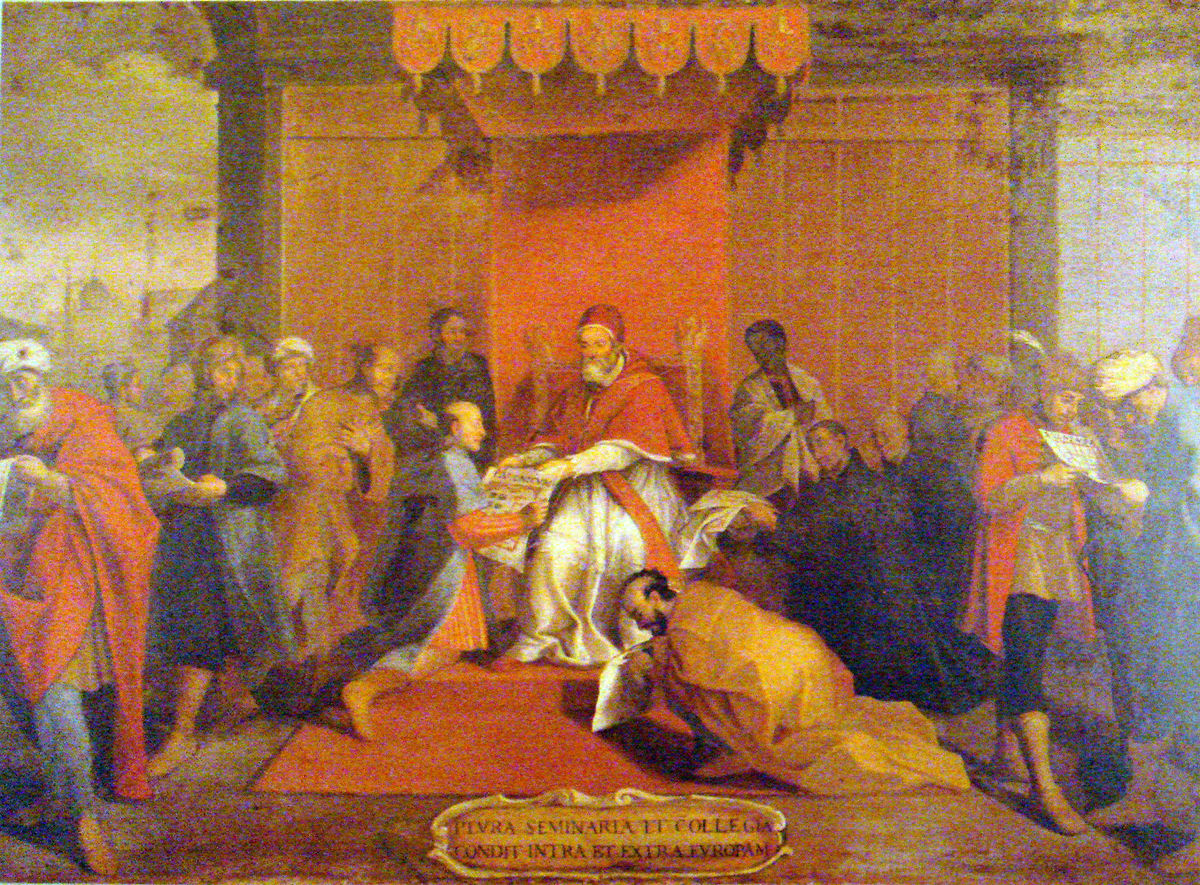
Japanese Delegates & Pope Gregory XIII
In order to safeguard the Catholic religion in Germany, he instituted a special Congregation of Cardinals for German affairs, the so-called Congregatio Germanica, which lasted from 1573-1578. To remain informed of the Catholic situation in that country and keep in closer contact with its rulers, he erected resident nunciatures at Vienna in 1581 and at Cologne in 1582. By his Bull “Provisionis nostrae” of 29 Jan., 1579, he confirmed the acts of his predecessor Pius V, condemning the errors of Baius, and at the same time he commissioned the Jesuit, Francis of Toledo, to demand the abjuration of Baius. In the religious orders Gregory XIII recognized a great power for the conversion of pagans, the repression of heresy and the maintenance of the Catholic religion. He was especially friendly towards the Jesuits, whose rapid spread during the pontificate was greatly due to his encouragement and financial assistance. Neither did he neglect the other orders. He approved the Congregation of the Oratory in 1574, the Barnabites in 1579, and the Discaleed Carmalites in 1580. The Premonstratensians he honoured by canonizing their founder, St. Norbert, in 1582.