Saint Anselm, Confessor, Archbishop Of Canterbury
(A. D. 1109)
If the Norman conquerors stripped the English nation of its liberty and many temporal advantages, it must be owned that by their valor they raised the reputation of its arms and deprived their own country of its greatest men, both in church and state, with whom they adorned this kingdom; of which this great doctor and his master Lanfranc are instances.
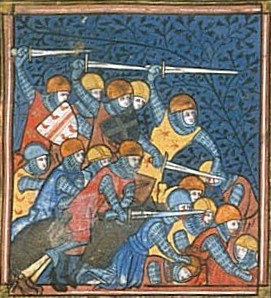 Saint Anselm was born of noble parents at Aoust, in Piedmont, about the year 1033. His pious mother took care to give him an early tincture of piety, and the impressions her instructions made upon him were as lasting as his life. At the age of fifteen, desirous of serving God in the monastic state, he petitioned an abbot to admit him into his house; but was refused out of apprehension of his father’s displeasure. Neglecting, during the course of his studies, to cultivate the divine seed in his heart, he lost this inclination, and his mother being dead he fell into tepidity; and, without being sensible of the fatal tendency of vanity and pleasure, began to walk in the broad way of the world: so dangerous a thing is it to neglect the inspirations of grace!
The saint, in his genuine meditations, expresses the deepest sentiments of compunction for these disorders, which his perfect spirit of penance exceedingly exaggerated to him, and which, like another David, he never ceased most bitterly to bewail to the end of his days. The ill-usage he met with from his father induced him, after his mother’s death, to leave his own country, where he had made a successful beginning in his studies; and, after a diligent application to them for three years in Burgundy (then a distinct government) and in France, invited by the great fame of Lanfranc, Prior of Bec, in Normandy, under the Abbot Herluin, he went thither and became his scholar. On his father’s death, Anselm advised with him about the state of life he was to embrace; as whether he should live upon his estate to employ its produce in alms, or should renounce it at once and embrace a monastic and eremitical life. Lanfranc, feeling an overbearing affection for so promising a disciple, durst not advise him in his vocation, fearing the bias of his own inclination; but he sent him to Maurillus, the holy Archbishop of Rouen. By him Anselm, after he had laid open to him his interior, was determined to enter the monastic state at Bec, and accordingly became a member of that house at the age of twenty-seven, in 1060, under the Abbot Herluin.
Three years after, Lanfranc was made Abbot of Saint Stephen’s at Caen, and Anselm Prior of Bec. At this promotion several of the monks murmured on account of his youth; but, by patience and sweetness, he won the affections of them all, and by little condescensions at first, so worked upon an irregular young monk, called Osbern, as to perfect his conversion and make him one of the most fervent. He had indeed so great a knowledge of the hearts and passions of men that he seemed to read their interior in their actions; by which he discovered the sources of virtues and vices, and knew how to adapt to each proper advice and instructions; which were rendered most powerful by the mildness and charity with which he applied them. In regard to the management and tutoring of youth, he looked upon excessive severity as highly pernicious. Eadmer has recorded a conversation he had on this subject with a neighboring abbot, who, by a conformity to our saint’s practice and advice in this regard, experienced that success in his labors which he had till then aspired to in vain by harshness and severity.
Saint Anselm applied himself diligently to the study of every part of theology, by the clear light of scripture and tradition. Whilst he was prior at Bec, he wrote his Monologium, so called because in this work he speaks alone, explaining the metaphysical proofs of the existence and nature of God. Also his Proslogium, or contemplation of God’s attributes in which he addresses his discourse to God, or himself. The Meditations, commonly called the Manual of Saint Augustin, are chiefly extracted out of this book. It was censured by a neighboring monk, which occasioned the saint’s Apology. These and other the like works, show the author to have excelled in metaphysics all the doctors of the church since Saint Augustin. He likewise wrote, whilst prior, On Truth, on Free Will, and On the Fall of the Devil, or, On the Origin of Evil; also his Grammarian, which is in reality a treatise on Dialectic, or the Art of Reasoning.

Abbaye du Bec Hellouin
Anselm’s reputation drew to Bec great numbers from all the neighboring kingdoms. Herluin dying in 1078, he was chosen Abbot of Bec, being forty-five years old, of which he had been prior fifteen. The abbey of Bec being possessed at that time of some lands in England, this obliged the abbot to make his appearance there in person at certain times. This occasioned our saint’s first journeys thither, which his tender regard for his old friend Lanfranc, at that time Archbishop of Canterbury, made the more agreeable. He was received with great honor and esteem by all ranks of people, both in church and state, and there was no one who did not think it a real misfortune if he had not been able to serve him in something or other. King William himself, whose title of Conqueror rendered him haughty and inaccessible to his subjects, was so affable to the good Abbot of Bec that he seemed to be another man in his presence. The saint, on his side, was all to all, by courtesy and charity, that he might find occasions of giving everyone some suitable instructions to promote their salvation; which were so much the more effectual as he communicated them, not as some do, with the dictatorial air of a master, but in a simple familiar manner, or by indirect though sensible examples.
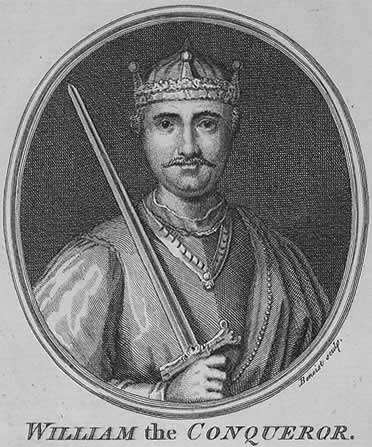
William the Conqueror seemed to be another man in the presence of St. Anselm
In the year 1092, Hugh, the great Earl of Chester, by three pressing messages, entreated Anselm to come again into England, to assist him, then dangerously sick, and to give his advice about the foundation of a monastery which that nobleman had undertaken at St. Wereburge’s church at Chester. A report that he would be made archbishop of Canterbury, in the room of Lanfranc, deceased, made him stand off for some time; but he could not forsake his old friend in his distress, and at last came over. He found him recovered, but the affairs of his own abbey, and of that which the earl was erecting, detained him five months in England. The metropolitan see of Canterbury had been vacant ever since the death of Lanfranc in 1089.
The sacrilegious and tyrannical king, William Rufus, who succeeded his father in 1087, by an injustice unknown till his time, usurped the revenues of vacant benefices, and deferred his permission, or (congé d’elire), in order to postpone the filling of the episcopal sees, that he might the longer enjoy their income. Having thus seized into his hands the revenues of the archbishopric, he reduced the monks of Canterbury to a scanty allowance, oppressing them moreover by his officers with continual insults, threats, and vexations. He had been much solicited by the most virtuous among the nobility to supply the see of Canterbury, in particular, with a person proper for that station; but continued deaf to all their remonstrances and answered them, at Christmas 1093, that neither Anselm nor any other should have that bishopric whilst he lived; and this he swore to by the holy face of Lucca, meaning a great crucifix in the cathedral of that city held in singular veneration, his usual oath. He was seized soon after with a violent fit of sickness, which in a few days brought him to extremity.
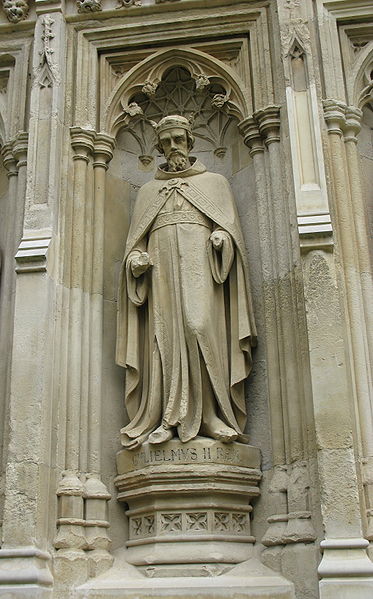
The sacrilegious and tyrannical king, William Rufus
He was then at Gloucester, and seeing himself in this condition, signed a proclamation, which was published, to release all those that had been taken prisoners in the field, to discharge all debts owing to the crown, and to grant a general pardon; promising likewise to govern according to law and to punish the instruments of injustice with exemplary severity. He moreover nominated Anselm to the see of Canterbury, at which all were extremely satisfied but the good abbot himself, who made all the decent opposition imaginable; alleging his age, his want of health and vigor enough for so weighty a charge, his unfitness for the management of public and secular affairs, which he had always declined to the best of his power. The king was extremely concerned at his opposition, and asked him why he endeavored to ruin him in the other world, being convinced that he should lose his soul in case he died before the archbishopric was filled. The king was seconded by the bishops and others present, who not only told him they were scandalized at his refusal, but added that, if he persisted in it, all the grievances of the church and nation would be placed to his account. Thereupon they forced a pastoral staff into his hands, in the king’s presence, carried him into the church, and sung Te Deum on the occasion. This was on the 6th of March 1093. He still declined the charge till the king had promised him the restitution of all the lands that were in the possession of that see in Lanfranc’s time. Anselm also insisted that he should acknowledge Urban II for lawful pope. Things being thus adjusted, Anselm was consecrated with great solemnity on the 4th of December 1093.
Anselm had not been long in possession of the see of Canterbury when the king, intending to wrest the duchy of Normandy out of the hands of his brother Robert, made large demands on his subjects for supplies. On this occasion, not content with the five hundred pounds (a very large sum in those days) offered him by the archbishop, the king insisted, at the instigation of some of his courtiers, on a thousand, for his nomination to the archbishopric, which Anselm constantly refused to pay; pressing him also to fill vacant abbeys and to consent that bishops should hold councils as formerly, and be allowed by canons to repress crimes and abuses, which were multiplied and passed into custom for want of such a remedy, especially incestuous marriages and other abominable debaucheries. The king was extremely provoked, and declared no one should extort from him his abbeys any more than his crown. And from that day he sought to deprive Anselm of his see.