Battle of Mühlberg 1547 and imprisonment of elector Johann Friedrich of Saxony. The pictorial report focuses on the end of the Battle of Mühlberg and the capture of the elector. On the right scenes from the five-year captivity are shown.
The Battle of Mühlberg took place near Mühlberg in the Electorate of Saxony in 1547, during the Schmalkaldic War. The Catholic princes of the Holy Roman Empire led by the Holy Roman Emperor Charles V decisively defeated the Lutheran Schmalkaldic League of Protestant princes under the command of Elector John Frederick I of Saxony and Landgrave Philip I of Hesse.
The battle ended the Schmalkaldic war and led to the dissolution of the Schmalkaldic League.
What was the Schmalkaldic League?
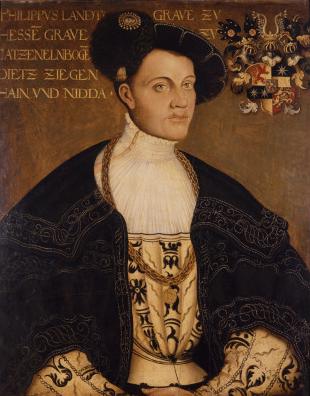
Philip I, Landgrave of Hesse
A politico-religious alliance formally concluded on 27 Feb., 1531, at Smalkalden in Hesse-Nassau, among German Protestant princes and cities for their mutual defence. The compact was entered into for six years, and stipulated that any military attack made upon any one of the confederates on account of religion or under any other pretext was to be considered as directed against them all and resisted in common. The parties to it were: the Landgrave Philip of Hesse; the Elector John of Saxony and his son John Frederick; the dukes Philip of Brunswick-Grubenhagen and Otto, Ernest, and Francis of Brunswick-Lünenburg; Prince Wolfgang of Anhalt; the counts Gebhard and Albrecht of Mansfeld and the towns of Strasburg, Ulm, Constance, Reutlingen, Memmingen, Lindau, Biberach, Isny, Magdeburg, and Bremen. The city of Lübeck joined the league on 3 May, and Bavaria on 24 Oct., 1531. The accession of foreign powers, notably England and France, was solicited, and the alliance of the latter nation secured in 1532. The princes of Saxony and Hesse were appointed military commanders of the confederation, and its military strength fixed at 10,000 infantry and 2000 cavalry. At a meeting held at Smalkalden in Dec., 1535, the alliance was renewed for ten years, and the maintenance of the former military strength decreed, with the stipulation that it should be doubled in case of emergency. In April, 1536, Dukes Ulrich of Würtemberg and Barnim and Philip of Pomerania, the cities of Frankfort, Augsburg, Hamburg, and Hanover joined the league with several other new confederates. An alliance was concluded with Denmark in 1538, while the usual accession of the German Estates which accepted the Reformation continued to strengthen the organization. Confident of its support, the Protestant princes introduced the new religion in numerous districts, suppressed bishoprics, confiscated church property, resisted imperial ordinances to the extent of refusing help against the Turks, and disregarded the decisions of the Imperial Court of Justice.
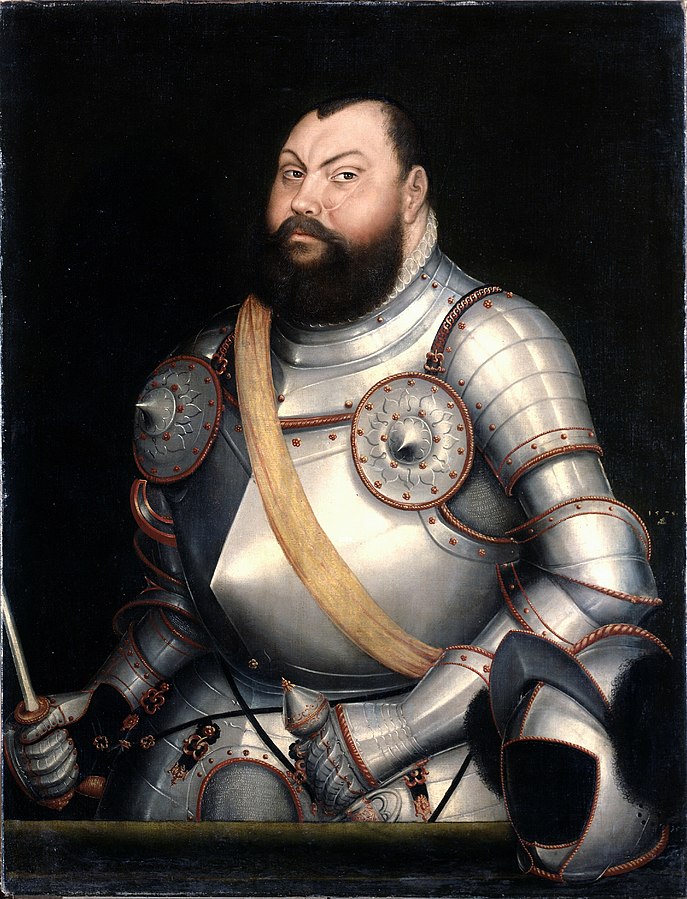
John Frederick I of Saxony
In self-defence against the treasonable machinations of the confederation, a Catholic League was formed in 1538 at Nuremberg under the leadership of the emperor. Both sides now actively prepared for an armed conflict, which seemed imminent. But negotiations carried on at the Diet of Frankfort in 1539 resulted, partly owing to the illness of the Landgrave of Hesse, in the patching up of a temporary peace. The emperor during this respite renewed his earnest but fruitless efforts to effect a religious settlement, while the Smalkaldic confederates continued their violent proceedings against the Catholics, particularly in the territory of Brunswick-Wolfenbüttel, where Duke Henry was unjustly expelled, and the new religion introduced (1542). It became more and more evident as time went on that a conflict was unavoidable. When, in 1546, the emperor adopted stern measures against some of the confederates, the War of Smalkalden ensued. Although it was mainly a religious conflict between Catholics and Protestants, the denominational lines were not sharply drawn. With Pope Paul III, who promised financial and military assistance, several Protestant princes, the principal among whom was Duke Marice of Saxony, defended the imperial and Catholic cause. The beginning of hostilities was marked nevertheless by the success of the Smalkaldic allies; but division and irresoluteness soon weakened them and caused their ruin in Southern Germany, where princes and cities submitted in rapid succession. The battle of Mühlberg (24 April, 1547) decided the issue in favour of the emperor in the north. The Elector John Frederick of Saxony was captured, and shortly after the Landgrave Philip of Hesse was also forced to submit. The conditions of peace included the transfer of the electoral dignity from the former to his cousin Maurice, the reinstatement of Duke Henry of Wolfenbüttel in his dominions, the restoration of Bishop Julius von Pflug to his See of Naumburg-Zeitz, and a promise demanded of the vanquished to recognize and attend the Council of Trent. The dissolution of the Smalkaldic League followed; the imperial success was complete, but temporary.
The Battle
Charles was suffering from gout at that time and his army had to face the desertion of the Papal soldiers that had helped him in the first part of the campaign. In addition the Saxon Elector’s army was larger than Charles’ forces. However, hoping to encourage a Protestant and anti-imperial uprising in Bohemia, John Frederick took the decision to split his forces and he deployed a large portion of his troops there.