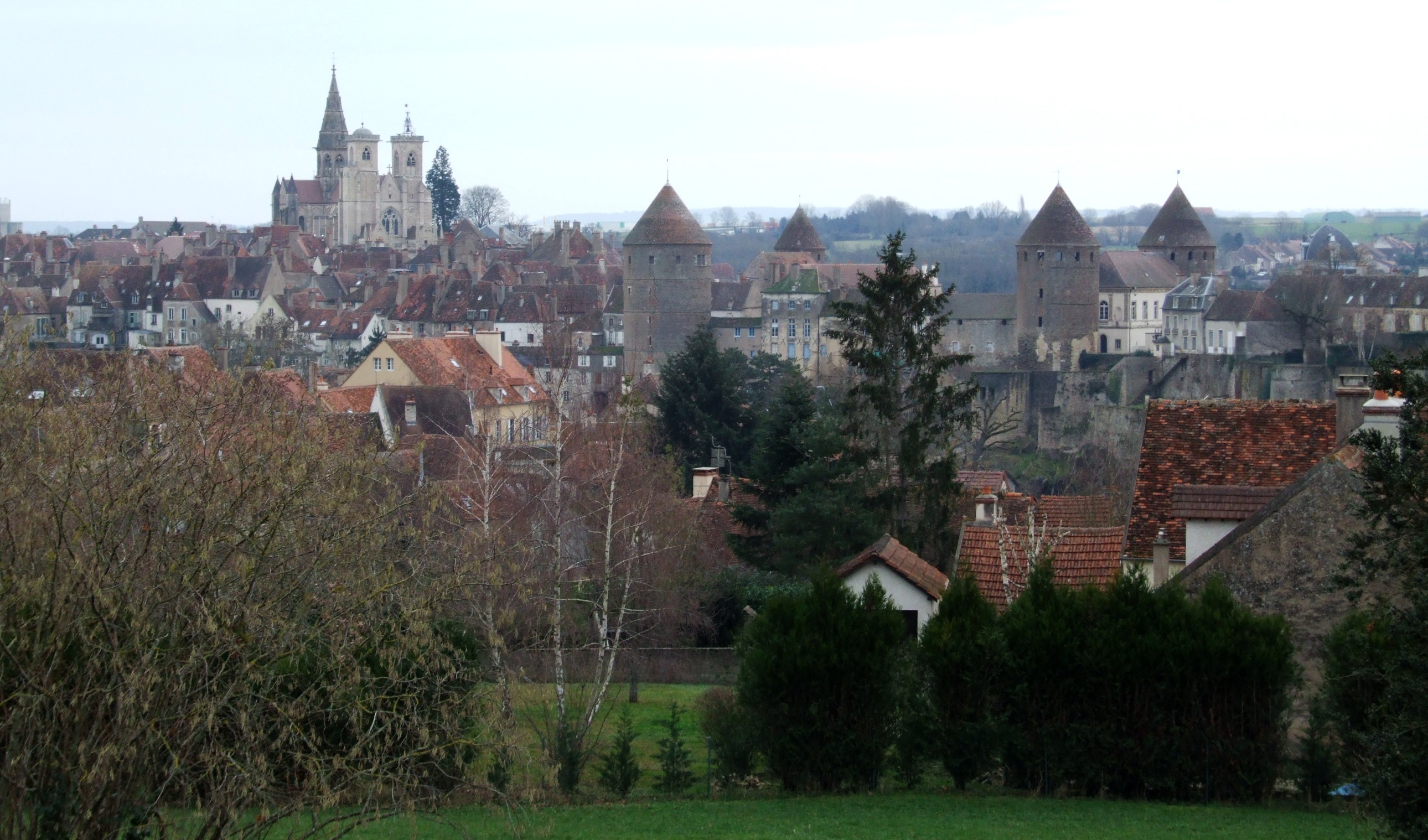
The Burgundian town of Semur where St. Hugh the Great was born. Photo by Christophe Finot
Saint Hugh the Great, Abbot of Cluny, born at Semur (Brionnais in the Diocese of Autun), 1024; died at Cluny, 28 April, 1109.
His early life
The eldest son of Count Dalmatius of Semur and Aremberge (Aremburgis) of Vergy, Hugh was descended from the noblest families in Burgundy. Dalmatius, devoted to war and the chase, desired that Hugh should adopt the knightly calling and succeed to the ancestral estates; his mother, however, influenced it is said by a vision vouchsafed to a priest whom she consulted, wished her son to dedicate himself to the service of God. From his earliest years Hugh gave indication of such extraordinary earnestness and piety that his father, recognizing his evident aversion from the so-called gentle pursuits, entrusted him to his grand-uncle Hugh, Bishop of Auxerre, for preparation for the priesthood. Under the protection of this relative, Hugh received his early education at the monastery school attached to the Priory of St. Marcellus.
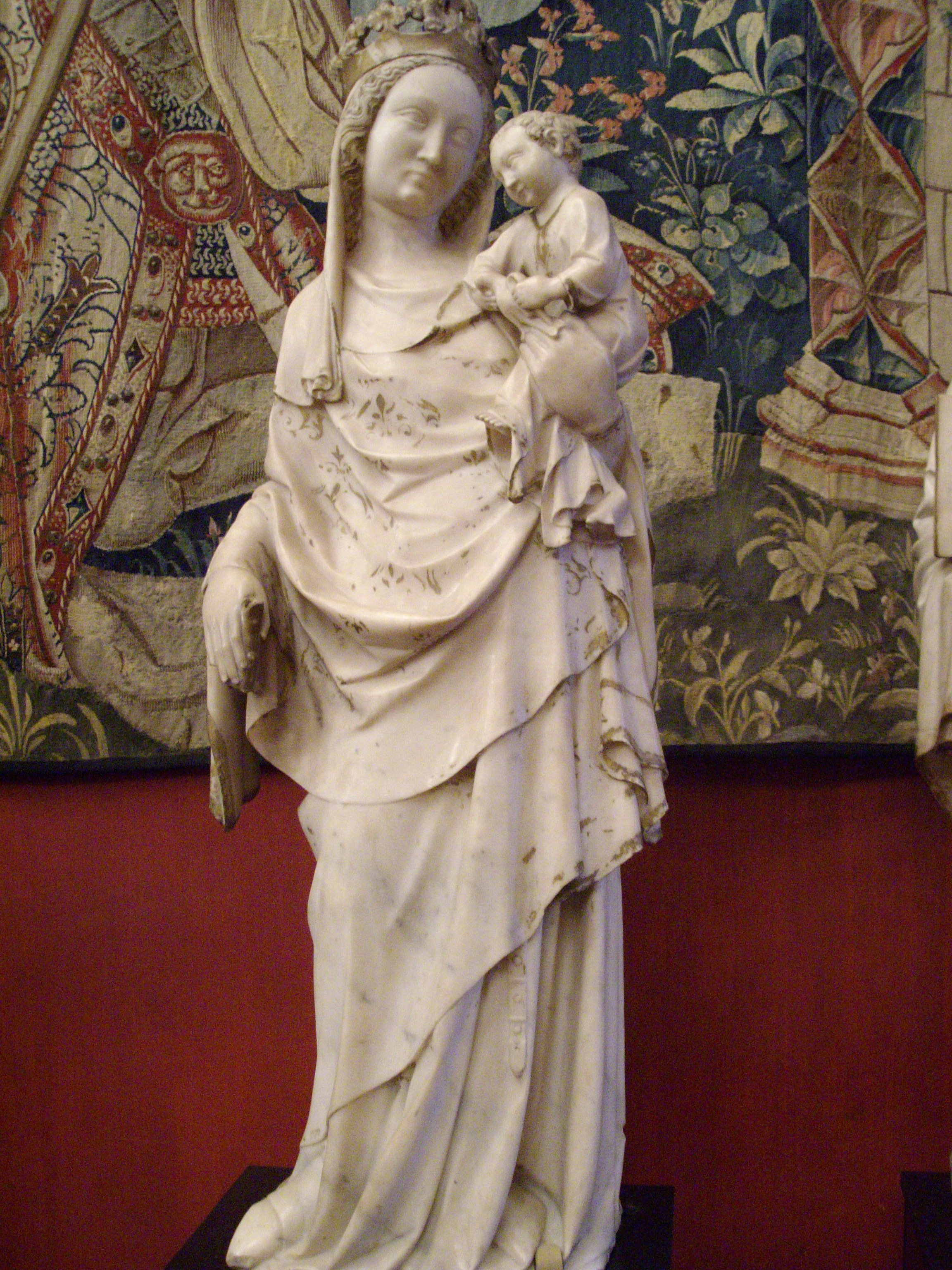
Statue of the Blessed Virgin Mary with the Christ Child, from the Abbey of Cluny. Photo by Harmonia Armand.
At the age of fourteen he entered the novitiate at Cluny, where he displayed such religious fervor that he was allowed to make his vows in the following year without completing the severe novitiate usual at this monastery. The special privilege of the Cluniac Congregation enabled him to become deacon at eighteen and priest at twenty. In recognition of his wonderful zeal for the discipline of the order, and of the confidence awakened by his conspicuous talent for government, he was quickly, in spite of his youth, chosen grand prior. In this capacity he was charged with the whole domestic direction of the cloister in both spiritual and temporal affairs, and represented the abbot during his absence (Cfr. D’Achery, “Spicilegium”, 2nd ed., I, 686). On the death of St. Odilo on 1 January, 1049, after a prolonged administration of nigh on half a century, Hugh was unanimously elected abbot, and was solemnly installed by Archbishop Hugh of Besançon on the Feast of the Chair of Peter at Antioch (22 February), 1049.

Very little of the original Abbey of Cluny survived the ravages of the French Revolution. This reconstructed model is by Hannes72
Hugh as abbot
Hugh’s character bears many points of resemblance to that of his great contemporary and friend, St. Gregory VII. Both were animated with a burning zeal to extirpate the abuses then prevalent among the clergy, to crush investiture with its corollaries, simony and clerical incontinence, and to rescue Christian society from the confusion into which the reckless ambition and avarice of rulers and the consequent political instability had thrown it. The emperor claimed the right to appoint bishops, abbot, even the Pope himself, and in too many cases his selection was swayed entirely by political motives to the exclusion of every thought of religious fitness. To prevent the Church from lapsing into a mere appanage of the State and to re-establish ecclesiastical discipline were the great objects alike of Gregory and Hugh, and if, in certain cases, Gregory allowed his zeal to outstrip his discretion, he found in Hugh an unflinching ally, and to the Benedictine Order, particularly the Cluniac branch, belongs the chief credit of promulgating among the people and carrying into effect in Western Europe the many salutary reforms emanating from the Holy See. In founding Cluny in 910, and endowing it with his entire domains, William the Pious of Aquitaine had placed it under the direct protection of Rome. Thus Cluny, with its network of daughter-foundations (see Cluny, Congregation of; Gallia Christ., II, 374), was a formidable weapon for reform in the hands of the successive Popes. Hugh entrusted the election of the superiors of all cloisters and churches subject to him into spiritual hands, promised them — in addition to the privileges of the congregation — the support and protection of Cluny, and thus saved hundreds of cloisters from the cupidity of secular lords, who were very loath to interfere with the rights of a congregation so powerful and enjoying such high favor with emperors and kings. To secure this protection numbers of cloisters became affiliated with Cluny; new houses were opened in France, Germany, Spain, and Italy, while under Hugh was also founded at St. Pancras near Lewes the first Benedictine house in England. (See, however, St. Augustine of Canterbury; St. Dunstan.) Since the superiors of most of these homes were either directly or indirectly nominated by Hugh, and since, as abbot, he had to ratify the elections, it is easy to understand how important a role he played in the great struggle between imperialism and the Holy See.

Simony was widespread and was one of the evils being addressed by the Church in the Investiture Question. In this woodcut, a king invests a bishop with the crozier and other insignia of his episcopal office, usurping the Pope’s sole right to do this.
As early as 1049, at the age of twenty-five, Hugh appeared at the Council of Reims. Here, at the request, and in the presence of Leo IX, he expressed so energetically against the reigning abuses that even the simoniacal bishops could not withstand his zeal. This advocacy contributed largely to the passing of many remedial ordinances concerning church discipline (cfr. Labbe, “Conc.”, IX, 1045-6), and led Leo IX to take Hugh with him to Rome that he might have the assistance and advice of the young abbot at the great council to be held in 1050, at which the question of clerical discipline was to be decided and the heresy of Berengarius condemned (cfr. Hefele, “Conciliengesch.”, IV, 741). Leo’s successor, Victor II, also held Hugh in the highest esteem, and confirmed in 1055 all the privileges of Cluny. On Hildebrand’s arrival in France as papal legate (1054), he hastened first to Cluny to consult with Hugh and secure his assistance at the Council of Tours. Stephen IX, immediately on his elevation, summoned Hugh to Rome, made him the companion of his journeys, and finally died in his arms at Florence (1058). Hugh was also the companion of Nicholas II, and under him took part in the Council of Rome which promulgated the important decree concerning papal elections (Easter, 1059). He was then sent to France with Cardinal Stephan, a Monk of Monte Cassino, to effect the execution of the decrees of the Roman synod, and proceeded to Aquitaine, while his colleague repaired to the northwest. The active support of the numerous cloisters subject to Cluny enabled him to discharge his mission with the greatest success. He assembled councils at Avignon and Vienne, and managed to win the support of the bishops for many important reforms. In the same year (1059) he presided over the Synod of Toulouse. At the Council of Rome in 1063 he defended the privileges of Cluny which had been recklessly attacked in France. Alexander II sent St. Peter Damian, Cardinal Bishop of Ostia, as legate to France to adjudicate in this and other matters, meanwhile ratifying all the privileges held by Hugh’s predecessors. After a stay at Cluny, during which he conceived the high admiration and veneration for the monastery and its abbot reflected in his letters (cfr. “Epist.”, VI, 2, 4, 5 in P.L., XCLIV, 378), the legate held a council at Châlons, which decided in favor of Hugh.
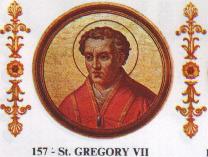
Pope Saint Gregory VII
Scarcely had Hildebrand ascended the Chair of Peter as Gregory VII when he wrote to Cluny to secure Hugh’s cooperation in promoting his various reforms. Hugh was entrusted to deal with the delicate case of the unworthy Archbishop Manasse of Reims, as well as with commissions in connection with the expedition of Count Evroul of Roucy against the Saracens in Spain. Frequently urged by Gregory to come to Rome, Hugh was unable to leave France until after the lamentable occurrences of 1076, but then hastened to visit the Pope at Canossa. With the assistance of Countess Mathilda, he managed to bring about the reconciliation — unfortunately of short duration — between Gregory and Henry IV, who had already addressed a letter full of affection declaring his great desire for the peace of the Church (cfr. “Hist. Lit. de la France”, loc. cit. infra). Hugh was subsequently engaged with the papal legate in Spain in the matter of ecclesiastical reform, and, as a result of his diligence and the high favor he enjoyed with Alphonsus VI of Castille, the Mozarabic was replaced by the Roman Ritual throughout that monarch’s realm. Thanks to the assistance of the many Cluniac foundations in Catalonia, Castille, Leon, Aragon, etc., and the many bishops chosen from their inmates, he was also enabled to give a great impetus to ecclesiastical reform in these countries. In 1077 he was commissioned to presides over the Council of Langres, and later to undertake the removal of the Bishop of Orleans and the Archbishop of Reims. Gregory wrote him many affectionate letters, and at the Roman synod in 1081 referred to Hugh in terms of praise seldom used by a successor of Peter concerning a living person. That this appreciation was not confined to the Holy Father is evident from the fact that, when asked by Gregory whether his opinion was shared by them, all present answered: “Placet, laudamus” (Bullar. Clun., p. 21).



