THE BATTLES OF LA NAVAL DE MANILA
Our Lady of the Most Holy Rosary Saves the Philippines from the Invading Dutch Fleet
Inside the Dominican church of Santo Domingo in Quezon City sits in celestial splendor and glory one of the most venerated and beloved image of the Most Holy Virgin in the Philippines. Among an impressive array of twenty-eight canonically crowned statues of the Mother of God in this Catholic nation in the Far East, Our Lady of the Rosary of La Naval de Manila, also known as La Gran Señora de Filipinas and Nuestra Señora del Santisimo Rosario, stands out preeminently in terms of grandeur and beauty. It holds the most singular distinction as the first Marian image to be officially and solemnly crowned as such in the country and Asia (1907).[1]
ORIGIN
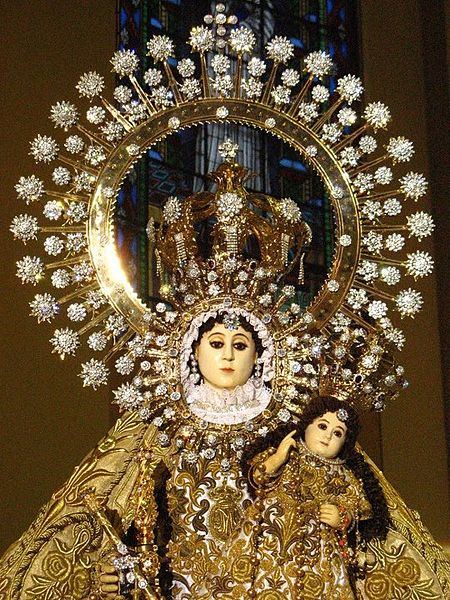
Our Lady of the Most Holy Rosary of La Naval de Manila in Sto. Domingo Church, Quezon City, Philippines. Photo by Interaksyon
One can trace the statue’s origin (circa 1593) to the auspices of a Spanish governor-general of the island nation, Luis Perez Dasmariñas (1593-1596) who commissioned its creation (under the supervision of Captain Hernando de los Ríos Coronel) to honor his deceased father and to serve as a memento to his regime. He entrusted the statue in the hands of Dominican friars who enshrined it in a simple primitive chapel made of cogon grass and nipa palm within the walled city of Intramuros of Old Manila.
Utilizing hardwood for the torso and elephant ivory for the face and hands, a pagan Chinese artisan, who according to pious tradition converted later to Catholicism through Our Lady’s intercession, skillfully carved and fashioned its unique and indigenous Oriental features that stood out when the white ivory took on a shade of brown through the patina of time.
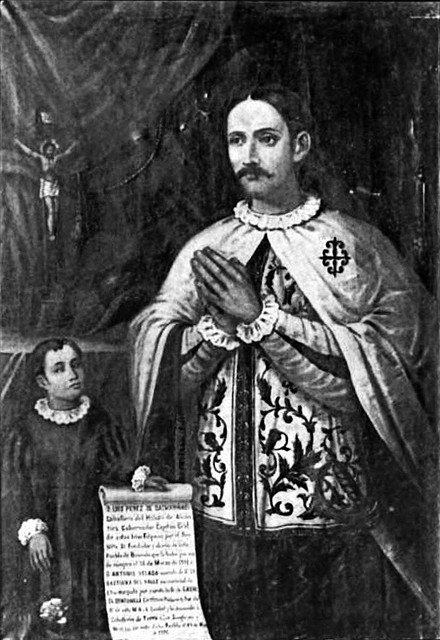
Luis Pérez Desmariñas
The Blessed Mother’s image measures 4 feet and 8 inches and is depicted carrying the Child Jesus in her right arm while holding a scepter in her left arm. Both images have a rosary slung on the right hand. From the very beginning, the faithful especially those belonging to Manila’s elite and aristocratic families have traditionally adorned both the Virgin and Child with elaborate raiment, ornate crowns and precious jewels. It now stands as the oldest ivory carving and the most resplendent example of traditional Marian iconography in the archipelagic nation.
The first Dominicans, who reached Philippine shores in 1587, established in the following year a confraternity in honor of Our Lady under the title of the Rosary. Upon receipt of the prized carved image from the benevolent Spanish governor-general, the Dominicans installed it in the aforementioned chapel within Intramuros effectively replacing a 2-foot statue of Our Lady of the Rosary that the pioneering friars brought from Mexico to be venerated there. Thus, began a special devotion that would transcend centuries of signal graces and favors granted to the Holy Virgin’s throng of ever increasing devotees.
In a decisive series of sea battles in the middle of the 17th century, the Virgin’s intercessory powers would prove crucial in staving off the attacks of the invading Dutch fleets, a heavenly prodigy that would earn her the title of La Naval in the annals of Philippine history.
THE SPANISH-DUTCH CONFLICT REACHES THE PHILIPPINES

The Eendracht and a Fleet of Dutch Men-of-war, painting by Ludolf Bakhuizen.
From the late fifteenth century to mid-sixteenth century, Spain and the Dutch Netherlands locked horns in a bitter and protracted war in Europe that came to be known as the Eighty Years war or the Dutch War of Independence (1568-1648).