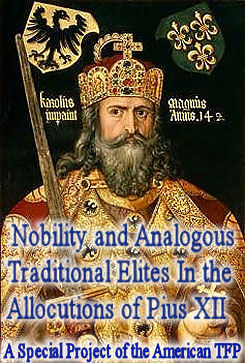
Saint Louis IX
King of France, son of Louis VIII and Blanche of Castile, born at Poissy, 25 April, 1215; died near Tunis, 25 August, 1270.
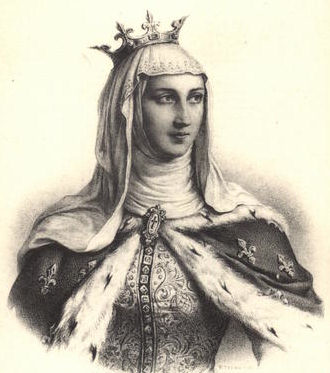
Marguerite of Provence, wife of St. Louis IX
He was eleven years of age when the death of Louis VIII made him king, and nineteen when he married Marguerite of Provence by whom he had eleven children. The regency of Blanche of Castile (1226-1234) was marked by the victorious struggle of the Crown against Raymond VII in Languedoc, against Pierre Mauclerc in Brittany, against Philip Hurepel in the Ile de France, and by indecisive combats against Henry III of England. In this period of disturbances the queen was powerfully supported by the legate Frangipani. Accredited to Louis VIII by Honorius III as early as 1225, Frangipani won over to the French cause the sympathies of Gregory IX, who was inclined to listen to Henry III, and through his intervention it was decreed that all the chapters of the dioceses should pay to Blanche of Castile tithes for the southern crusade. It was the legate who received the submission of Raymond VII, Count of Languedoc, at Paris, in front of Notre-Dame, and this submission put an end to the Albigensian war and prepared the union of the southern provinces to France by the Treaty of Paris (April 1229). The influence of Blanche de Castile over the government extended far beyond St. Louis’s minority. Even later, in public business and when ambassadors were officially received, she appeared at his side. She died in 1253.
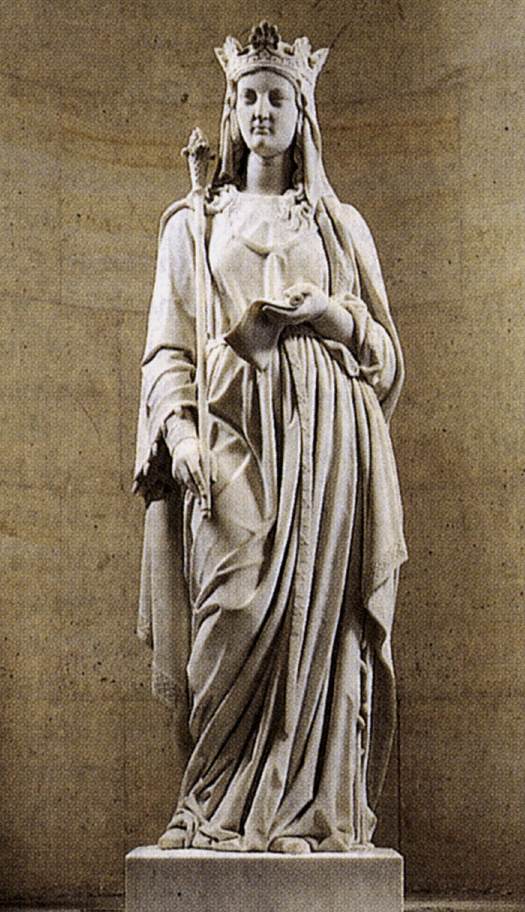
Blanche of Castile Sculptor Antoine Etex located at Versailles
In the first years of the king’s personal government, the Crown had to combat a fresh rebellion against feudalism, led by the Count de la Marche, in league with Henry III. St. Louis’s victory over this coalition at Taillebourg, 1242, was followed by the Peace of Bordeaux which annexed to the French realm a part of Saintonge.
It was one of St. Louis’s chief characteristics to carry on abreast his administration as national sovereign and the performance of his duties towards Christendom; and taking advantage of the respite which the Peace of Bordeaux afforded, he turned his thoughts towards a crusade. Stricken down with a fierce malady in 1244, he resolved to take the cross when news came that Turcomans had defeated the Christians and the Moslems and invaded Jerusalem. Between the two crusades he opened negotiations with Henry III, which he thought would prevent new conflicts between France and England. The Treaty of Paris (28 May, 1258) which St. Louis concluded with the King of England after five years’ parley, has been very much discussed.

Treaty of Paris. King Henry III of England does homage to Saint Louis.
By this treaty St. Louis gave Henry III all the fiefs and domains belonging to the King of France in the Dioceses of Limoges, Cahors, and Périgueux; and in the event of Alphonsus of Poitiers dying without issue, Saintonge and Agenais would escheat to Henry III. On the other hand Henry III renounced his claims to Normandy, Anjou, Touraine, Maine, Poitou, and promised to do homage for the Duchy of Guyenne. It was generally considered and Joinville voiced the opinion of the people, that St. Louis made too many territorial concessions to Henry III; and many historians held that if, on the contrary, St. Louis had carried the war against Henry III further, the Hundred Years War would have been averted. But St. Louis considered that by making the Duchy of Guyenne a fief of the Crown of France he was gaining a moral advantage; and it is an undoubted fact that the Treaty of Paris, was as displeasing to the English as it was to the French. In 1263, St. Louis was chosen as arbitrator in a difference which separated Henry III and the English barons: by the Dit d’Amiens (24 January, 1264) he declared himself for Henry III against the barons, and annulled the Provisions of Oxford, by which the barons had attempted to restrict the authority of the king. It was also in the period between the two crusades that St. Louis, by the Treaty of Corbeil, imposed upon the King of Aragon the abandonment of his claims to all the fiefs in Languedoc excepting Montpellier, and the surrender of his rights to Provence (11 May, 1258). Treaties and arbitrations prove St. Louis to have been above all a lover of peace, a king who desired not only to put an end to conflicts, but also to remove the causes for fresh wars, and this spirit of peace rested upon the Christian conception.