Plinio Corrêa de Oliveira
In September 1292, Yacub Ben Yussuf, King of Morocco, took over the stronghold of Tarifa. Infant Dom João, brother of Sancho IV the brave, king of Castile and Leon, in fact made a pact with Yacub that enabled him to conquer Tarifa, defended by Alonso Perez de Guzman. Rather than surrender, Guzman allowed his own son, a prisoner of the Infant, to be sacrificed within its walls, a deed that earned him the nickname ‘The Good’ (1294).
In a handwritten letter, King Dom Sancho thanked Guzman for his loyalty, saying, “For the death of your son, which made you like unto our Father Abraham, out of courage, loyalty and fidelity to the oath you had made to me regarding the city of Tarifa, you provided the dagger with which the Moors beheaded him.” This excerpt is taken from Johann Baptist Weiss, História Universal, vol VI, p.603. That page reproduces a painting depicting the heroic gesture of Dom Alonso de Guzman as he throws, from atop the walls, the dagger to the Moors.
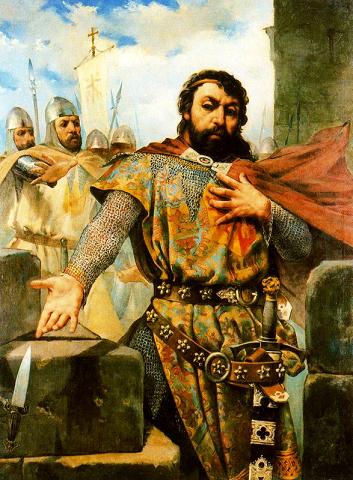
From atop the walls, Dom Alonso de Guzman throws the dagger to the Moors.
So this is how that historic episode unfolded: The one Yacub took the town of Tarifa. The king’s brother had made a pact with Yacub so he could pull it off; in other words, he betrayed. Tarifa was defended by Alonso Perez de Guzman, who, in order not to surrender, allowed his own son, a prisoner of the wayward prince, to be sacrificed within its walls.
From atop the wall he threw the dagger for the Moors to kill his son, as if saying, “You are saying you will kill my son if I do not surrender the place. Look, here is a dagger, go ahead and kill him.”
It is an extraordinary move, one with such grandeur as to leave us absolutely at a loss for words.
We can see such feats in our Saint-of-the-Day series and in some episodes in the life of Christian civilization. There is such a great integrity of soul in Don Alonso’s attitude and he takes sacrifice to such a point and bears the pain of his situation in such a manly fashion that no manner of pettiness or fear can be found in him at all.
He could have said, for example – in the romantic fashion in vogue in the 19th century – “Well, go ahead, take my son. Dear son of mine, be thou the pained yet innocent victim of the hateful enemy of Christian civilization.” None of that! He could at least have said, “I watch impassible and indignant, shaking with sorrow, this sacrifice about to be done.” None of that, either.

Castle of Tarifa, where Don Alonso threw the knife to the Moors.
His attitude was like saying, “For you to see that I command my own soul and master even the most legitimate feelings of my paternal love out of love for the Catholic Church, look, here is my dagger.” And he throws it. This really means, “I take to the ultimate degree my victory over the legitimate fears of nature.”
This integrity is really enchanting. One can say this truly is a Catholic man in whom there is no fraud, the praise Our Lord made of St. Bartholomew: “Behold an Israelite indeed, in whom there is no guile” [John. 1:47]. No deceit, no concession. He goes all the way to the full length of his duty. This is what is so enchanting in that magnificent move.
One of you could object: Well, Dr. Plínio, all this is true but only to a certain degree. Because in the final analysis, it is a bit inhumane for a father to watch so deliberately the death of his son. I would like to see some uncertainty in that father; I would like to see some tears in his eyes; I would like to see some hesitation: ‘Should I or should I not let them kill him?’ If that father atop the walls had only had a moment of hesitation and then said, ‘Well, go ahead, kill him!’ I would understand and sympathize with him more than when I see that determination from the very first instance, taken to the point of throwing them the dagger with which to kill his son.”
Read More Here
Tagged as:
Chivalry,
Commentary,
Conquest of Granada,
Honor,
Leader,
Muslims,
Nobility,
Plinio Correa de Oliveira,
Spanish Reconquista,
War


Commentaries on how Don Alonso Peres de Guzman sacrificed his own son rather than surrender to the Muslims
August 31, 2026
Plinio Corrêa de Oliveira
In September 1292, Yacub Ben Yussuf, King of Morocco, took over the stronghold of Tarifa. Infant Dom João, brother of Sancho IV the brave, king of Castile and Leon, in fact made a pact with Yacub that enabled him to conquer Tarifa, defended by Alonso Perez de Guzman. Rather than surrender, Guzman allowed his own son, a prisoner of the Infant, to be sacrificed within its walls, a deed that earned him the nickname ‘The Good’ (1294).
In a handwritten letter, King Dom Sancho thanked Guzman for his loyalty, saying, “For the death of your son, which made you like unto our Father Abraham, out of courage, loyalty and fidelity to the oath you had made to me regarding the city of Tarifa, you provided the dagger with which the Moors beheaded him.” This excerpt is taken from Johann Baptist Weiss, História Universal, vol VI, p.603. That page reproduces a painting depicting the heroic gesture of Dom Alonso de Guzman as he throws, from atop the walls, the dagger to the Moors.
From atop the walls, Dom Alonso de Guzman throws the dagger to the Moors.
So this is how that historic episode unfolded: The one Yacub took the town of Tarifa. The king’s brother had made a pact with Yacub so he could pull it off; in other words, he betrayed. Tarifa was defended by Alonso Perez de Guzman, who, in order not to surrender, allowed his own son, a prisoner of the wayward prince, to be sacrificed within its walls.
From atop the wall he threw the dagger for the Moors to kill his son, as if saying, “You are saying you will kill my son if I do not surrender the place. Look, here is a dagger, go ahead and kill him.”
It is an extraordinary move, one with such grandeur as to leave us absolutely at a loss for words.
We can see such feats in our Saint-of-the-Day series and in some episodes in the life of Christian civilization. There is such a great integrity of soul in Don Alonso’s attitude and he takes sacrifice to such a point and bears the pain of his situation in such a manly fashion that no manner of pettiness or fear can be found in him at all.
He could have said, for example – in the romantic fashion in vogue in the 19th century – “Well, go ahead, take my son. Dear son of mine, be thou the pained yet innocent victim of the hateful enemy of Christian civilization.” None of that! He could at least have said, “I watch impassible and indignant, shaking with sorrow, this sacrifice about to be done.” None of that, either.
Castle of Tarifa, where Don Alonso threw the knife to the Moors.
His attitude was like saying, “For you to see that I command my own soul and master even the most legitimate feelings of my paternal love out of love for the Catholic Church, look, here is my dagger.” And he throws it. This really means, “I take to the ultimate degree my victory over the legitimate fears of nature.”
This integrity is really enchanting. One can say this truly is a Catholic man in whom there is no fraud, the praise Our Lord made of St. Bartholomew: “Behold an Israelite indeed, in whom there is no guile” [John. 1:47]. No deceit, no concession. He goes all the way to the full length of his duty. This is what is so enchanting in that magnificent move.
One of you could object: Well, Dr. Plínio, all this is true but only to a certain degree. Because in the final analysis, it is a bit inhumane for a father to watch so deliberately the death of his son. I would like to see some uncertainty in that father; I would like to see some tears in his eyes; I would like to see some hesitation: ‘Should I or should I not let them kill him?’ If that father atop the walls had only had a moment of hesitation and then said, ‘Well, go ahead, kill him!’ I would understand and sympathize with him more than when I see that determination from the very first instance, taken to the point of throwing them the dagger with which to kill his son.”
Read More Here
Tagged as: Chivalry, Commentary, Conquest of Granada, Honor, Leader, Muslims, Nobility, Plinio Correa de Oliveira, Spanish Reconquista, War