USA Book Launching of Nobility and Analogous Traditional Elites in the Allocutions of Pius XII
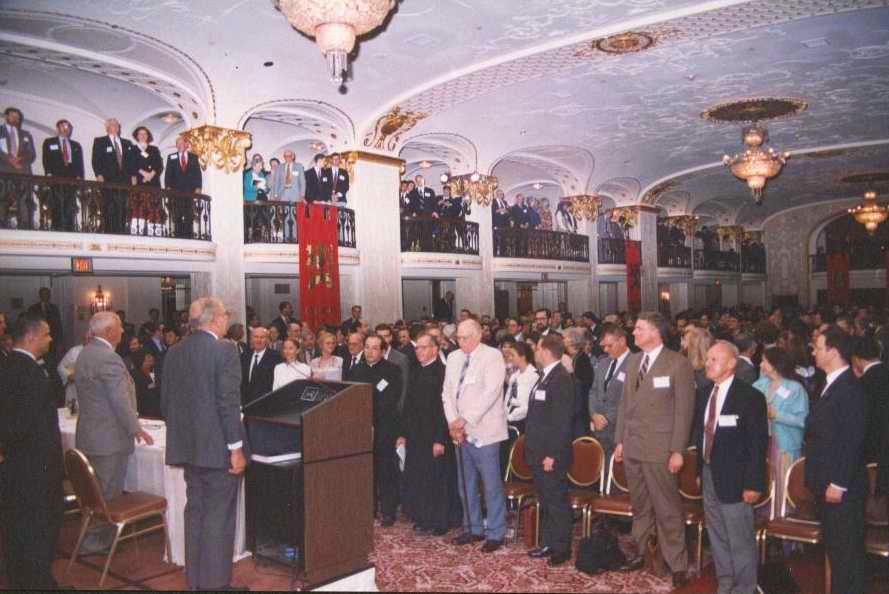
The book launching of Nobility and Analogous Traditional Elites in the Allocutions of Pius XII at the historic Mayflower Hotel, Washington, D.C. – September 28, 1993.
Distinguished Chairman, Mr. Morton Blackwell,
Imperial and Royal Highness, Archduchess Monica of Austria,
Your Grace, Duke of Maqueda, illustrious writer of the preface to the Spanish edition of the book that brings us together today,
reverend and beloved Priests,
Sir Roberto de Mattei and my lord Marquis Coda Nunziante, representatives of the dynamic Roman association Lepanto,
illustrious seminar participants, or better still, dear friends with whom I share so many aspirations and ideals.
Allow me to begin by greeting you, who have gathered here from so many places to reflect upon and experience a great event, namely, the launching of a book that addresses a crucial subject which has influenced the thought of the world’s great nations and the paths they have chosen for at least two centuries.
In many ways, the launching of a book is like the birth of a child. The difference is that healthy, ordinary children are continuously born. Thus, not every birth is likely to stir many hearts and souls, much less change the course of people and civilizations.
The importance of the launching of a book is proportional to the scope of the book’s theme. If the theme is great, the book undoubtedly will move souls, perhaps even civilizations, even if the book is not great.
If the book is truly great, it will stir the finest souls and civilizations. If it is merely mediocre it can still play an important role by moving mediocre people.
Seldom in history have mediocre people governed the main ideas, customs and civilizations so easily as today. In this apogee of mediocrity, which is assured by the media promoting (and even glorifying) so many mediocre people, a mediocre book’s potential for success and fame has never been greater.
Perhaps, it is a mediocre book that is here brought before a far-from-mediocre public. Perhaps its author, or the way he develops its theme is mediocre as well. Nonetheless, if the theme is not mediocre, neither is the book, since significant themes always have far reaching repercussions when brought before a noteworthy public.
Thus I begin my reflections perfectly tranquil. Your character and intelligent critique will provide for the book, despite its author’s inadequacy. The doors to mediocrity are therefore barred.
Ladies and gentlemen, our theme is central to the thought and actions of mankind. It is well known. It is always old, always new and always inexhaustible. It is the theme of elites.
Contemplating the inequalities that exist in all ages of history and human societies, three questions come to mind:
1. Is the existence of elites just?
2. Are elites useful for the religious, moral, political and cultural common good of peoples and civilizations?
3. Precisely, what constitutes an elite?
We must answer these questions first.
Inside everyone, there are diverse and conflicting tendencies. One such tendency leads those who strive to be upright and reasonable to seek perfection.
They believe that this perfection will bring happiness. Thus motivated, husband and wife strive to treat each other perfectly, in hopes of establishing a perfect home – a heaven on earth. They try to treat their children perfectly and expect harmonious, happy and significant progeny.
Inspired by this tendency, a professional acts the same way in his profession, as does the lady or gentleman in their social realm, and a thousand other kinds of people in a thousand other situations, all hoping to reach the pinnacle of happiness. Most people so insatiably hunger for happiness that they will follow the same impulse Mitterrand professed during his honeymoon with power, “To want for oneself everything, now and forever.”
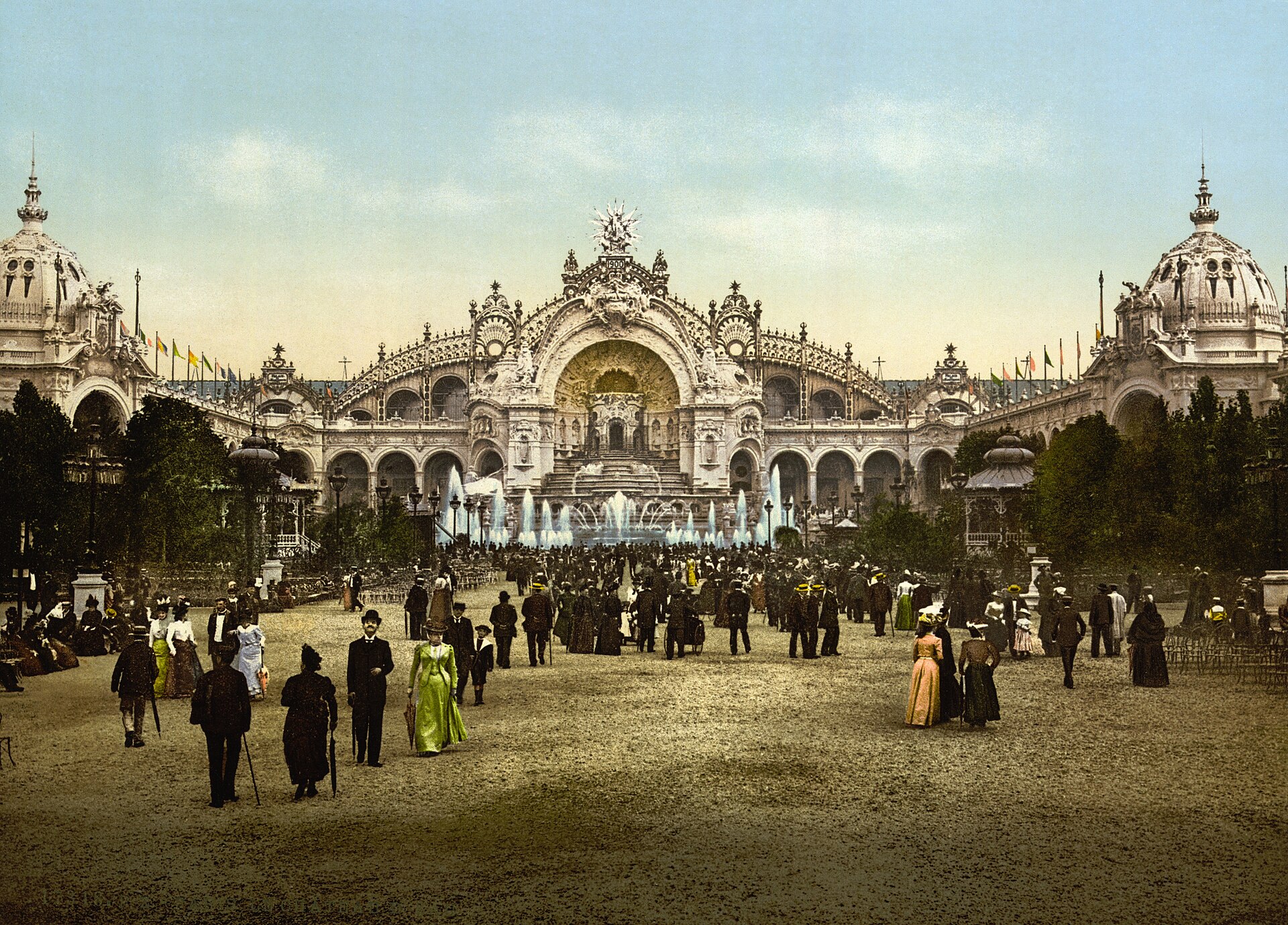
Le Château d’eau and plaza for the 1900 World’s Fair Exposition in Paris, France, during the Belle Époque.
From a certain vantage, this ambitious ascent seems like the march towards progress as it is currently understood, that is acquiring in the least possible time and effort, all that is needed, useful and convenient. Securing the possession of the goods thus gained forever, constituted the life goal of the pleasure-seeking man born in the joys and hopes of the Belle Epoque.
Not even two unprecedented world wars, whose finale in Hiroshima and Nagasaki foretold worse perils, destroyed this dream.
Even in the 1950s, most evolved peoples (and we regret having to say “evolved” due to the many errors, illusions and deceptions this word represents as a standard and talisman) expressed this dream in a chorus of joy and hope.
Those predicting problems, crises and anxieties which contradicted these facile and felicitous “Belle Epochian” prophesies were often subject to a roar of revolutionary dissonance.
During this epoch, a main element of “progress,” often connoting “evolution,” was social equality. However, an evident and universal fact of life defied this universal joy and revolutionary roar: inequality.
What is the correlation between the chorus and the clamor? In other words, is inequality a factor in man’s progress and happiness? Is it a friendly force to be protected and encouraged, or a hostile one to be suppressed?
This, ladies and gentlemen, is the central problem from which, amid the post-World War II chaos, the august voice of Pius XII arose in fourteen immortal allocutions to the Roman Patriciate and Nobility and the notable analogous teachings of Benedict XV to the Roman Patriciate and Nobility in his allocution “Nella Recente Anniversaria,” of January 5, 1920, which justice demands that we mention.

Pope Benedict XV
Earlier, many diverse thinkers had sporadically considered equality and its relation to the common good. The protagonists and leaders of the Enlightenment passionately examined the problem. Their false solutions convulsed the entire civilized world from the end of the eighteenth century until today. No revolution has been separated from it, nor has the motivation or outcome of any war escaped its influence. Equality is part of the amorphous trilogy Liberty, Equality, Fraternity, whose definition is so controversial that even pontifical texts are dissonant in its interpretation.1
Rather than reopening the controversy of that infamous trilogy, we will analyze its second catchword: “equality,” not from a purely philosophical view, but from the viewpoint of the contemporary “man in the street,” who constitutes the “sovereign” majority and decisive voice to all modern representative regimes.
Contemporary man must judge this great theme. In doing so, he has an advantage over his forefathers, namely he has Pope Pius XII’s memorable allocutions to guide him. It is with special consideration, that I offer you some of the reflections on this theme, found in my book.
Our theme is marked by two symmetrical boundaries: (1) there must be limits to inequality, and (2) there must be limits to equality.