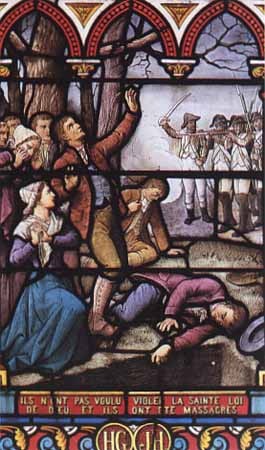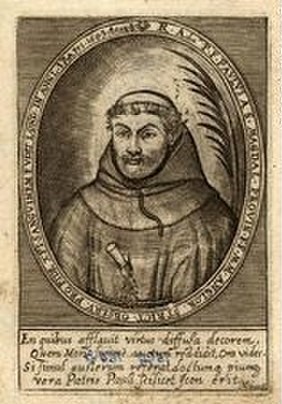
Blessed Fr. James Bell

Stone marking the site of the Tyburn tree on the traffic island at the junction of Edgware Road, Marble Arch and Oxford Street

Stone marking the site of the Tyburn tree on the traffic island at the junction of Edgware Road, Marble Arch and Oxford Street

Priest and martyr, born at Warrington in Lancashire, England, probably about 1520; died 20 April, 1584. For the little known of him we depend on the account published four years after his death by Bridgewater in his “Concertatio” (1588), and derived from a manuscript which was kept at Douay when Challoner wrote his “Missionary Priests” in 1741, and is now in the Westminster Diocesan Archives. A few further details were collected by Challoner, and others are supplied by the State Papers. Having studied at Oxford he was ordained priest in Mary’s reign, but unfortunately conformed to the established Church under Elizabeth, and according to the Douay MS. “ministered their bare few sacraments about 20 years in diverse places of England”.  Finally deterred by conscience from the cure of souls and reduced to destitution, he sought a small readership as a bare subsistence. To obtain this he approached the patron’s wife, a Catholic lady, who induced him to be reconciled to the Church. After some time he was allowed to resume priestly functions, and for two years devoted himself to arduous missionary labours. He was at length apprehended (17 January 1583-84) and, having confessed his priesthood, was arraigned at Manchester Quarter-Sessions held during the same month, and sent for trial at Lancaster Assizes in March. When condemned and sentenced he said to the Judge: “I beg your Lordship would add to the sentence that my lips and the tops of my fingers may be cut off, for having sworn and subscribed to the articles of heretics contrary both to my conscience and to God’s Truth”. He spent that night in prayer and on the following day was hanged and quartered together with Ven. John Finch, a layman, 20 April, 1584.

He was beatified in 1929.

BRIDGEWATER, Concertatio ecclesiæ Catholicæ in Anglia, 1588; YEPEZ, Historia particular de la persecucion de Inglatera, 1599; CHALLONER, Missionary Priests 1741; Dict. Nat. Biog., IV, 163; GILLOW, Bibl. Dict. Eng. Cath., I, 173, citing State Papers in Public Record Office.

EDWIN BURTON (Catholic Encyclopedia)

{ 0 comments }

Bl. John Finch

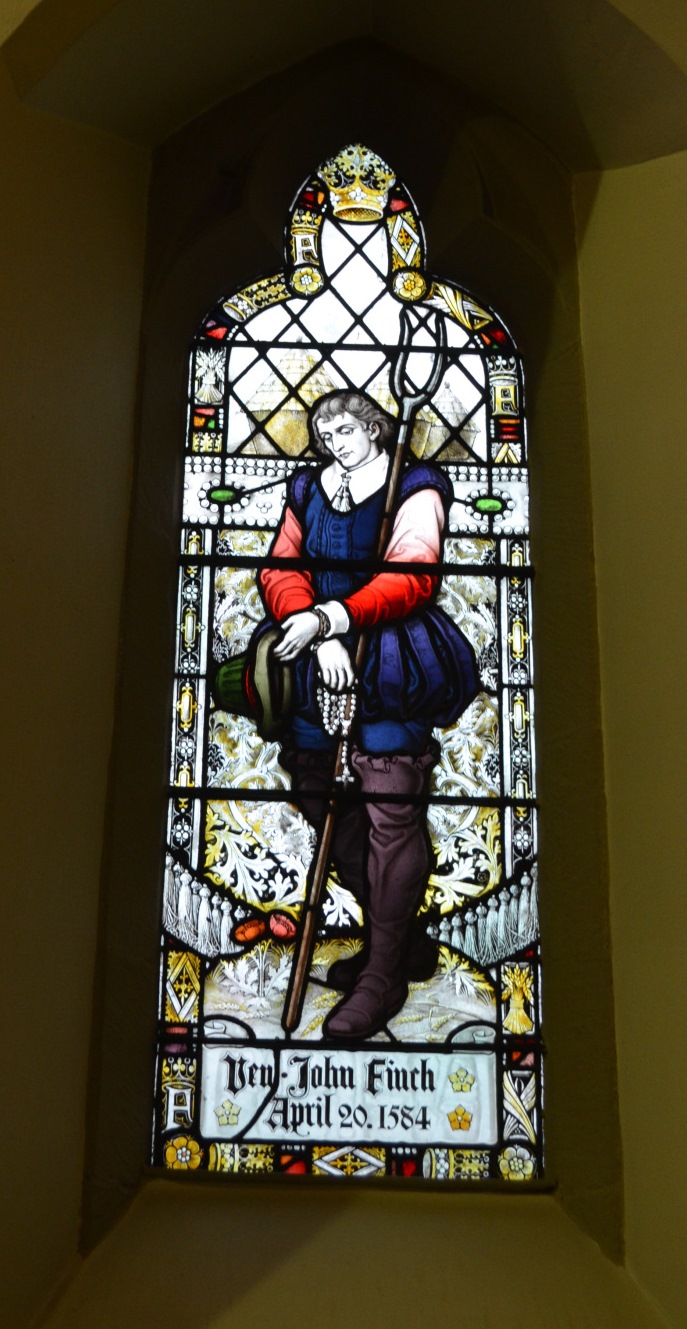
A stained glass window in St. Mary’s Catholic Church in Chorley, England. Permission to use by Roberta Estes.

A stained glass window in St. Mary’s Catholic Church in Chorley, England. Permission to use by Roberta Estes.

A martyr, born about 1548; died 20 April, 1584.

He was a yeoman of Eccleston, Lancashire, and a member of a well-known old Catholic family, but he appears to have been brought up in schism. When he was twenty years old he went to London where he spent nearly a year with some cousins at Inner Temple. While there he was forcibly struck by the contrast between Protestantism and Catholicism in practice and determined to lead a Catholic life. Failing to find advancement in London he returned to Lancashire where he was reconciled to Catholic Church. He then married and settled down, his house becoming a centre of missionary work, he himself harbouring priests and aiding them in every way, besides acting as catechist. His zeal drew on him the hostility of the authorities, and at Christmas, 1581, he was entrapped into bringing a priest, George Ostliffe, to a place where both were apprehended. It was given out that Finch, having betrayed the priest and other Catholics, had taken refuge with the Earl of Derby, but in fact, he was kept in the earl’s house as a prisoner, sometimes tortured and sometimes bribed in order to pervert him and induce him to give information. This failing, he was removed to the Fleet prison at Manchester and afterwards to the House of Correction. When he refused to go to the Protestant church he was dragged there by the feet, his head beating on the stones. For many months he lay in a damp dungeon, ill-fed and ill-treated, desiring always that he might be brought to trial and martyrdom. After three years’ imprisonment, he was sent to be tried at Lancaster. There he was brought to trial with three priests on 18 April, 1584. He was found guilty and, 20 April, having spent the night in converting some condemned felons, he suffered with Ven. James Bell at Lancaster. The cause of his beatification with those of the other English Martyrs was introduced by decree of the Sacred Congregation of Rites, 4 Dec., 1886.

He was beatified in 1929.

EDWIN BURTON (Catholic Encyclopedia)

{ 0 comments }

Stephen Theodore Badin

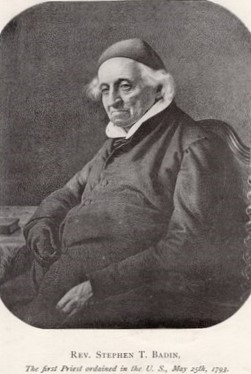
The first Catholic priest ordained within the limits of the original thirteen States of the Union, pioneer missionary of Kentucky, b. at Orléans, France, 17 July, 1768; d. at Cincinnati, Ohio, 21 April, 1853. Educated at Montaigu College, Paris, he entered the Sulpician Seminary of his native city in 1789. He was subdeacon when the seminary was closed by the revolutionary government, in 1791, and sailed from Bordeaux for the American mission in November of the same year, with the Revs. B.J. Flaget and J.B. David, both destined in God’s providence to wear the mitre in Kentucky. They arrived in Philadelphia on the 26th of March, 1792, and were welcomed at Baltimore by Bishop Carroll on the 28th. Stephen T. Badin pursued his theological studies with the Sulpicians and was ordained a priest by Bishop Carroll, 25 May, 1793. His was the first ordination in the United States. After a few months spent at Georgetown to perfect himself in English, Father Badin was appointed to the Mission of Kentucky. He left for that scene of his apostolic labours with Father Barrières, 3 September, 1793, travelled on foot as far as Pittsburgh, and by flat boat down the Ohio, landing at Limestone (Maysville), Ky., where they found twenty Catholic families. They walked sixty-five miles to Lexington, and on the first Sunday of Advent, 1793, Father Badin said his first Mass in Kentucky at the house of Denis McCarthy.

He settled at White Sulphur, Scott County, sixteen miles from Lexington, and for about eighteen months attended this church and neighbouring missions. In April, 1794, his companion, who resided in Bardstown, left for New Orleans, and Father Badin was now alone in the Kentucky mission. For fourteen years he attended to the spiritual wants of the various Catholic settlements, scattered over an extent of more than 120 miles, forming new congregations, building churches, never missing an appointment. To visit his missions regularly he had to live in the saddle, and it is estimated that he rode more than 100,000 miles during his ministry in Kentucky. For many years he was unaided and alone; it was only in July, 1806, that he received permanent help, when the Rev. Charles Nerinckx came to take the larger part of the burden from his shoulders. They lived together at St. Stephen’s, on Pottingers Creek, which was still their headquarters on the arrival, in 1811, of Bishop Flaget, whom Father Badin had suggested and urged as first Bishop of Bardstown. Difficulties about the holding of church property soon arose between the bishop and Father Badin, without, however, interfering with the reverence of the latter for the bishop and the bishop’s friendship for him. Together they went to Baltimore in 1812 to submit the controversy to Archbishop Carroll. It was not settled. They returned to Kentucky in April, 1813, and Father Badin resumed his missionary duties and accompanied his bishop on many pastoral journeys, until 1819. The Rev. J. B. David had been appointed coadjutor in 1817, but persistently refused to accept the honour. Father Badin, believing that this selection would put an end to the controversy about church property, and be for the good of the diocese of which he was the founder, left for France in the spring of 1819. The consecration of Bishop David in September of that year, and unjust suspicions about his disposition of church properties caused him to remain abroad. In 1820 he accepted the parish of Millaney and Marreilly-en-Gault, about forty miles from Orléans. He continued, however, to take the greatest interest in the Kentucky missions, insisted on his loyalty to Bishop Flaget, and helped constantly and generously to secure gifts in money and valuable church-furniture for the missionaries. In 1822 he published in Paris, a “Statement of the Missions in Kentucky”, with the same purpose in view.

Father Badin returned to America in 1828. After a year on the Michigan mission, he went back to Kentucky in 1829. The next year he offered his services to Bishop Fenwick of Cincinnati, and took charge of the Pottawottomie Indians at St. Joseph’s River. Miss Campau of Detroit, an expert Indian linguist, acted as interpreter and teacher, until Father Badin left the place in 1836. Having returned to Cincinnati in that year, he wrote for the “Catholic Telegraph” a series of controversial “Letters to an Episcopalian Friend”. In 1837 he went to Bardstown, Ky., was appointed vicar-general, and continued to visit the various missions. In 1841 he removed to Louisville with the bishop’s household. In that year he conveyed a great deal of church property (notably that of Portland, near Louisville) to the bishop, and a farm to the Very Rev. E. Sorin of Notre Dame, Indiana.

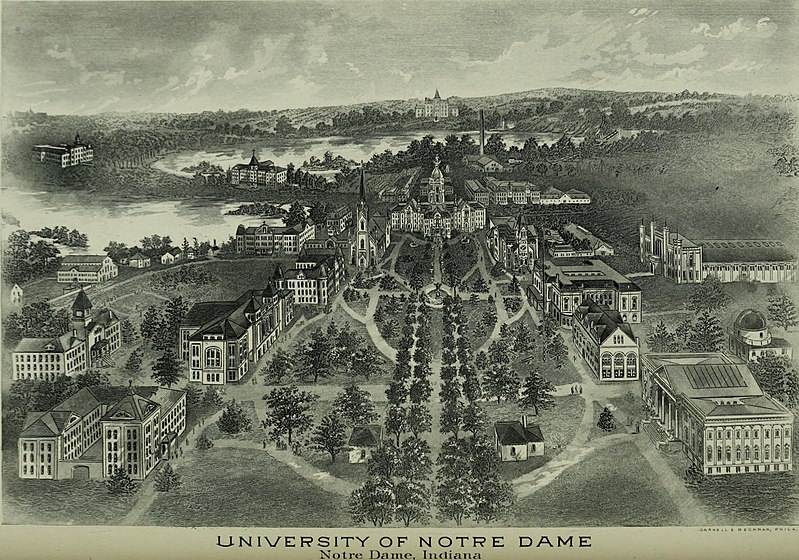
On the 25th of May, 1843, Father Badin celebrated the golden jubilee of his priesthood, at Lexington, where he had offered up the Holy Sacrifice of the Mass for the first time in Kentucky. In September, 1846, he accepted from Bishop Quarter of Chicago the pastorship of the French settlement at Bourbonnais Grove, Kankakee County, Illinois. In the winter of 1848 he was again in Kentucky, and Bishop-Coadjutor Spalding welcomed him to the episcopal household. About two years later he became the guest of Archbishop Purcell at Cincinnati, and eventually died at the archbishop’s residence. His body lay undisturbed in the cathedral crypt for over fifty years. In 1904 Archbishop Elder permitted its removal to the University of Notre Dame, Indiana.

Father Badin‘s writings are: “Etat des missions du Kentucky” (Paris, 1822), tr. in the “U.S. Cath. Miscellany” for December, 1824, and in the “Catholic World”, September, 1875; “Carmen Sacrum”, a Latin poem composed on the arrival of Bishop Flaget in Kentucky, June, 1811, translated into English by Colonel Theodore O’Hara of Frankfort, Ky., author of the “Bivouac of the Dead”; “Epicedium”, Latin poem composed on the occasion of the death of Col. Joe Davis at the Battle of Tippecanoe, 7 November, 1811, translated by Doctor Michell of New York (Louisville, 1844); “Sanctissimæ Trinitatis Laudes et Invocatio” (Louisville, 1843), also the original text and tr. in Webb’s “The Centenary of Catholicity in Kentucky” (Louisville, 1844); “Letters to an Episcopalian Friend”—-three controversial articles on the Church and the Eucharist (published in the “Catholic Telegraph” of Cincinnati, 1836).

SPALDING, Sketches of the Early Catholic Missions of Kentucky (Louisville, 1844); IDEM, Life of Bishop Flaget (Louisville, 1852); Life of Rev. Chas. Nerinckx (Cincinnati, 1880); WEBB, Centenary of Catholicity in Kentucky (Louisville, 1884).

CAMILLUS P. MAES (Catholic Encyclopedia)

{ 0 comments }

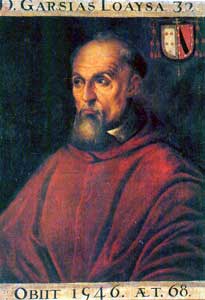
Garcia de Loaisa

Cardinal and Archbishop of Seville, b. in Talavera, Spain, c. 1479; d. at Madrid, 21 April, 1546. His parents were nobles; at a very early age he entered the Dominican convent at Salamanca. Its severe discipline, however, affected his delicate constitution and he was transferred to the convent of St. Paul in Peñafiel where he was professed in 1495. On the completion of his studies in Alcala, and later at St. Gregory’s College, Valladolid, he taught philosophy and theology. About the same time he was appointed regent of studies and for two terms filled the office of rector in St. Gregory’s College. In 1518 he represented his province at the general chapter held at Rome where his accomplishments, his sound judgment, and piety secured for him by unanimous vote the generalship of the order in succession to Cardinal Cajetan. After visiting the Dominican houses in Sicily and other countries he returned to Spain. Here he made the acquaintance of King Charles V who, recognizing in him a man of more than ordinary ability, chose him for his confessor and later, with papal sanction, offered him the See of Osma, for which he was consecrated in 1524. Subsequently he held several offices of considerable political importance. In 1530 Clement VII created him cardinal and transferred him to the See of Siguenza. The following year he was made Archbishop of Seville, and Commissary-General of the Inquisition. G. Haine found, in the royal library at Simancas, Garcia’s letters to Charles V written in the years 1530-32. They contain information of the greatest importance for the history of the Reformation as well as for the religious and political history of Spain during that period. They manifest, moreover, the accomplishments of the author, the honour in which he was held and the unlimited confidence the emperor placed in him. His writings are limited to a few pastoral letters.

JOSEPH SCHROEDER (Catholic Encyclopedia)

{ 0 comments }

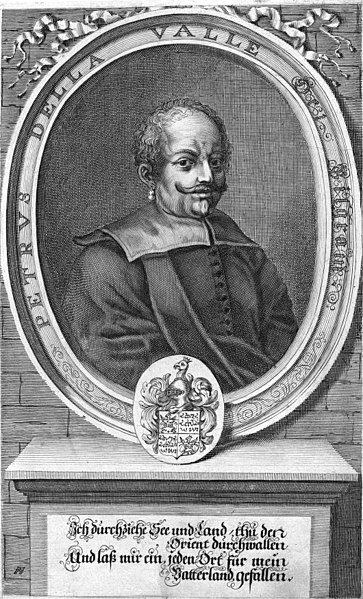
Pietro della Valle

Italian traveller in the Orient, b. at Rome, 2 April, 1586; d. there, 21 April, 1652. He belonged to a noble family and received an excellent education. As a young man he was a poet, orator, a soldier in the papal service, and a member of the Roman Academy of the Umoristi. In 1611 he took part in a campaign against the Barbary States. An unfortunate love-affair was the cause of a pilgrimage, lasting eleven years. On 8 June, 1614, he started from Venice by sea and went first to Constantinople where he remained a year and learned both Turkish and Arabic. On 25 September, 1615, he traveled to Alexandria, thence to Cairo, and in the spring of 1616 on to Jerusalem. After visiting the Holy Places he continued his journey to Damascus, Aleppo, and Bagdad. Here he married a Syrian Christian named Maani who accompanied him on his travels during the succeeding years. It was probably on account of his marriage that he visited Persia, for the parents of his wife had been robbed by Kurds. In 1618 he was hospitably received in Northern Persia by the Shah Abbas the Great whom he followed to the capital Ispahan. He acted as mediator between the shah and the Christians of Persia. During the next four years he explored Persia; then in October, 1621, he started for Perseopolis and Schiras. He was prevented from continuing his journey as far as India by the war between the Portuguese and Persians. His wife died on 30 December, 1621, and he kept her body with him until his return. In 1622 he took part in the siege of Ormus from which the Portuguese were driven. He then spent two years (1623-24) in India, where his headquarters were Surat and Goa. In 1625 he started on the return journey by way of Muscat, Basra, Aleppo, Cyprus, and Naples, and arrived at Rome, 28 March, 1626. Urban VIII appointed him a papal chamberlain. The rest of Valle’s life was fairly peaceful. His second wife was a Georgian orphan Mariuccia, who had accompanied him on his travels. The most important of his works is his account of his travels (Viaggi) in fifty-four friendly letters (Lettere famigliari) addressed to Mario Schipano, a professor of medicine at Naples. They appeared first at Rome in three volumes (1650-53) and were translated later into English, French, German, and Dutch. The narrative is distinguished by learning and keen observation but inclines to credulity and stories of marvellous occurrences.

The Travels of Pietro della Valle, ed. GREY (London, 1892); CIAMPI, Della vita e delle opere di Pietro della Valle (Rome, 1880).

Klemens Löffler (Catholic Encyclopedia)

{ 0 comments }

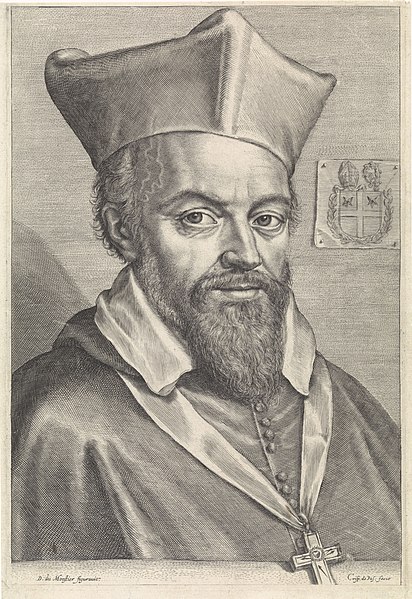
Nicolas Coeffeteau

Preacher and controversialist, born 1574, at Château-du-Loir, province of Maine, France; died Paris, 21 April, 1623. He entered the Dominican convent of Sens, 1588, and after his profession, 1590, was sent to St-Jacques, the house of studies at Paris. There in 1595 he began to teach philosophy. On 4 May, 1600, he received the doctorate and was appointed regent of studies, which position he filled until 1606 and again from 1609 to the spring of 1612. He also served two terms as prior and was vicar-general of the French congregation from 1606 to 1609. At this time Coeffeteau had already acquired distinction by his preaching at Blois, Chartres, Angers, and in Paris. Queen Margaret of Valois had made him her almoner in 1602, and in 1608 he received the appointment of preacher in ordinary to King Henry IV. In June, 1617, he was proposed by Louis XIII and confirmed by Pope Paul V as titular Bishop of Dardania and Administrator of the Diocese of Mets. By his vigilance and zealous preaching he checked the spread of Calvinistic errors, renewed and re-established Divine services, and restored ecclesiastical discipline, especially in the great abbeys of Mets and in the monasteries of the diocese. After four years he was transferred, 22 Aug., 1621, to the Diocese of Marseilles; but ill-health kept him from his see. He secured François de Loménie as his coadjutor, but he himself remained at Paris until his death. He was buried in St. Thomas’s chapel of the convent of St-Jacques. Coeffeteau’s writings are chiefly polemical. Five treatises on the Eucharist were occasioned by a controversy with Pierre du Moulin, Calvinist minister of Charenton. Another series on ecclesiastical and pontifical authority was prompted by the action of the French Protestants in relation to political and religious disturbances in England. At the request of Gregory XV, Coeffeteau wrote a refutation of the “De Republicâ Christianâ” by the apostate Archbishop of Spalato, Marc’ Antonio de Dominis. In all these writings, at a time in which partisanship was wont to be violent, Coeffeteau maintained an equable temper and a praiseworthy spirit of moderation, always handling his subjects objectively and dispassionately. His erudition was extraordinary and he was possessed of a rare and penetrating critical judgment. On the question of papal power and authority, Coeffeteau’s position is described as that of a modified Gallicanism. He held that the infallibility of the pope or of an œcumenical council was restricted to matters of faith and did not bear upon questions of fact or of persons. A council, he held, was not superior to a pope except in the case of schism, when it could depose the doubtful incumbent to elect one whose right and authority would be beyond question. In this Coeffeteau differed from the Sorbonne, which asserted the council’s superiority in all cases. Besides being called the father of French eloquence, Coeffeteau was a recognized master of the French language. He was the first to use it as a means of theological expression, and the purity of his diction, especially in his historical writings and translations, is admitted and commended by many excellent authorities.

QUÉTIF-ECHARD, Scriptores Ord. Prœd., II, 434; COULON in VACANT, Dict. de théol. cath. (Paris, 1906), fase. XVIII, col. 267; URBAIN, Nicolas Coeffeteau (Paris, 1894).

John R. Volz (Catholic Encyclopedia)

{ 0 comments }

Saint Anselm, Confessor, Archbishop Of Canterbury

(A. D. 1109)

If the Norman conquerors stripped the English nation of its liberty and many temporal advantages, it must be owned that by their valor they raised the reputation of its arms and deprived their own country of its greatest men, both in church and state, with whom they adorned this kingdom; of which this great doctor and his master Lanfranc are instances.

NormansSaint Anselm was born of noble parents at Aoust, in Piedmont, about the year 1033. His pious mother took care to give him an early tincture of piety, and the impressions her instructions made upon him were as lasting as his life. At the age of fifteen, desirous of serving God in the monastic state, he petitioned an abbot to admit him into his house; but was refused out of apprehension of his father’s displeasure. Neglecting, during the course of his studies, to cultivate the divine seed in his heart, he lost this inclination, and his mother being dead he fell into tepidity; and, without being sensible of the fatal tendency of vanity and pleasure, began to walk in the broad way of the world: so dangerous a thing is it to neglect the inspirations of grace!

The saint, in his genuine meditations, expresses the deepest sentiments of compunction for these disorders, which his perfect spirit of penance exceedingly exaggerated to him, and which, like another David, he never ceased most bitterly to bewail to the end of his days. The ill-usage he met with from his father induced him, after his mother’s death, to leave his own country, where he had made a successful beginning in his studies; and, after a diligent application to them for three years in Burgundy (then a distinct government) and in France, invited by the great fame of Lanfranc, Prior of Bec, in Normandy, under the Abbot Herluin, he went thither and became his scholar. On his father’s death, Anselm advised with him about the state of life he was to embrace; as whether he should live upon his estate to employ its produce in alms, or should renounce it at once and embrace a monastic and eremitical life. Lanfranc, feeling an overbearing affection for so promising a disciple, durst not advise him in his vocation, fearing the bias of his own inclination; but he sent him to Maurillus, the holy Archbishop of Rouen. By him Anselm, after he had laid open to him his interior, was determined to enter the monastic state at Bec, and accordingly became a member of that house at the age of twenty-seven, in 1060, under the Abbot Herluin.

Three years after, Lanfranc was made Abbot of Saint Stephen’s at Caen, and Anselm Prior of Bec. At this promotion several of the monks murmured on account of his youth; but, by patience and sweetness, he won the affections of them all, and by little condescensions at first, so worked upon an irregular young monk, called Osbern, as to perfect his conversion and make him one of the most fervent. He had indeed so great a knowledge of the hearts and passions of men that he seemed to read their interior in their actions; by which he discovered the sources of virtues and vices, and knew how to adapt to each proper advice and instructions; which were rendered most powerful by the mildness and charity with which he applied them. In regard to the management and tutoring of youth, he looked upon excessive severity as highly pernicious. Eadmer has recorded a conversation he had on this subject with a neighboring abbot, who, by a conformity to our saint’s practice and advice in this regard, experienced that success in his labors which he had till then aspired to in vain by harshness and severity.

Saint Anselm applied himself diligently to the study of every part of theology, by the clear light of scripture and tradition. Whilst he was prior at Bec, he wrote his Monologium, so called because in this work he speaks alone, explaining the metaphysical proofs of the existence and nature of God. Also his Proslogium, or contemplation of God’s attributes in which he addresses his discourse to God, or himself. The Meditations, commonly called the Manual of Saint Augustin, are chiefly extracted out of this book. It was censured by a neighboring monk, which occasioned the saint’s Apology. These and other the like works, show the author to have excelled in metaphysics all the doctors of the church since Saint Augustin. He likewise wrote, whilst prior, On Truth, on Free Will, and On the Fall of the Devil, or, On the Origin of Evil; also his Grammarian, which is in reality a treatise on Dialectic, or the Art of Reasoning.

Abbaye du Bec Hellouin

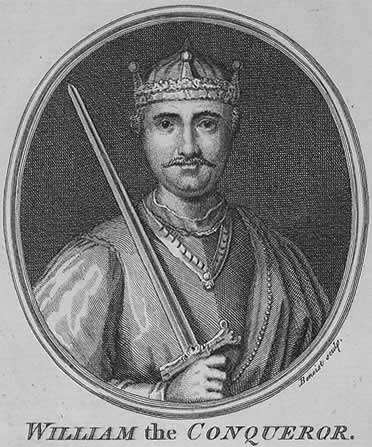
Anselm’s reputation drew to Bec great numbers from all the neighboring kingdoms. Herluin dying in 1078, he was chosen Abbot of Bec, being forty-five years old, of which he had been prior fifteen. The abbey of Bec being possessed at that time of some lands in England, this obliged the abbot to make his appearance there in person at certain times. This occasioned our saint’s first journeys thither, which his tender regard for his old friend Lanfranc, at that time Archbishop of Canterbury, made the more agreeable. He was received with great honor and esteem by all ranks of people, both in church and state, and there was no one who did not think it a real misfortune if he had not been able to serve him in something or other. King William himself, whose title of Conqueror rendered him haughty and inaccessible to his subjects, was so affable to the good Abbot of Bec that he seemed to be another man in his presence. The saint, on his side, was all to all, by courtesy and charity, that he might find occasions of giving everyone some suitable instructions to promote their salvation; which were so much the more effectual as he communicated them, not as some do, with the dictatorial air of a master, but in a simple familiar manner, or by indirect though sensible examples.

William the Conqueror seemed to be another man in the presence of St. Anselm

William the Conqueror seemed to be another man in the presence of St. Anselm

In the year 1092, Hugh, the great Earl of Chester, by three pressing messages, entreated Anselm to come again into England, to assist him, then dangerously sick, and to give his advice about the foundation of a monastery which that nobleman had undertaken at St. Wereburge’s church at Chester. A report that he would be made archbishop of Canterbury, in the room of Lanfranc, deceased, made him stand off for some time; but he could not forsake his old friend in his distress, and at last came over. He found him recovered, but the affairs of his own abbey, and of that which the earl was erecting, detained him five months in England. The metropolitan see of Canterbury had been vacant ever since the death of Lanfranc in 1089.

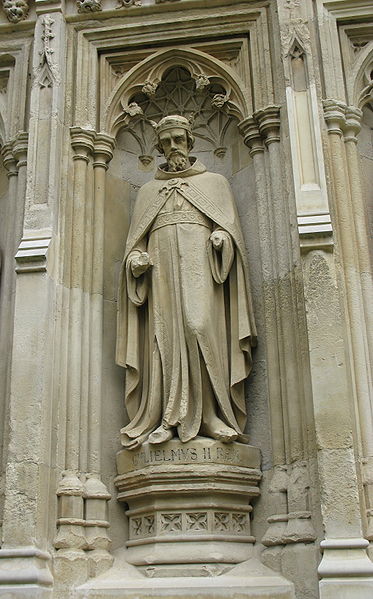
The sacrilegious and tyrannical king, William Rufus, who succeeded his father in 1087, by an injustice unknown till his time, usurped the revenues of vacant benefices, and deferred his permission, or (congé d’elire), in order to postpone the filling of the episcopal sees, that he might the longer enjoy their income. Having thus seized into his hands the revenues of the archbishopric, he reduced the monks of Canterbury to a scanty allowance, oppressing them moreover by his officers with continual insults, threats, and vexations. He had been much solicited by the most virtuous among the nobility to supply the see of Canterbury, in particular, with a person proper for that station; but continued deaf to all their remonstrances and answered them, at Christmas 1093, that neither Anselm nor any other should have that bishopric whilst he lived; and this he swore to by the holy face of Lucca, meaning a great crucifix in the cathedral of that city held in singular veneration, his usual oath. He was seized soon after with a violent fit of sickness, which in a few days brought him to extremity.

The sacrilegious and tyrannical king, William Rufus

The sacrilegious and tyrannical king, William Rufus

He was then at Gloucester, and seeing himself in this condition, signed a proclamation, which was published, to release all those that had been taken prisoners in the field, to discharge all debts owing to the crown, and to grant a general pardon; promising likewise to govern according to law and to punish the instruments of injustice with exemplary severity. He moreover nominated Anselm to the see of Canterbury, at which all were extremely satisfied but the good abbot himself, who made all the decent opposition imaginable; alleging his age, his want of health and vigor enough for so weighty a charge, his unfitness for the management of public and secular affairs, which he had always declined to the best of his power. The king was extremely concerned at his opposition, and asked him why he endeavored to ruin him in the other world, being convinced that he should lose his soul in case he died before the archbishopric was filled. The king was seconded by the bishops and others present, who not only told him they were scandalized at his refusal, but added that, if he persisted in it, all the grievances of the church and nation would be placed to his account. Thereupon they forced a pastoral staff into his hands, in the king’s presence, carried him into the church, and sung Te Deum on the occasion. This was on the 6th of March 1093. He still declined the charge till the king had promised him the restitution of all the lands that were in the possession of that see in Lanfranc’s time. Anselm also insisted that he should acknowledge Urban II for lawful pope. Things being thus adjusted, Anselm was consecrated with great solemnity on the 4th of December 1093.

Anselm had not been long in possession of the see of Canterbury when the king, intending to wrest the duchy of Normandy out of the hands of his brother Robert, made large demands on his subjects for supplies. On this occasion, not content with the five hundred pounds (a very large sum in those days) offered him by the archbishop, the king insisted, at the instigation of some of his courtiers, on a thousand, for his nomination to the archbishopric, which Anselm constantly refused to pay; pressing him also to fill vacant abbeys and to consent that bishops should hold councils as formerly, and be allowed by canons to repress crimes and abuses, which were multiplied and passed into custom for want of such a remedy, especially incestuous marriages and other abominable debaucheries. The king was extremely provoked, and declared no one should extort from him his abbeys any more than his crown. And from that day he sought to deprive Anselm of his see.

Read More Here

{ 0 comments }

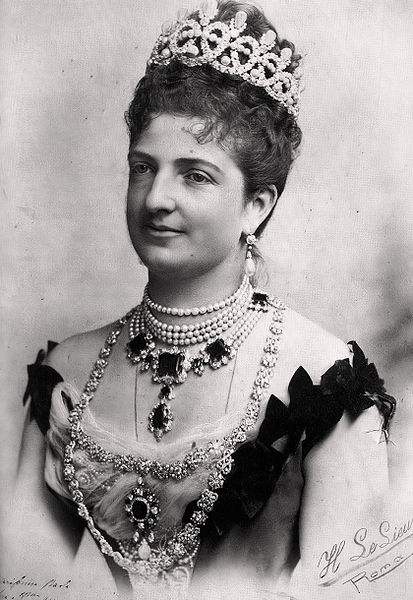
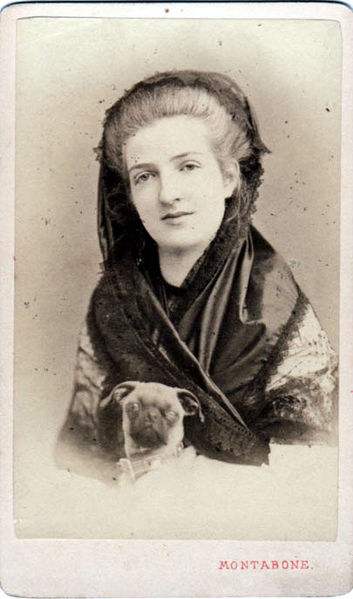
Margherita of Savoy-Genoa, queen of Italy

Margherita of Savoy-Genoa, Queen Consort of Italy


Margherita Teresa Giovanna, Princess of Savoy, was born in Turin, on November 20, 1851. On April 21, 1868, when just sixteen years old, she married her first cousin, Umberto, Crown Prince of Italy.

Pizza Margherita was named after her. This is how it happened…

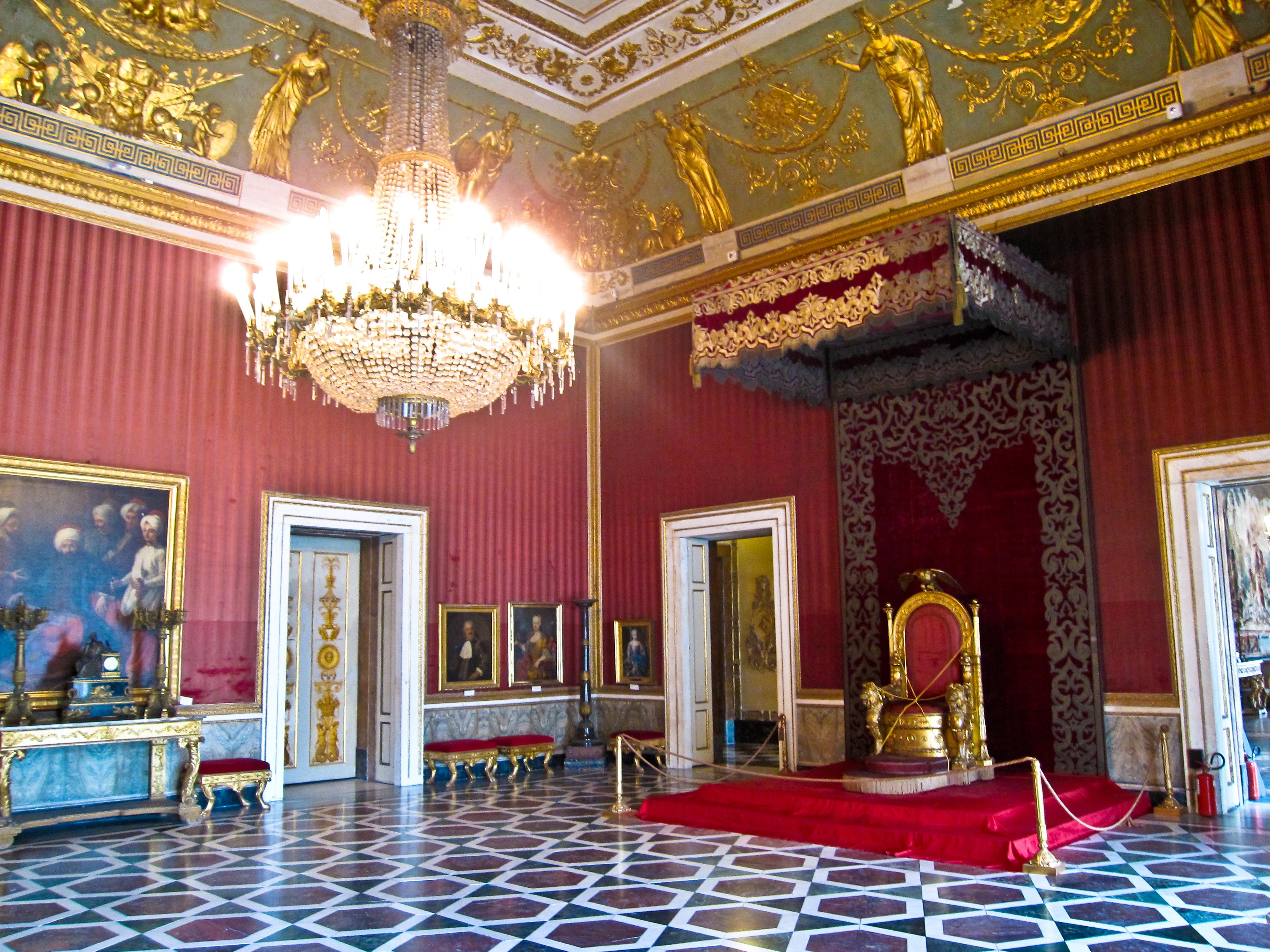
In June 1898, Margherita accompanied her husband, now Umberto I, King of Italy, on a visit to Naples. While there, Raffaele Esposito and Maria Giovanni Brandi, owners of Pizzeria Brandi, a very old pizzeria close to the Royal Palace, were officially invited to come to Court.

One of the rooms inside the Royal Palace. Naples, Italy. Photo by Armando Mancini

One of the rooms inside the Royal Palace. Naples, Italy. Photo by Armando Mancini

Raffaele prepared three pizzas for this unforgettable moment in their family history. The first was a white pizza, with olive oil, cheese and basil and no tomato sauce. The second was topped with cecenielle (a small fish).

It was the third one however, that caught the Queen’s eye, with its blending of red, white, and green, using tomato slices, mozzarella, and basil. Queen Margherita enjoyed it immensely and Raffaele immediately named it Pizza Margherita in her honor.

The next day, the Queen had one of her officials send a thank you note to express her appreciation.


Margherita Pizza

This note, dated June 11, 1898, is carefully preserved at Pizzeria Brandi, where it can still be seen today, graciously attesting to the Queen’s kindness. And while the Pizzeria itself is no longer owned by descendants of Raffaele and Maria Giovanna,  their famous creation, Pizza Margherita, is the delight of millions around the world.


 Margherita, Queen of Italy

Click for the Recipe!

{ 0 comments }

Pedralvarez Cabral

(Pedro Alvarez.)

Lithograph of Pedro Álvares Cabral

Lithograph of Pedro Álvares Cabral

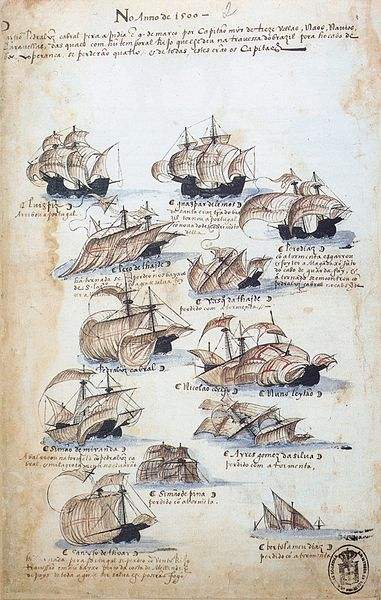
A celebrated Portugese navigator, generally called the discoverer of Brazil, born probably around 1460; date of death uncertain. Very little is known concerning the life of Cabral. He was the third son of Fernao Cabral, Governor of Beira and Belmonte, and Isabel de Gouvea, and married Isabel de Castro, the daughter of the distinguished Fernando de Noronha. He must have had an excellent training in navigation and large experience as a seaman, for King Emmanuel of Portugal considered him competent to continue the work of Vasco da Gama, and in the year 1500 placed him in command of a fleet which was to set sail for India. His commission was to establish permanent commercial relations and to introduce Christianity wherever he went, using force of arms when necessary to gain his point. The nature of the undertaking led rich Florentine merchants to contribute to the equipment of the ships, and priests to join the expedition. Among the captains of the fleet, which consisted of thirteen ships with 1,200 men, were Bartolomeu Diaz, Pero Vaz de Caminha, and Nicolao Coelho, the latter the companion of da Gama. Da Gama himself gave the directions necessary for the course of the voyage.

Pedro Álvares Cabral sees the land that would later be known as Brazil for the first time. Painting by Aurélio de Figueiredo.

Pedro Álvares Cabral sees the land that would later be known as Brazil for the first time. Painting by Aurélio de Figueiredo.

The fleet left Lisbon, 9 March, 1500, and following the course laid down, sought to avoid the calms of the coast of Guinea. On leaving the Cape Verde Islands, where Luis Pirez was forced by a storm to return to Lisbon, they sailed in a decidedly southwesterly direction. On 22 April a mountain was visible, to which the name of “Mt. Paschoal” was given; on the 23rd Coelho landed on the coast of Brazil, and on the 25th the entire fleet sailed into the harbor called “Porto Seguro”. Cabral perceived that the new country lay east of the line of demarcation made by Alexander VI, and at once sent Andreas Gonçalvez (according to other authorities Gaspar de Lemos) to Portugal with the important tidings.

Twelve of 13 ships that were part of Cabral's fleet are depicted. Many were lost, as can be seen in this drawing from Memória das Armadas, c.1568

Twelve of 13 ships that were part of Cabral’s fleet are depicted. Many were lost, as can be seen in this drawing from Memória das Armadas, c.1568

Believing the island to be an island he gave it the name of “Island of Vera Cruz” and took possession of it by erecting a cross and holding a religious service. The service was celebrated by the Franciscan, Father Henrique, afterwards Bishop of Ceuta, on the island called Coroa Vermelha in the bay of Cabralia. Cabral resumed his voyage 3 May; by the end of the month the fleet approached the Cape of Good Hope, where it was struck by a storm in which four vessels, including that of Bartolomeu Diaz, were lost. With the ships now reduced to one-half of the original number, Cabral reached Sofala, 16 July, and Mozambique, 20 July; in the latter place he received a cordial greeting.


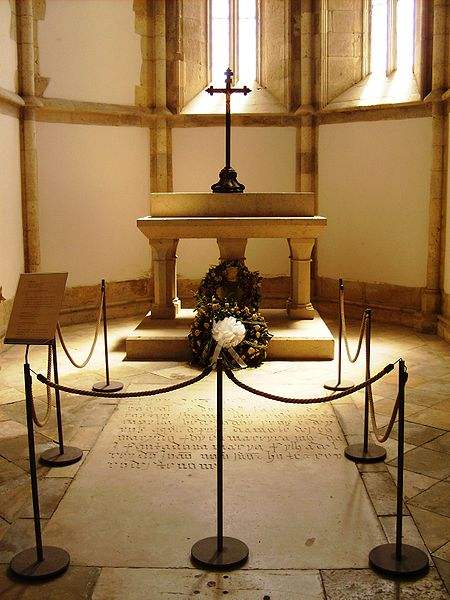
Tomb of Pedro Álvares Cabral in the Church of Our Lady of Grace, Santarém, Portugal.

Tomb of Pedro Álvares Cabral in the Church of Our Lady of Grace, Santarém, Portugal from 1529 until 1903.

On 26 July he came to Kilwa where he was unable to make an agreement with the ruler; on 2 August he reached Melinde; here he had a friendly welcome and obtained a pilot to take him to India. At Calicut, where he arrived 13 September, he met with many obstacles, so that he was obliged to bombard the town for two days; in Cochin and Kananur, however, he succeeded in making advantageous treaties. Cabral started on the return voyage, 16 January, 1501, and arrived at Lisbon, 31 July, or, as is sometiimes given, 23 June. On the way home he met Pero Diaz whom he had dispatched, during his voyage, to Magadoxo, and in September the last of his ships, in command of Sancho de Toar whom he had sent to Sofala, returned to Lisbon. Of his later life nothing is known.

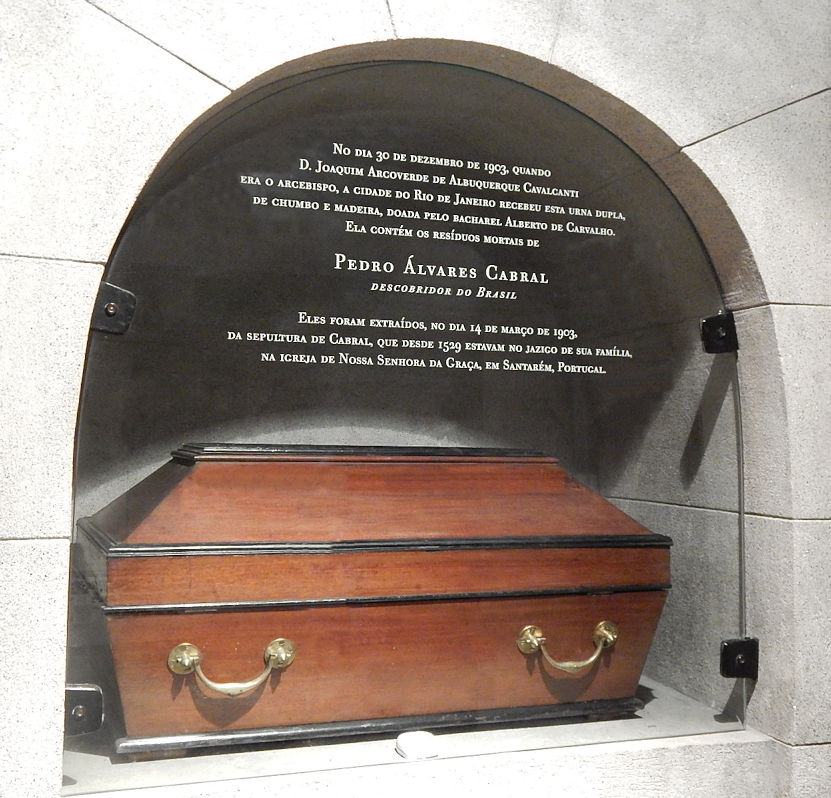
In 1903, Pedro Álvares Cabral's remains were interred in the Church of Our Lady of Mt. Carmel (Igreja de Nossa Senhora do Monte do Carmo) in Rio de Janeiro, Brazil.

In 1903, Pedro Álvares Cabral’s remains were interred in the Church of Our Lady of Mt. Carmel (Igreja de Nossa Senhora do Monte do Carmo) in Rio de Janeiro, Brazil.

The authorities for the voyage of discovery of Cabral are contained in the reports of eyewitnesses, especially in the letter of VAZ DE CAMINHA to King Emmanuel, of which the original was discovered in 1790. This letter was first published by CAZAL in his Corografía brazilica (1817), I, 12-34; the best edition is in the Revista do Instituto Historico Geographico do Brasil (Rio de Janeiro, 1877), XL, Pt. II, 12-37. Another narrative is that of a pilot, published by RAMUSIO in his Delle Navig. e Viaggi (Venice, 1563), I, 1221-127. There is also a description of the voyage in BARROS, Asia (Lisbon, 1552), Dec. I, lib. V, i-x; in FARIO Y SOUSA, Asia Port., I, 1, v, 45-49, and in the writings of other historians. VARNHAGEN, Historia geral do Brazil (Rio de Janeiro, 1854), I; Materials for a Biography in Revista do Instituto Histor. Geog. do Brasil (1843), V, 496-98; BALDAQUE DA SILVA, O Descobrimento do Brazil por Pedro Alvarez Cabral (Lisbon, 1892).

OTTO HARTIG (Catholic Encyclopedia)

Subscription14.1

{ 0 comments }

St. Leonidas

(Or LEONIDES.)

The Roman Martyrology records several feast days of martyrs of this name in different countries. Under date of 28 January there is a martyr called Leonides, a native of the Thebaid, whose death with several companions is supposed to have occurred during the Diocletian persecution (Acta SS., January, II, 832). Another Leonides appears on 2 September, in a long list of martyrs headed by a St. Diomedes. Together with a St. Eleutherius, a Leonides is honoured on 8 August. From other sources we know of a St. Leonidas, Bishop of Athens, who lived about the sixth century, and whose feast is celebrated on 15 April (“Acta SS.”, April, II, 378; “Bibliotheca hagiographica graeca”, 2nd ed., 137). Still another martyr of the name is honoured on 16 April, with Callistus, Charysius, and other companions (Acta SS., April, II, 402).

Origen Adamantius, the son of St. Leonides of Alexandria.

Origen Adamantius, the son of St. Leonides of Alexandria.

The best known of them all, however, is St. Leonides of Alexandria, father of the great Origen. From Eusebius (Hist. Eccles., VI, 1, 2) we learn that he died a martyr during the persecution under Septimius Severus in 202. He was condemned to death by the prefect of Egypt, Lactus, and beheaded. His property was confiscated. Leonides carefully cultivated the brilliant intellect of his son Origen from the latter’s childhood, and imparted to him the knowledge of Holy Scripture. The feast of St. Leonidas of Alexandria is celebrated on 22 April.

J.P. KIRSCH (Catholic Encyclopedia)

{ 0 comments }

h/t smithsonianmag.com

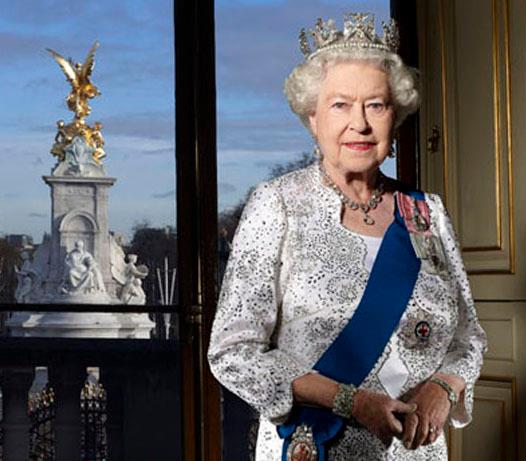
King’s Gallery at Buckingham Palace is showcasing 300 selections drawn from a collection of 4,000 items she owned.

The collection also highlights the queen’s talent for melding fashion with diplomacy. Some notable pieces she sported while meeting with leaders abroad include a cherry blossom dress from her 1975 trip to Japan, the green-and-white dress she wore to a 1961 state banquet in Pakistan to match the country’s flag, and a shamrock-dappled gown from her 2011 visit to Ireland.

 “Queen Elizabeth II: Her Life in Style” is on display through October 18 at the King’s Gallery, Buckingham Palace.

h/t smithsonianmag.com

{ 0 comments }

by Byron Whitcraft
h/t tfp.org

Mary Queen of Scots: Catholic Martyr?

After almost five centuries, the legendary Queen Mary of Scotland is now again in the spotlight. The last letter she penned just six hours prior to her execution is on display in Perth, Scotland. The exhibit is on display at the Perth Museum until April 26, 2026, and the letter is expected to attract thousands of visitors before it is removed for safekeeping.

Why does the name of Mary Stewart, so shrouded in mystery, still attract the attention of scholars, historians and the Scottish people? The answer to this question can be found in her royal lineage and the way she left this world. She was the daughter of James V of Scotland and Mary of Guise. She was also the granddaughter of Henry VIII’s sister Margaret. As a cousin of Elizabeth I of England, she had a strong right to the thrones of both countries.

Mary Queen of Scots

There were controversial episodes in her troubled life. Though never proven, some theories hold that she had a part in the assassination of her husband, Lord Darnley. Marrying the prime suspect in that death, James Hepburn, the Earl of Bothwell, on May 15, 1567, did not help her cause. The uproar over this affair led her to abdicate the throne of Scotland in favor of her son James. Her half-brother ruled as regent.

After losing the Battle of Langside against her half-brother to regain the throne of Scotland, she fled to England, hoping to find assistance and asylum from her cousin Elizabeth I. Instead, Elizabeth held her under house arrest for the next 19 years. During this time, Mary lived through several attempts from English and Scottish nobles to rescue her and put her on the throne. Her complicity and involvement in any of those plots have never been proven entirely. During her captivity, her strong Catholicity could not have been more evident. She never compromised any of her Catholic beliefs and practiced her religion faithfully. For a time, Jesuit priests and other clergy would come disguised and celebrate Mass for her in secret.

Mary, Queen of Scots, in captivity. Painting by John Callcott Horsley.


Some accounts relate a special permission from Pope Saint Pius V for her to administer the Eucharist to herself in the absence of a Catholic clergyman. Depictions of Mary made during her imprisonment frequently show her holding a rosary, a symbol of her Catholic devotion. The cause of her execution was her involvement in the Babington plot of 1586. In this last episode of her life, she supposedly consented to a plot to assassinate Elizabeth I. Coded letters intercepted were used to prove her guilt. At her trial, she denied involvement in plotting the murder of the English Queen. Historians debate the extent of her involvement in this plot to the present day. After being found guilty, Mary was sentenced to death, but Elizabeth took four agonizing months to sign the death warrant for her execution.

Mary Stuart listens to the order of her execution.

Once the warrant was secured, officials announced to her that she was to be executed the next morning. Her last letter, now on display in Perth, was written at two o’clock in the wee hours of the morning on which she was executed. The letter that Mary penned was to her former brother-in-law, Henry III of France. It is a testament to her staunch Catholicity. The most beautiful part of the relatively short letter and subject of the Scottish exhibition states, “I scorn death and vow that I meet it innocent of any crime, even if I were their subject. The Catholic faith and the assertion of my God-given right to the English crown are the two issues on which I am condemned, and yet I am not allowed to say that it is for the Catholic religion that I die, but for fear of interference with theirs. The proof of this is that they have taken away my chaplain, and although he is in the building, I have not been able to get permission for him to come and hear my confession and give me the Last Sacrament, while they have been most insistent that I receive the consolation and instruction of their minister, brought here for that purpose.”1

On February 8, 1587 Mary Stewart is led to her execution.

On February 8, 1587, at eight on the same morning, Mary Queen of Scots left this valley of tears. Her executioner turned the beheading into a gruesome affair by taking three strikes of his axe before severing Mary’s noble head. It was this way that Mary ended her sorrowful and troubled life. Mary had a beautiful and noble death. Clearly, her Catholicity played a role in the persecution she received in her last 19 years.

This 1613 watercolor in the National Portrait Gallery of Scotland, of the beheading of Mary, Queen of Scots, was made for a Dutch magistrate. The [watercolor] picture does reflect eye witness accounts of the event. Queen Mary was not beheaded with a single strike. The first blow missed her neck and struck the back of her head. The second blow severed the neck, except for a small bit of sinew, which the executioner cut through using the axe. All of her clothing, the block, and everything touched by her blood were burnt to prevent supporters keeping them as relics. This scene is shown on the far left.

Was she a martyr? At present, there is no canonical process in the Catholic Church to answer this question. Though many martyrs in the history of the Church did not have such a process, they were, in fact, true martyrs. Saint Thomas Aquinas refers to these in a special way. He says these unrecognized souls are not martyrs in the “Heart of the Church” but in the “Heart of God.” Considering her last letter and what she symbolized, one would think Mary Stuart, Queen of Scots, would be one of those.

Footnotes

  1. https://digital.nls.uk/mqs/trans1.html

{ 0 comments }

Just a few of the many martyrs during the French Revolution († 1792-1799)

16 April 1794 in Avrillé, Maine-et-Loire (France)

Pierre Delépine
layperson of the diocese of Angers
born: 24 May 1732 in Marigné, Maine-et-Loire (France)
Jean Ménard
layperson of the diocese of Angers; married
born: 16 November 1736 in Andigné, Maine-et-Loire (France)
Renée Bourgeais veuve Juret
layperson of the diocese of Angers; married
born: 12 November 1751 in Montjean, Maine-et-Loire (France)
Perrine Bourigault
layperson of the diocese of Angers
born: 07 August 1743 in Montjean, Maine-et-Loire (France)
Madeleine Cady épouse Desvignes
layperson of the diocese of Angers; married
born: 07 April 1756 in Saint-Maurille de Chalonnes-sur-Loire, Maine-et-Loire (France)

Martyrs of the French RevolutionMarie Forestier
layperson of the diocese of Angers
born: 16 January 1768 in Montjean, Maine-et-Loire (France)
Marie Gingueneau veuve Coiffard
layperson of the diocese of Angers; married
born: ca. 1739 in (?)
Jeanne Gourdon veuve Moreau
layperson of the diocese of Angers; married
born: 08 October 1733 in Sainte-Christine, Maine-et-Loire (France)
Marie Lardeux
layperson of the diocese of Angers
born: ca. 1748 in (?)
Perrine Laurent
layperson of the diocese of Angers
born: 02 September 1746 in Louvaines, Maine-et-Loire (France)
Jeanne Leduc épouse Paquier
layperson of the diocese of Angers; married
born: 10 February 1754 in Chalonnes-sur-Loire, Maine-et-Loire (France)
Anne Maugrain
layperson of the diocese of Angers
born: 12 April 1760 in Rochefort-sur-Loire, Maine-et-Loire (France)
Françoise Micheneau veuve Gillot
layperson of the diocese of Angers; married
born: 19 May 1737 in Chanteloup-les-Bois, Maine-et-Loire (France)
Jeanne Onillon veuve Onillon
layperson of the diocese of Angers; married
born: 19 April 1753 in Montjean, Maine-et-Loire (France)

Martyrs of the French RevolutionMarie Piou épouse Supiot
layperson of the diocese of Angers; married
born: 19 May 1755 in Montrevault, Maine-et-Loire (France)
Perrine Pottier épouse Turpault
layperson of the diocese of Angers; married
born: 26 April 1750 in Cléré-sur-Layon, Maine-et-Loire (France)
Marie-Genevieve Poulain de la Forestrie
layperson of the diocese of Angers
born: 03 January 1741 in Lion-d’Angers, Maine-et-Loire (France)
Marthe Poulain de la Forestrie
layperson of the diocese of Angers
born: 02 October 1743 in Lion-d’Angers, Maine-et-Loire (France)
Renée Rigault épouse Papin
layperson of the diocese of Angers; married
born: 14 May 1750 in Saint-Florent-le-Vieil, Maine-et-Loire (France)
Marguerite Robin
layperson of the diocese of Angers
born: 22 December 1725 in Montjean, Maine-et-Loire (France)
Marie Rechard
layperson of the diocese of Angers
born: 29 April 1763 in Montjean, Maine-et-Loire (France)
Marie Roger veuve Chartier
layperson of the diocese of Angers; married
born: 14 January 1727 in Montjean, Maine-et-Loire (France)
Madeleine Sallé épouse Havard
layperson of the diocese of Angers; married
born: ca. 1751 in (?)
Renée Sechet veuve Davy
layperson of the diocese of Angers; married
born: 28 December 1753 in Montjean, Maine-et-Loire (France)
Françoise Suhard veuve Ménard
layperson of the diocese of Angers; married
born: February 5, 1731 in Saint-Gemmes-d’Andigné, Maine-et-Loire (France)
Jeanne Thomas veuve Delaunay
layperson of the diocese of Angers; married
born: ca. 1730 in (?)

{ 0 comments }

Ven. Henry Heath

English Franciscan and martyr, son of John Heath; christened at St. John’s, Peterborough, 16 December, 1599; executed at Tyburn, 17 April, 1643. He went to Corpus Christi College, Cambridge, 1617, proceeded B.A. in 1621, and was made college librarian. In 1622 he was received into the Church by George Muscott, and, after a short stay at the English College at Douai, entered St. Bonaventure’s convent there in 1625, taking the name of Paul of St. Magdalen. Early in 1643, he with much trouble obtained leave to go on the English mission and crossed from Dunkirk to Dover disguised as a sailor. A German gentleman paid for his passage and offered him further money for his journey, but, in the spirit of St. Francis, Heath refused it and preferred to walk from Dover to London, begging his way. On the very night of his arrival, as he was resting on a door step, the master of the house gave him into custody as a shoplifter. Some papers found in his cap betrayed his religion and he was taken to the Compter Prison. The next day he was brought before the Lord Mayor, and, on confessing he was a priest, was sent to Newgate. Shortly afterwards he was examined by a Parliamentary committee, and again confessed his priesthood. He was eventually indicted under 27 Eliz. c. 2, for being a priest and into the realm. At Tyburn he reconciled in the very cart one of the criminals that were executed with him. He was allowed to hang until he was dead.

CHALLONER, Missionary Priests, II, 175; COOPER, in Dict. Nat. Biog., s.v.; GlLLOW,, Bibl. Dict. Cath, III, 239.

J. B. Wainewright (Catholic Encyclopedia)

{ 0 comments }

Adele Amalie Gallitzin

(Or GOLYZIN).

Princess; b. at Berlin, 28 Aug., 1748; d. at Angelmodde, near Münster, Westphalia, 17 April, 1806. She was the daughter of the Prussian General Count von Schmettau, and educated in the Catholic faith, though she soon became estranged from her religion. In 1768, she married the Russian Prince Dimitry Alexejewitsch Gallitzin, who was under Catherine II ambassador at Paris, Turin and The Hague. In each of these capitals, the princess, thanks to her beauty and her eminent qualities of mind and heart, played a brilliant role. At the age of twenty-four she forsook society suddenly and devoted herself to the education of her children. She applied herself assiduously to the study of mathematics, classical philology, and philosophy under the noted philosopher Franz Hemsterhuis, who kindled her enthusiasm for Socratic-Platonic idealism, and later under the name of “Diokles” dedicated to her the “Diotima”, his famous “Lettres sur l’atheisme”.

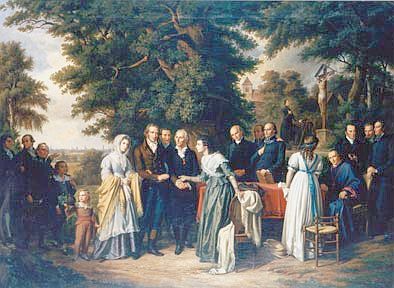
Princess of Gallitzin in the circle of her friends in 1800, who welcomed the recently converted Friedrich Leopold Graf von Stolberg with his wife.

The educational reform introduced by Franz v. Furstenberg, Vicar-General of Münster, induced her to take up her residence in the Westphalian capital. Here she soon became the centre of a set of intellectual men led by Furstenberg. This circle also included the gymnasial teachers, (whom she incited to the deeper study of Plato), Overberg, the reformer of popular school education, Clemens Augustus von Droste-Vischering, Count Leopold von Stolberg, the profound philosopher Hamann, who was interred in her garden. The poet Claudius of the “Wandsbecker Bote” was also a familiar visitor, and Goethe numbered the hours passed by him in this circle among his most pleasant recollections. The reading of Sacred Scripture, necessitated by the religious education of her children, and her constant intercourse with noble Catholic souls, led to her return to positive religious convictions.

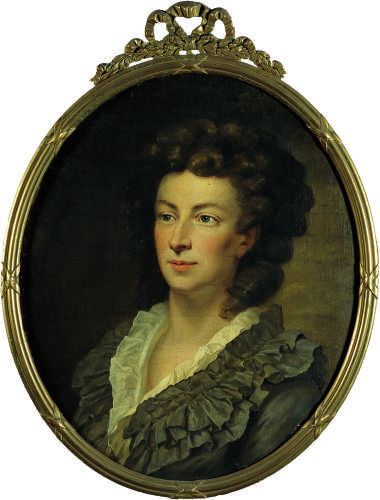
Princess Adelheid Amalie Gallitzin

On 28 Aug., 1786, at the instance of Overberg, she approached the tribunal of penance for the first time in many years. Soon after she made this zealous priest her chaplain. Under his influence, she underwent a complete change which affected all her surroundings. Her religious life took on a larger growth, and produced the most admirable fruit. She became the centre of Catholic activity in Münster. In those revolutionary and godless times, she provided for the spread of religious writings, proved a support for the religious faith of many of her friends, and induced others, among them Count Stolberg, to make their peace with the Church.

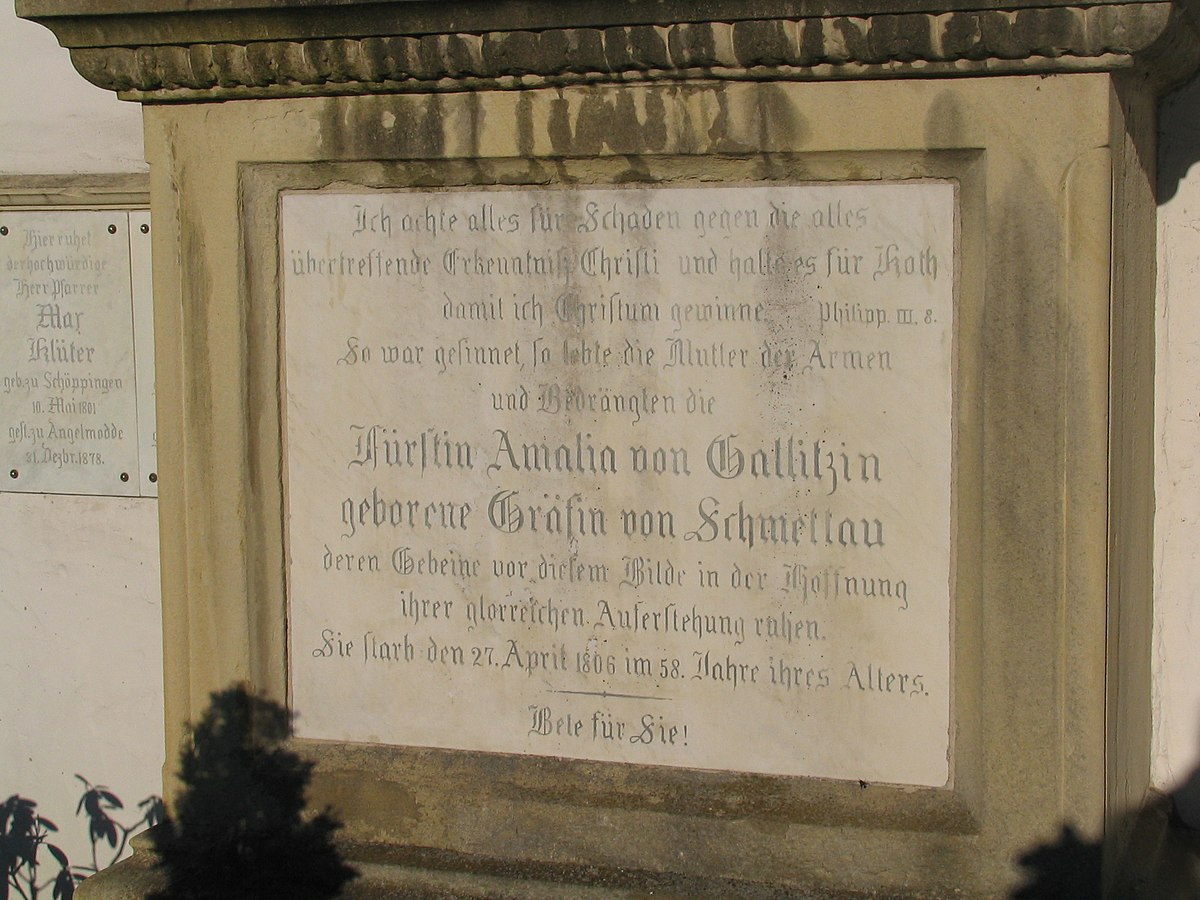
Tomb of Princess Amalie of Gallitzin in Angelmodde. Photo by Suedwester93.

Her gentle charity assuaged the distress of many, and she readily and generously assisted poor and destitute priests. For extensive circles hers was a model of religious life, and her social activity was for many a providential blessing. Portions of her correspondence and diaries were published by Scheuter (Münster, 1874-76) in three parts. This admirable lady was the mother of the well-known American missionary Prince Demetrius Gallitzin.

PATRICIUS SCHLAGER (Catholic Encyclopedia)

{ 0 comments }

Pope Benedict III

Date of birth unknown; d. 17 April, 858. The election of the learned and ascetic Roman, Benedict, the son of Peter, was a troubled one. On the death of Leo IV (17 July, 855) Benedict was chosen to succeed him, and envoys were despatched to secure the ratification of the decree of election by the Emperors Lothaire and Louis II. But the legates betrayed their trust and allowed themselves to be influenced in favour of the ambitious and excommunicated Cardinal Anastasius. The imperial missi, gained over in turn by them, endeavoured to force Anastasius on the Roman Church. Benedict was insulted and imprisoned. Most of the clergy and people, however, remained true to him, and the missi had to yield. Benedict was accordingly consecrated on the 29th of September, or 6th of October, 855, and though his rival was condemned by a synod, he admitted him to lay communion. Owing to dissensions and attacks from without, the kingdom of the Franks was in disorder, and the Church within its borders was oppressed. Benedict wrote to the Frankish bishops, attributing much of the misery in the empire to their silence (cf. “Capitularia regum Francorum”, ed. Boretius, II, 424); and to lessen its internal evils endeavoured to curb the powerful subdeacon Hubert (Ep. Bened., in Mon. Germ. Epp., V, 612), who was the brother-in-law of Lothaire II, King of Lorraine, and defied the laws of God and man till he was slain, in 864. In an appeal made to Benedict from the East, he held the balance fair between St. Ignatius, Patriarch of Constantinople, and Gregory, Bishop of Syracuse. He was visited by the Ango-Saxon King Ethelwulf with his famous son Alfred, and completed the restoration of the Schola Anglorum, destroyed by fire in 847. He continued the work of repairing the damage done to the churches in Rome by the Saracen raid of 846. He was buried near the principal gate of St. Peter’s. One of his coins proves there was no Pope Joan between Leo IV and himself [Garampi, “De nummo argenteo Bened. III” (Rome, 1749)].

The most important source for the history of the first nine popes who bore the name of Benedict is the biographies in the Liber Pontificalis, of which the most useful edition is that of Duchesne, Le Liber Pontificalis (Paris, 1886-92), and the latest that of Mommsen, Gesta Pontif. Roman. (to the end of the reign of Constantine only, Berlin, 1898). Jaffé, Regesta Pont. Rom. (2d ed., Leipzig, 1885), gives a summary of the letters of each pope and tells where they may be read at length. Modern accounts of these popes will be found in any large Church history, or history of the City of Rome. The fullest account in English of most of them is to be read in Mann, Lives of the Popes in the Early Middle Ages (London, 1902, passim).

Horace K. Mann (Catholic Encyclopedia)

{ 0 comments }

Thomas of Jesus

(THOMAS DE ANDRADA).

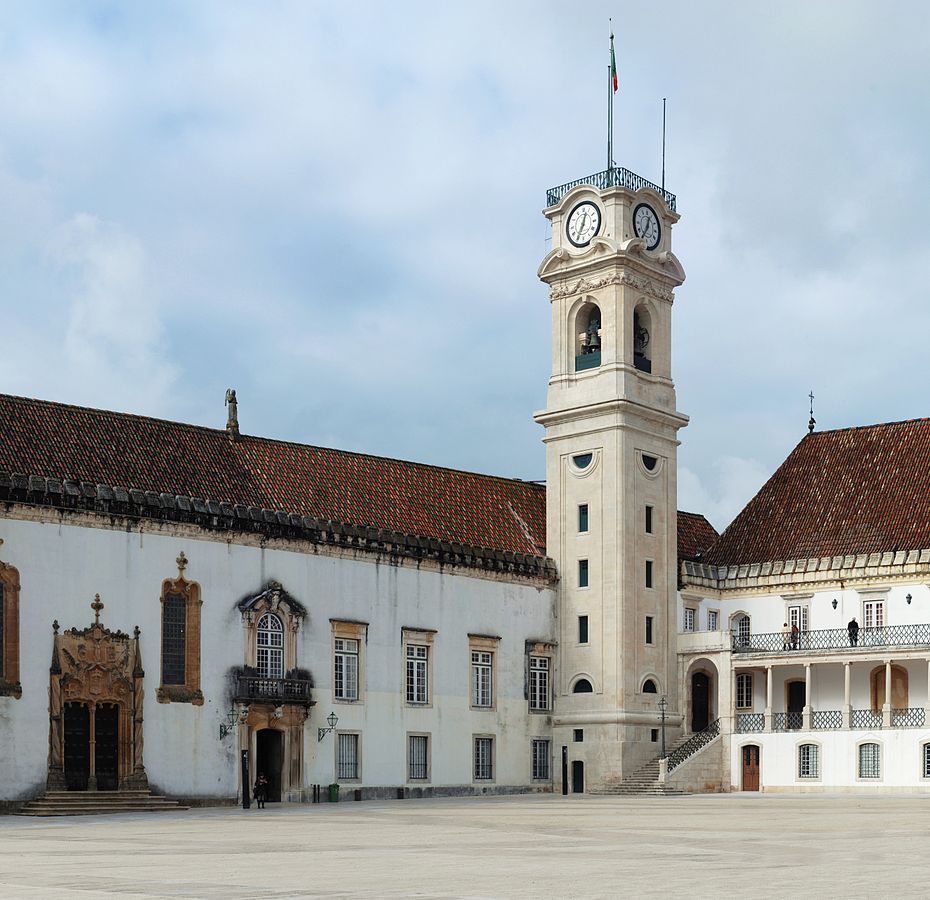
The tower of the University of Coimbra, Portugal. At left, the manueline door to the Chapel of Saint Michael. Photo by Alvesgaspar.

Reformer and preacher, born at Lisbon, 1529; died at Sagena, Morocco, 17 April, 1582. He was educated by the Augustinian Hermits from age of ten, entered the order at Lisbon in 1534, completed his studies at Coimbra, and was appointed novice-master. In his zeal for primitive observance he attempted a thorough reform of the order, but the opposition was such that he was obliged to desist. However, the eventual establishment of the Discalced or Reformed Augustinians is attributed to the initiative of Thomas de Andrada (see Hermits of St. Augustine). High in favour at Court, Thomas assisted, in 1578, at the death of John III, of which he has left an interesting narrative in a letter still extant.

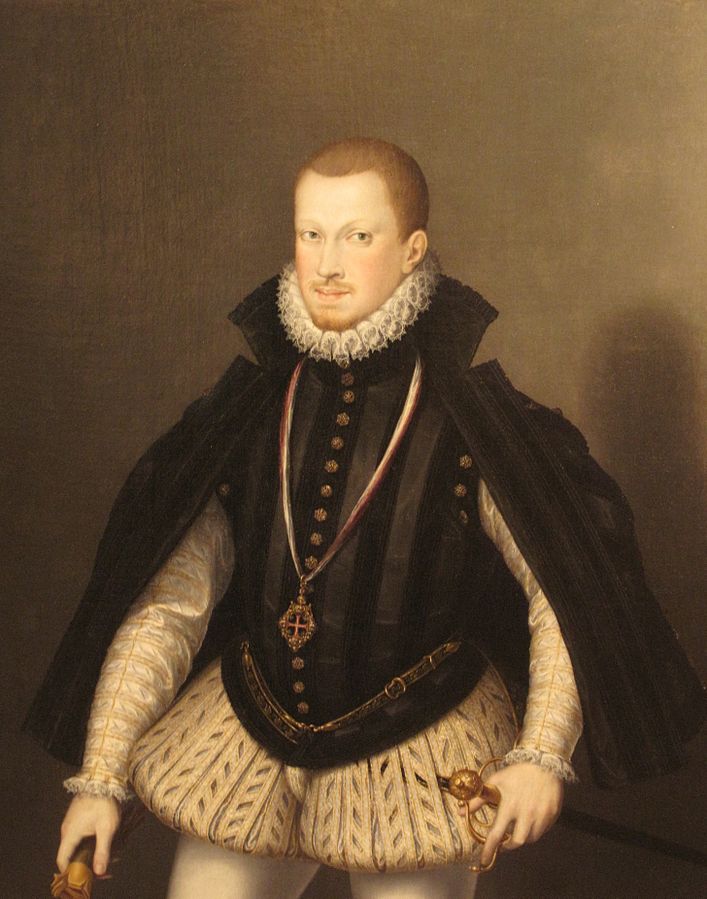
King Dom Sebastião I of Portugal

John’s successor, Sebastian, immediately set out on his ill-starred expedition to Africa (see PORTUGAL), and he insisted that Thomas should accompany the forces. The holy Hermit laboured among the soldiery with his accustomed zeal until wounded and taken captive at Alcacer, 1578. A Mohammedan monk became his master and, first by kindness then by torture, strove to secure his perversion. Into the dungeon where he was confined a faint gleam penetrated for a short period at midday, and by that light, day after day, Thomas composed for the comfort of his fellow-prisoners his great work, Os trabalhos de Jesus, contemplations on the sufferings of Jesus, which have since proved the nourishment and edification of countless souls. The Portuguese ambassador, learning of his pitiable plight, rescued Thomas and placed him under the care of a Christian merchant. But he begged to be sent on at once to Sagena, where some two thousand of the poorest captives were detained. There he commenced an apostolate which was soon blessed with marvellous fruit; the jail seemed transformed into a monastery, numbers were saved from apostasy or reconciled, and several of his penitents suffered a glorious martyrdom. Meanwhile vigorous efforts were being made to procure his complete liberation, but Thomas declared that, captive or free, he would remain to the end in the service of the Christian slaves of the Moors. His enfeebled frame at last succumbed to the combined effects of his sufferings, toils, and austerities. He spent his dying breath in reassuring some poor Christians on the point of apostasy that their ransom would arrive by a certain date if they persevered, as indeed it did.

Since early in the eighteenth century there have been several English editions of Thomas’s famous work on the Passion, but the last complete version has long been out of print.

For biography see Introduction to Sufferings of Jesus (tr., London, 1863). For interesting and complete account of various English versions of Os trabalhos de Jesus see PRESTAGE in Boletim da segunda classe: Academia das Sciencias de Lisboa, IV, No. 1 (Lisbon, 1911).

Vincent Scully (Catholic Encyclopedia)

{ 0 comments }

Maximilian I

Duke of Bavaria, 1598-1622, Elector of Bavaria and Lord High Steward of the Holy Roman Empire, 1623-1651; born at Munich, 17 April, 1573; died at Ingolstadt, 27 September, 1651.

The lasting services he rendered his country and the Catholic Church justly entitle him to the surname of “Great”. He was the son of zealous Catholic parents, William V, the Pious, of Bavaria, and Renate of Lorraine.

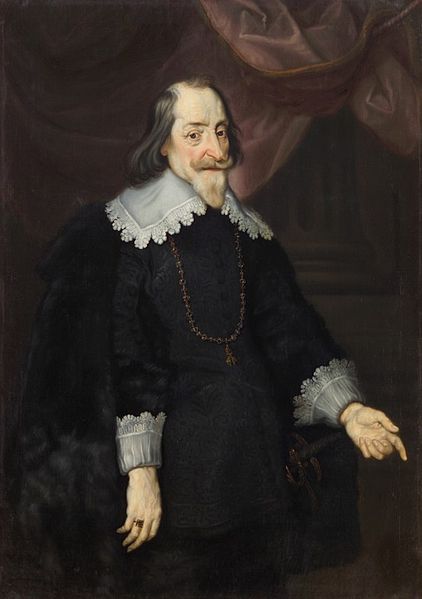
Maximilian I, painting by Joachim von Sandrart

Maximilian I, painting by Joachim von Sandrart

Mentally well endowed, Maximilian received a strict Catholic training from private tutors and later (1587-91) studied law, history, and mathematics at the University of Ingolstadt. He further increased his knowledge by visits to foreign courts, as Prague and Naples, and to places of pilgrimage including Rome, Loretto, and Einsiedeln. Thus equipped Maximilian assumed (15 Oct., 1597) the government of the small, thinly populated country at his father’s wish during the latter’s lifetime.

Owing to the over-lenient rule of the two preceding rulers the land was burdened with a heavy debt. By curtailing expenditure and enlarging the revenues, chiefly by working the salt-mines himself and by increasing the taxes without regard to the complaints of the powerless estates, the finances were not only brought into a better condition, but it was also possible to collect a reserve fund which, in spite of the unusually difficult conditions of the age, was never quite exhausted. At the same time internal order was maintained by a series of laws issued in 1616.

Maximilian gave great attention to military matters. No other German prince of that time possessed an army so well organized and equipped. Its commander was the veteran soldier from the Netherlands Johann Tserclaes, Count of Tilly, who, austere himself, knew how to maintain discipline among his troops. The fortifications at Ingolstadt on the Danube were greatly strengthened, and Munich and other towns were surrounded by walls and moats. Well-filled arsenals were established in different places as preparation for time of need. Opportunity for the use of this armament soon offered itself.

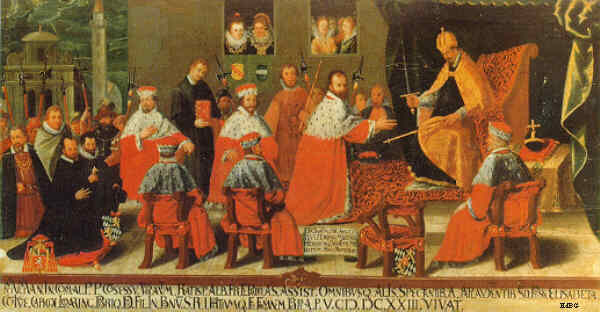
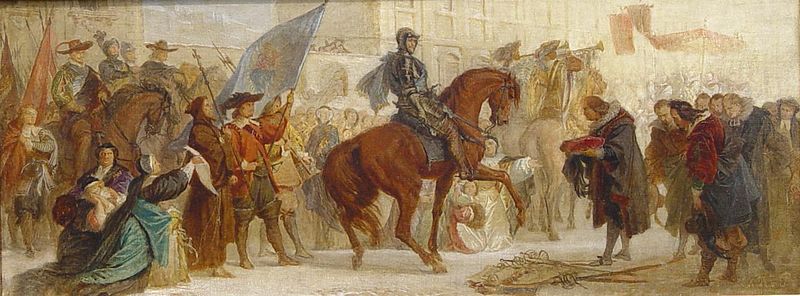
Presentation of the Electorate of Duke Maximilian I of Bavaria at the Regensburg Princes 1623

Presentation of the Electorate of Duke Maximilian I of Bavaria at the Regensburg Princes 1623

The small free city of Donauwörth fell under the imperial ban for violating the religious peace. In executing the imperial decree Maximilian not only succeeded in bringing this city into subjection to Bavaria but also in re-establishing the Catholic Church as the one and only religion in it. This led to the forming (1608) of the Protestant Union, an offensive and defensive confederation of Protestant princes, in opposition to which arose in 1609 the Catholic League organized by Maximilian. Oddly enough, both coalitions were headed by princes of the Wittelsbach line: Maximilian I as head of the League, Frederick IV of the Palatinate, of the Union.

The Thirty Years’ War, during which Bavaria suffered terribly, broke out in 1619. Under Tilly’s leadership the Bohemian revolt was crushed at the battle of the White Mountain (Weissen Berg) near Prague, 8 November, 1620, and the newly elected King of Bohemia, Frederick V, forced to flee. His allies, the Margrave of Baden and the Duke of Brunswick, were defeated by the forces of Bavaria and the League at Wimpfen and Hochst (1622), as was also at a later date (1626) King Christian of Denmark.

Conditions, however, changed when Maximilian, through jealousy of the House of Hapsburg, was led in 1630 to seek the dismissal of the head of the imperial army, Wallenstein. The youthful Swedish king, Gustavus Adolphus, defeated Tilly, the veteran leader of the army of the League at Breitenfeld (1631), and in a battle with Gustavus Adolphus near the Lech, 16 April, 1632, Tilly was again vanquished, receiving a wound from which he died two weeks later at Ingolstadt. Although the siege of this city by the Swedes was unsuccessful, Gustavus plundered the Bavarian towns and villages, laid waste the country and pillaged Munich.

Duke Maximilian I in Prague after the victory on the White Mountain in 1620

Duke Maximilian I in Prague after the victory on the White Mountain in 1620

Maximilian, who since 1623 had been both Elector and ruler of the Upper Palatinate, implored Wallenstein, now once more the head of the imperial forces, for help in vain until he agreed to place himself and his army under Wallenstein’s command. The united forces under Wallenstein took up an entrenched position near Nuremberg where Wallenstein repulsed the Swedish attacks; by advancing towards Saxony he even forced them to evacuate Maximilian’s territories. The relief to Bavaria, however, was not of long duration. After the death of Gustavus Adolphus at the battle of Lützen (1632) Bernhard of Weimar, unmolested by Wallenstein, ravaged Bavaria until he received a crushing defeat at the battle of Nordlingen (6 Sept., 1634). Even in the last ten years of the war the Subscriptioncountry was not spared from hostile attacks. Consequently Maximilian sought by means of a truce with the enemy (1647) to gain for Bavaria an opportunity to recover. The desired result, however, not being attained, he united his forces to those of the imperial army, but the allied troops were not sufficient to overthrow the confederated French and Swedes, and the country once more suffered all the terrors of a pitiless invasion. The fighting ended with the capture of the Swedish generals, 6 Oct., 1648, and the Peace of Westphalia was signed at Munster, 24 Oct. of the same year.

The material benefits derived by Maximilian from his attitude in politics were meagre: the Electoral dignity, the office of Lord High Steward, and the Upper Palatinate. The abstract gains, on the other hand, appear far greater. Not only since then has Bavaria had the second place among the Catholic principalities of Germany, ranking next to Austria, but for centuries a strong bulwark was opposed to the advance of Protestantism, and the latter was, at times, even driven back. A few years after the Peace of Westphalia and eighteen months after the administration of Bavaria had been transferred to his still minor son Ferdinand Maria, Maximilian’s eventful and troublesome life closed. He was buried in the church of St. Michael at Munich. A fine equestrian statue, designed by Thorwaldsen and cast by Stiglmayer, was erected at Munich by King Louis I in 1839.

Although there was almost incessant war during his reign, and Bavaria in the middle of the seventeenth century was like a desert, nevertheless Maximilian did much for the arts, e.g. by building the palace, the Mariensäule (Mary Column), etc. Learning also, especially at the University of Ingolstadt, had in this era distinguished representatives. The Jesuit Balde was a brilliant writer both of Latin and German verse and Father Scheiner, another member of the same order, was the first to discover the spots on the sun; historians also, such as Heinrich Canisius, Matthias Rader, etc., produced important works of lasting merit.

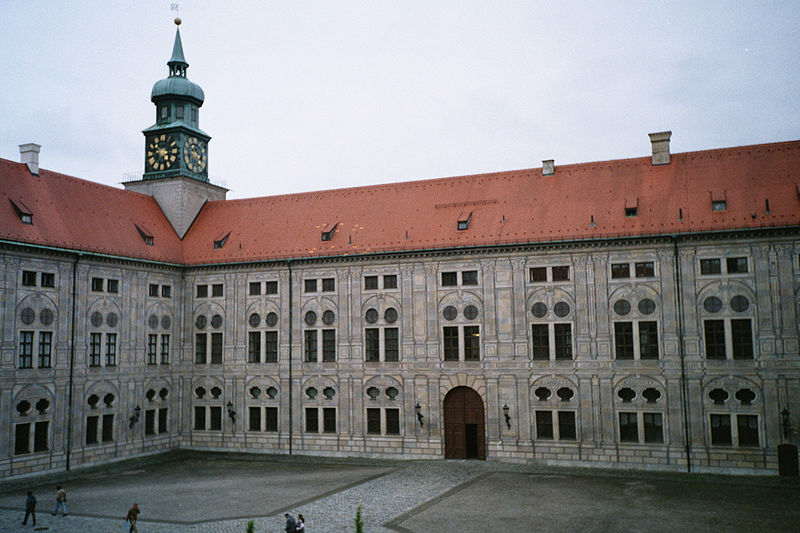
Emperor's Courtyard, Residenz Munich

Emperor’s Courtyard, Residenz Munich

Maximilian, however, gave for more attention to the advancement of religion among the people than to art and learning. He founded five Jesuit colleges: Amberg, Burghausen, Landshut, Mindelheim, and Straubing. Besides establishing a monastery for the Minims and one for the Carmelites at Munich, he founded nine monasteries for Franciscans and fourteen for Capuchins who venerate him as one of their greatest benefactors. He also founded at Munich a home for aged and infirm Court officials, and gave 30,000 guldens for the Chinese missions, as well as large sums to the Scotch-English college of the Jesuits at Liège. His private charities among the poor and needy of all descriptions were unlimited.

Maximilian was endowed with an uncommon ability for work. He was also sincerely religious and rigidly moral in conduct; he even went beyond the permissible in his efforts to uphold and spread the faith. Maintaining like all princes of his time the axiom “Cujus regio ejus religio”, he not only put down every movement in opposition to the Church in his country but also exterminated Calvinism and Lutheranism root and branch in the territories he had acquired. Where admonition and instruction were not sufficient the soldier stepped in, and the poor people, who had already been obliged to change their faith several times with change of ruler, had now no choice but return to the Church or exile. Maximilian, in addition, never lost sight of secular advantage, as is shown by his numerous acquisitions of territory. Especially valuable was the purchase of two-thirds of the countship of Helfenstein, now a part of Wurtemberg, which as a Bavarian dependence was preserved to the Church and has remained Catholic up to the present time, notwithstanding its Protestant surroundings. Maximilian was twice married. The first marriage was childless. By his second wife Maria, daughter of the Emperor Ferdinand II, whom he married 15 July, 1635, he had two sons; the elder of these, Ferdinand Maria, as already mentioned, succeeded him.

STIEVE, Maximilian I in Allgem. Deutsche Biog., XXI (1885)21 sq., gives bibliography before 1885; cf. the statements in DOBERL, Entwicklungsgeschichte Bayerns, I (2nd ed., 1908).—HAGL, Die Bekehrung der Oberpfalz (2 vols., 1903); RABEL, Das ehemaliga Benediktiner-Adelstift Weissenohe in Jahrb. des Hist. Vereins Bomberg (1908).—For the founding of monasteries by Maximilian: EBERL, Gesch. d. bay. Kapuzinerodensprovinz 1593-1902 (1902).—DEUTINGER, Beitrage zur Geschichte des Erzbisthums Munchen-Freising, New Series, I (1901).—LAVISSE-RAMBAUD, Histoire generale, V, 508 sqq.; HIMLY, Hist. de la formation territoriale des etats de l’Europe centrale, II (1876), 164 sqq.; CORREARD, Precis d’histoire moderne et contemporaine, 36 sqq.

PIUS WITTMANN (Catholic Encyclopedia)

Short Stories on Honor, Chivalry, and the World of Nobility—no. 377

{ 0 comments }

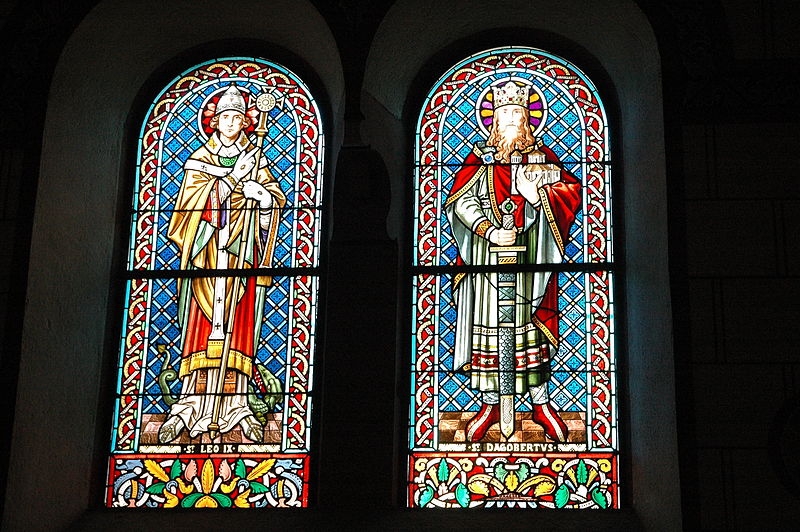
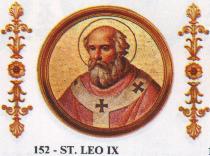
Pope St. Leo IX

Pope St. Leo IX

Pope St. Leo IX

Pope St. Leo IX earnestly spread the Cluny reform

Born at Egisheim, near Colmar, on the borders of Alsace, 21 June, 1002, Pope St. Leo IX died on 19 April, 1054. He belonged to a noble family which had given or was to give saints to the Church and rulers to the Empire. He was named Bruno. His father Hugh was first cousin to Emperor Conrad, and both Hugh and his wife Heilewide were remarkable for their piety and learning.

When five years of age, he was committed to the care of the energetic Berthold, Bishop of Toul, who had a school for the sons of the nobility. Intelligent, graceful in body, and gracious in disposition, Bruno was a favorite with his schoolfellows. Whilst still a youth and at home for his holidays, he was attacked when asleep by some animal, and so much injured that for some time he lay between life and death. In that condition he saw, as he used afterwards to tell his friends, a vision of St. Benedict, who cured him by touching his wounds with a cross. This we are told by Leo’s principal biographer, Wibert, who was his intimate friend when the saint was Bishop of Toul.

Bruno became a canon of St. Stephen’s at Toul (1017), and though still quite young exerted a soothing influence on Herimann, the choleric successor of Bishop Berthold. When, in 1024, Conrad, Bruno’s cousin, succeeded the Emperor Henry I, the saint’s relatives sent him to the new king’s court “to serve in his chapel”. His virtue soon made itself felt, and his companions, to distinguish him from others who bore the same name, always spoke of him as “the good Bruno”.
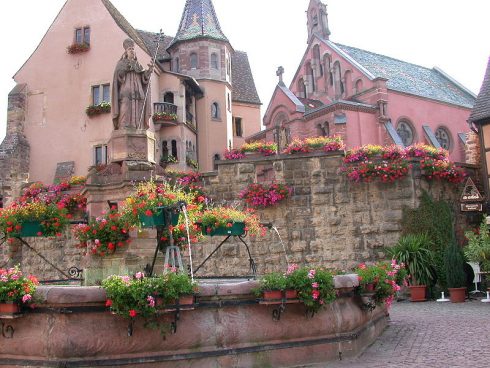
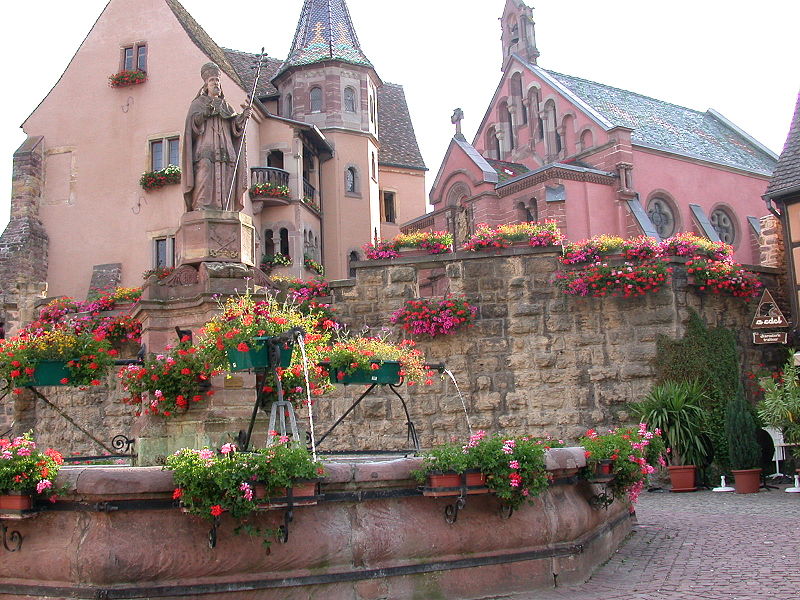
Castle of the Counts of Eguisheim - birthplace of Pope St. Leo IX photo by Mschlindwein

Castle of the Counts of Eguisheim – birthplace of Pope St. Leo IX photo by Mschlindwein

In 1026 Conrad set out for Italy to make his authority respected in that portion of his dominions, and as Herimann, Bishop of Toul, was too old to lead his contingent into the peninsula, he entrusted the command of it to Bruno, then a deacon. There is reason to believe that this novel occupation was not altogether uncongenial to him, for soldiers seem always to have had an attraction for him.

While he was thus in the midst of arms, Bishop Herimann died and Bruno was at once elected to succeed him. Conrad, who destined him for higher things, was loath to allow him to accept that insignificant see. But Bruno, who was wholly disinclined for the higher things, and wished to live in as much obscurity as possible, induced his sovereign to permit him to take the see. Consecrated in 1027, Bruno administered the Diocese of Toul for over twenty years, in a season of stress and trouble of all kinds.

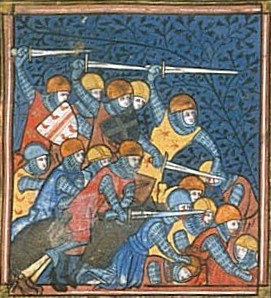
He had to contend not merely with famine, but also with war, to which as a frontier town Toul was much exposed. Bruno, however, was equal to his position. He knew how to make peace, and, if necessary, to wield the sword in self-defense.
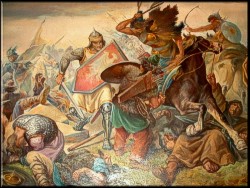
Great Battle, by Grizzli

Great Battle, by Grizzli

Sent by Conrad to Robert the Pious, he established so firm a peace between France and the empire that it was not again broken even during the reigns of the sons of both Conrad and Robert. On the other hand, he held his episcopal city against Eudes, Count of Blois, a rebel against Conrad, and “by his wisdom and exertions” added Burgundy to the empire. It was whilst he was bishop that he was saddened by the death not merely of his father and mother, but also of two of his brothers. Amid his trials Bruno found some consolation in music, in which he proved himself very efficient.

The German Pope Damasus II died in 1048, and the Romans sent to ask Henry III, Conrad’s successor, to let them have as the new pope either Halinard, Archbishop of Lyons, or Bruno. Both of them were favorably known to the Romans by what they had seen of them when they came to Rome on pilgrimage. Henry at once fixed upon Bruno, who did all he could to avoid the honor which his sovereign wished to impose upon him. When at length he was overcome by the combined importunities of the emperor, the Germans, and the Romans, he agreed to go to Rome, and to accept the papacy if freely elected thereto by the Roman people. He wished, at least, to rescue the See of Peter from its servitude to the German emperors. When, in company with Hildebrand he reached Rome, and presented himself to its people clad in pilgrim’s guise and barefooted, but still tall, and fair to look upon, they cried out with one voice that him and no other would they have as pope. Assuming the name of Leo, he was solemnly enthroned 12 February, 1049. Before Leo could do anything in the matter of the reform of the Church on which his heart was set, he had first to put down another attempt on the part of the ex-Pope Benedict IX to seize the papal throne. He had then to attend to money matters, as the papal finances were in a deplorable condition. To better them he put them in the hands of Hildebrand, a man capable of improving anything.
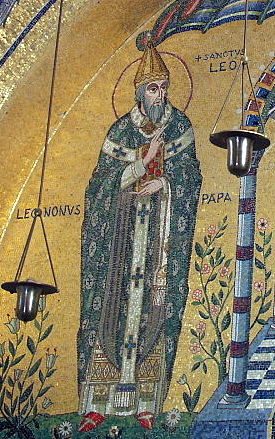
Pope St. Leo IX then began the work of reform which was to give the next hundred years a character of their own

Pope St. Leo IX then began the work of reform which was to give the next hundred years a character of their own

He then began the work of reform which was to give the next hundred years a character of their own, and which his great successor Gregory VII was to carry so far forward. In April, 1049, he held a synod at which he condemned the two notorious evils of the day, simony and clerical incontinence. Then he commenced those journeys throughout Europe in the cause of a reformation of manners which gave him a pre- eminent right to be styled Peregrinus Apostolicus. Leaving Rome in May, he held a council of reform at Pavia, and pushed on through Germany to Cologne, where he joined the Emperor Henry III. In union with him he brought about peace in Lorraine by excommunicating the rebel Godfrey the Bearded. Despite the jealous efforts of King Henry I to prevent him from coming to France, Leo next proceeded to Reims, where he held an important synod, at which both bishops and abbots from England assisted. There also assembled in the city to see the famous pope an enormous number of enthusiastic people, “Spaniards, Bretons, Franks, Irish, and English”. Besides excommunicating the Archbishop of Compostela (because he had ventured to assume the title of Apostolicus, reserved to the pope alone), and forbidding marriage between William (afterwards called the Conqueror) and Matilda of Flanders, the assembly issued many decrees of reform. On his way back to Rome Leo held another synod at Mainz, everywhere rousing public opinion against the great evils of the time as he went along, and everywhere being received with unbounded enthusiasm.
Subscription14.1In January, 1050, Leo returned to Rome, only to leave it again almost immediately for Southern Italy, whither the sufferings of its people called him. They were being heavily oppressed by the Normans. To the expostulations of Leo the wily Normans replied with promises, and when the pope, after holding a council at Spoleto, returned to Rome, they continued their oppressions as before. At the usual paschal synod which Leo was in the habit of holding at Rome, the heresy of Berengarius of Tours was condemned-a condemnation repeated by the pope a few months later at Vercelli. Before the year 1050 had come to a close, Leo had begun his second transalpine journey. He went first to Toul, in order solemnly to translate the relics of Gerard, bishop of that city, whom he had just canonized, and then to Germany to interview the Emperor Henry the Black. One of the results of this meeting was that Hunfrid, Archbishop of Ravenna, was compelled by the emperor to cease acting as though he were the independent ruler of Ravenna and its district, and to submit to the pope. Returning to Rome, Leo held another of his paschal synods in April, 1051, and in July went to take possession of Benevento. Harassed by their enemies, the Beneventans concluded that their only hope of peace was to submit themselves to the authority of the pope. This they did, and received Leo into their city with the greatest honor. While in this vicinity, Leo again made further efforts to lessen the excesses of the Normans, but they were crippled by the native Lombards, who with as much folly as wickedness massacred a number of the Normans in Apulia. Realizing that nothing could then be done with the irate Norman survivors, Leo retraced his steps to Rome (1051).
Pope Leo raised what forces he could among the Italian princes and declared war on the Normans

Pope Leo raised what forces he could among the Italian princes and declared war on the Normans

The Norman question was henceforth ever present to the pope’s mind. Constantly oppressed by the Normans, the people of Southern Italy ceased not to implore the pope to come and help them. The Greeks, fearful of being expelled from the peninsula altogether, begged Leo to co-operate with them against the common foe. Thus urged, Leo sought assistance on all sides. Failing to obtain it, he again tried the effect of personal mediation (1052). But again failure attended his efforts. He began to be convinced that appeal would have to be made to the sword. At this juncture an embassy arrived from the Hungarians, entreating him to come and make peace between them and the emperor. Again Leo crossed the Alps, but, thinking he was sure of success, Henry would not accept the terms proposed by the pope, with the result that his expedition against the Hungarians proved a failure. And though he at first undertook to let Leo have a German force to act against the Normans, he afterwards withdrew his promise, and the pope had to return to Italy with only a few German troops raised by his relatives (1053). In March, 1053, Leo was back in Rome. Finding the state of affairs in Southern Italy worse than ever, he raised what forces he could among the Italian princes, and, declaring war on the Normans, tried to effect a junction with the Greek general. But the Normans defeated first the Greeks and then the pope at Civitella (June, 1053). After the battle Leo gave himself up to his conquerors, who treated him with the utmost respect and consideration, and professed themselves his soldiers.

Though he gained more by defeat than he could have gained by victory, Leo betook himself to Benevento, a broken-hearted man. After the battle of Civitella Leo never recovered his spirits. Seized at length with a mortal illness, he caused himself to be carried to Rome (March, 1054), where he died a most edifying death. He was buried in St. Peter’s, was a worker of miracles both in life and in death, and found a place in the Roman Martyrology.

WIBERT and other contemporary biographers of the saint in WATTERICH, Pont. Rom. Vitæ, I (Leipzig, 1862); P. L., CXLIII, etc.; ANSELM OF REIMS, ibid., CXLII; LIBUIN in WATTERICH and in P. L., CXLIII; see also BONIZO OF SUTRI; ST. PETER DAMIAN, LANFRANC, and other contemporaries of the saint. His letters are to be found in P. L., CXLIII; cf. DELARC, Un pape Alsacien (Paris, 1876); BRUCKER, l’Alsace et l’é au temps du pape S. Léon (Paris, 1889); MARTIN, S. Léon IX (Paris, 1904); BRÉHIER, Le Schisme Oriental au XIe Siecle (Paris, 1899); FORTESCUE, The Orthodox Eastern Church (London, 1907), v; MANN, Lives of the Popes, VI (London, 1910).

HORACE K. MANN (Catholic Encyclopedia)
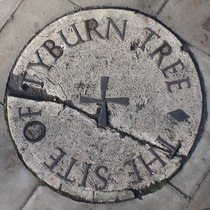
{ 0 comments }

St. Alphege

(or Elphege), Saint, born 954; died 1012; also called Godwine, martyred Archbishop of Canterbury, left his widowed mother and patrimony for the monastery of Deerhurst (Gloucestershire).

St. Alphege being asked for advice.

St. Alphege being asked for advice.

After some years as an anchorite at Bath, he there became abbot, and (19 Oct., 984) was made Bishop of Winchester. In 994 Elphege administered confirmation to Olaf of Norway at Andover, and it is suggested that his patriotic spirit inspired the decrees of the Council of Enham. In 1006, on becoming Archbishop of Canterbury, he went to Rome for the pallium. At this period England was much harassed by the Danes, who, towards the end of September, 1011, having sacked and burned Canterbury, made Elphege a prisoner.
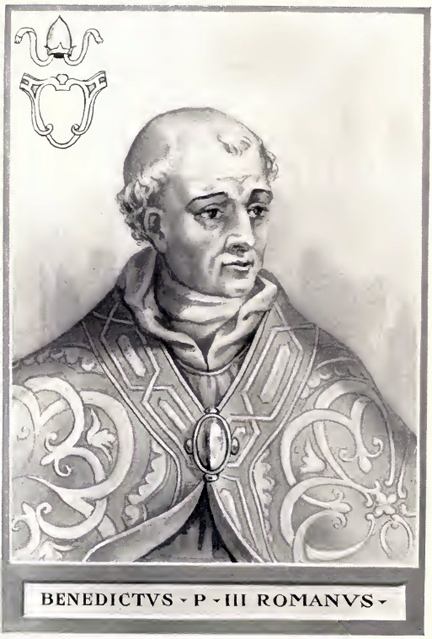
On 19 April, 1012, at Greenwich, his captors, drunk with wine, and enraged at ransom being refused, pelted Elphege with bones of oxen and stones, till one Thurm dispatched him with an axe. Elphege’s body, after resting eleven years in St. Paul’s (London), was translated by King Canute to Canterbury.

His principal feast is kept on the 19th of April; that of his translation on the 8th of June.

He is sometimes represented with an axe cleaving his skull.

Subscription4


Anglo-Saxon Chronicle, ed. PLUMMER (Oxford, 1892-99); THIETMAR, Chronicle, in P. L., CXXXIX, 1384; OSBERN, Vita S. Elphegi in WHARTON, Anglia Sacra, II, 122 sqq.; Acta SS., April, II, 630; Bibl. Hag. Lat., 377; CHEVALIER, Repertoire, I, 1313; FREEMAN, Norman Conquest, I, v; BUTLER, Lives of the Saints, 18 April; STANTON, Menology, 19 April; HUNT in Dict. Nat. Biogr., s. v. AElfheah.

PATRICK RYAN

{ 0 comments }

April 18 – St. Willigis

April 16, 2026

St. Willigis Archbishop of Mainz, d. 23 Feb., 1011. Feast, 23 February or 18 April. Though of humble birth he received a good education, and through the influence of Bishop Volkold of Meissen entered the service of Otto I, and after 971 figured as chancellor of Germany. Otto II in 975 made him Archbishop of […]

Read the full article →

April 18 – Blessed Marie de l’Incarnation

April 16, 2026

Bl. Marie de l’Incarnation Known also as Madame Acarie, foundress of the French Carmel, born in Paris, 1 February, 1566; died at Pontoise, April, 1618. By her family Barbara Avrillot belonged to the higher bourgeois society in Paris. Her father, Nicholas Avrillot was accountant general in the Chamber of Paris, and chancellor of Marguerite of […]

Read the full article →

April 13 – Pope St. Martin I

April 13, 2026

Pope St. Martin I Martyr, born at Todi on the Tiber, son of Fabricius; elected Pope at Rome, 21 July, 649, to succeed Theodore I; d at Cherson in the present peninsulas of Krym, 16 Sept., 655, after a reign of 6 years, one month and twenty six days, having ordained eleven priests, five deacons […]

Read the full article →

April 13 – This Prince Defied His Family

April 13, 2026

St. Hermengild Date of birth unknown; died 13 April, 585. Leovigild, the Arian King of the Visigoths (569-86), had two sons, Hermengild and Reccared, by his first marriage with the Catholic Princess Theodosia. Hermengild married, in 576, Ingundis, a Frankish Catholic princess, the daughter of Sigebert and Brunhilde. Led by his own inclination, and influenced […]

Read the full article →

April 13 – Henry James Coleridge

April 13, 2026

Henry James Coleridge A writer and preacher, b. 20 September 1822, in Devonshire, England; d. at Roehampton, 13 April 1893. He was the son of Sir John Taylor Coleridge, a Judge of the King’s Bench, and brother of John Duke, Lord Coleridge, Chief Justice of England. His grandfather, Captain James Coleridge, was brother to Samuel […]

Read the full article →

April 14 – Apostle of the Detroit Hurons

April 13, 2026

Jean Baptiste Marchand Second principal in order of succession of the Sulpician College of Montreal and missionary of the Detroit Hurons at Sandwich, Ont.; b. at Verchères, Que., 25 Feb. 1760, son of Louis Marchand and Marguerite de Niverville; d. at Sandwich, 14 Apr., 1825. Marchand was ordained 11 March, 1786, affiliated to the Sulpician […]

Read the full article →

April 14 – She suffered for the moral corruption and decay of her time

April 13, 2026

Saint Lydwine In 1380, Saint Lydwine was born in the small town of Schiedam in Holland. Her father was a wealthy noble named Peter, and her mother was from a poor family who worked their own farm. Her father’s family lost their fortune, and the whole family was reduced to poverty. At that time, all […]

Read the full article →

April 14 – St. Peter Gonzalez (aka St. Elmo)

April 13, 2026

St. Peter Gonzalez Popularly known as St. Elmo, b. in 1190 at Astorga, Spain; d. 15 April, 1246, at Tuy. He was educated by his uncle, Bishop of Astorga, who gave him when very young a canonry. Later he entered the Dominican Order and became a renowned preacher; crowds gathered to hear him and numberless […]

Read the full article →

April 15 – The Notkers of St. Gall

April 13, 2026

Notker.—Among the various monks of St. Gall who bore this name, the following are the most important: (1) Notker Balbulus (Stammerer), Blessed, monk and author, b. about 840, at Jonswil, canton of St. Gall (Switzerland); d. 912. Of a distinguished family, he received his education with Tuotilo, originator of tropes, at St. Gall’s, from Iso […]

Read the full article →

A Democratic Constitution Should Assume and Protect the Values of the Christian Faith, Without Which It Will Not Be Able to Survive

April 13, 2026

[previous] In view of the peculiar circumstances of our day, it is opportune to quote a judicious analysis of Joseph Cardinal Ratzinger, Prefect of the Congregation for the Doctrine of the Faith [Nobility.org: and presently, the Sovereign Pontiff, Pope Benedict XVI], in an interview to the newspaper El Mercurio of Santiago, Chile (June 12, 1988): […]

Read the full article →

A Requiem for Manners

April 9, 2026

by Stephen M. Klugewicz On April 9, 1865, General Robert E. Lee met General Ulysses S. Grant at the McLean House in Appomattox, Virginia, for the purpose of surrendering the Army of Northern Virginia. Lee had asked for the meeting and had prepared by putting on his finest uniform: a new, long dress coat with […]

Read the full article →

April 9 – She persuaded her husband the Count to become a monk

April 9, 2026

St. Waudru She was daughter to the princess St. Bertille, elder sister to St. Aldegondes, and wife to Madelgaire, count of Hainault, and one of the principal lords of King Dagobert’s court. After bearing him two sons and two daughters, she induced him to embrace the monastic state at Haumont, near Maubeuge, taking the name […]

Read the full article →

April 9 – Mary of Cleophas

April 9, 2026

Mary of Cleophas This title occurs only in John, xix, 25. A comparison of the lists of those who stood at the foot of the cross would seem to identify her with Mary, the mother of James the Less and Joseph ( Mark, xv, 40; cf. Matt., xxvii, 56). Some have indeed tried to identify […]

Read the full article →

April 10 – Friend of Cluny

April 9, 2026

St. Fulbert of Chartres Bishop, born between 952 and 962; died 10 April, 1028 or 1029. Mabillon and others think that he was born in Italy, probably at Rome; but Pfister, his latest biographer, designates as his birthplace the Diocese of Laudun in the present department of Gard in France. He was of humble parentage […]

Read the full article →

April 10 – Pope Gregory XIII

April 9, 2026

Pope Gregory XIII (UGO BUONCOMPAGNI). Born at Bologna, 7 Jan., 1502; died at Rome, 10 April, 1585. He studied jurisprudence at the University of Bologna, from which he was graduated at an early age as doctor of canon and of civil law. Later, he taught jurisprudence at the same university, and had among his pupils […]

Read the full article →

April 11 – His donations helped build the first California missions

April 9, 2026

Juan Caballero y Ocio Born at Querétaro, Mexico, 4 May, 1644; died there 11 April, 1707. A priest remarkable for lavish gifts to the Church and for charity. While still a layman he was a mayor of his native city. After taking Holy Orders he held several high offices. He gave large sums of money […]

Read the full article →

April 11 – Antonio Ruiz de Montoya

April 9, 2026

Antonio Ruiz de Montoya One of the most distinguished pioneers of the original Jesuit mission in Paraguay, and a remarkable linguist; b. at Lima Peru, on 13 June, 1585, d. there 11 April, 1652. After a youth full of wild and daring pranks and adventures he entered the Society of Jesus on 1 November, 1606. […]

Read the full article →

April 11 – American Hero of the Seal of Confession

April 9, 2026

Antony Kohlmann Educator and missionary, b. 13 July, 1771, at Kaiserberg, Alsace; d. at Rome, 11 April, 1836. He is to be ranked among the lights of the restored Society of Jesus, and among its most distinguished members in America, where he spent nearly a quarter of a century of his laborious life. At an […]

Read the full article →

April 12 – Crusader in every sense of the word

April 9, 2026

Bl. Angelo Carletti di Chivasso Moral theologian of the order of Friars Minor; born at Chivasso in Piedmont, in 1411; and died at Coni, in Piedmont, in 1495. From his tenderest years the Blessed Angelo was remarkable for the holiness and purity of his life. He attended the University of Bologna, where he received the […]

Read the full article →

April 12 – St. Teresa of the Andes

April 9, 2026

Saint Teresa of the Andes, O.C.D. (July 13, 1900 – April 12, 1920), also known as Saint Teresa of Jesus of the Andes (Spanish: Teresa de Jesús de los Andes), was a Chilean nun of the Discalced Carmelite order. She was born Juana Enriqueta Josefina de los Sagrados Corazones Fernández y Solar in Santiago, Chile […]

Read the full article →

April 6 – With his head split open, he wrote on the ground with his own blood: “Credo”

April 6, 2026

St. Peter of Verona Born at Verona, 1206; died near Milan, 6 April, 1252. His parents were adherents of the Manichæan heresy, which still survived in northern Italy in the thirteenth century. Sent to a Catholic school, and later to the University of Bologna, he there met St. Dominic, and entered the Order of the […]

Read the full article →

April 6 – Richard the Lionheart

April 6, 2026

Richard I, King Of England Born at Oxford, 6 Sept, 1157; died at Chaluz, France, 6 April, 1199; was known to the minstrels of a later age, rather than to his contemporaries, as “Coeur-de-Lion”. He was only the second son of Henry II, but it was part of his father’s policy, holding, as he did, […]

Read the full article →

April 6 – Thomas Bourchier

April 6, 2026

Thomas Bourchier Born 1406; died 1486, Cardinal, was the third son of William Bourchier, Earl of Eu, and of Lady Anne Plantagenet, a daughter of Thomas of Woodstock, Duke of Gloucester, youngest son of Edward III. At an early age he entered the University of Oxford, and in due course, embracing a clerical career, was […]

Read the full article →

April 6 – Pope St. Sixtus I

April 6, 2026

Pope St. Sixtus I (in the oldest documents, Xystus is the spelling used for the first three popes of that name), succeeded St. Alexander and was followed by St. Telesphorus. According to the “Liberian Catalogue” of popes, he ruled the Church during the reign of Adrian “a conulatu Nigri et Aproniani usque Vero III et […]

Read the full article →

April 7 – St. Brenach

April 6, 2026

An Irish missionary in Wales, a contemporary of St. Patrick, and among the earliest of the Irish saints who laboured among the Celts of that country. About the year 418 he travelled to Rome and Brittany, and thence to Milford Haven. He erected various oratories near the rivers Cleddau, Gwain, and Caman, and at the […]

Read the full article →

April 7 – Ven. Henry Walpole

April 6, 2026

English Jesuit martyr, born at Docking, Norfolk, 1558; martyred at York, 7 April, 1595. He was the eldest son of Christopher Walpole, by Margery, heiress of Richard Beckham of Narford, and was educated at Norwich School, Peterhouse, Cambridge, and Gray’s Inn. Converted by the death of Blessed Edward Campion, he went by way of Rouen […]

Read the full article →

A crusade is needed, for external and internal reasons

April 6, 2026

By Plinio Corrêa de Oliveira Pius XII has a document in which he says that if he wanted, he would be entitled to call a crusade against communism; but he thought that for a number of reasons it was not the case to do it. As far as we are concerned, the greater the risk […]

Read the full article →

April 8 – Don Bosco’s Prince; nobility of blood joins nobility of spirit

April 6, 2026

Augusto Czartoryski was born on 2 August 1858 in Paris, France, the firstborn son to Prince Ladislaus of Poland and Princess Maria Amparo, daughter of the Queen of Spain. The noble Czartoryski Family had been living in exile in France for almost 30 years, in the Lambert Palace. Here, with the hope of restoring unity […]

Read the full article →

April 8 – Together with a noble who escaped the Terror, she founded the Sisters of Notre Dame

April 6, 2026

St. Julie Billiart (Also Julia). Foundress, and first superior-general of the Congregation of the Sisters of Notre Dame of Namur, born 12 July, 1751, at Cuvilly, a village of Picardy, in the Diocese of Beauvais and the Department of Oise, France; died 8 April, 1816, at the motherhouse of her institute, Namur, Belgium. She was […]

Read the full article →

April 2 – St. Francis of Paola and the Bartlett Pear

April 2, 2026

The Bartlett pear is called “The Good Christian” in France, after St. Francis of Paola introduced it ‘poire bon chretien’ (good Christian pear) “Said to have originated in Calabria in southern Italy, Bartletts probably were introduced to France by St. Francis of Paola. St. Francis brought a young tree as a gift for King Louis […]

Read the full article →

King Stanislaus and Lent

April 2, 2026

King Stanislaus of Poland was a faithful observer of the ancient discipline of the Church; he made but one meal in Lent, not even allowing himself the collation; moreover, on Fridays he denied himself the use of fish and eggs. From his dinner on Holy Thursday, till the following Saturday, at noon, he denied himself […]

Read the full article →

On Holy Thursday, King Saint Ferdinand washes the feet of twelve poor men

April 2, 2026

Lent passed, and Holy Week came. That year, the love of Christ inflamed the holy King’s heart more than ever. At times he would spend the whole night in contemplation of the sorrows that Our Lord suffered to redeem us; he slept so little that his nobles, worried, reached the point of telling him that […]

Read the full article →

Queen Mary washes the feet of the poor on Maundy Thursday

April 2, 2026

… and on Holy Thursday, at 3 o’clock in the afternoon, the most Serene Queen performed the ceremony of feet-washing, thus – Her Majesty being accompanied by the Right Reverend Legate and by the Council, entered a large hall, at the head of which was my Lord Bishop of Ely as Dean (come Decano) of […]

Read the full article →

For Contrast: Two Royal Attitudes to Washing the Feet of the Poor

April 2, 2026

In February, he returned to Castile, arriving in time to observe Holy Week at San Lorenzo, and to wash the feet of the poor on Holy Thursday “with his usual great tenderness and humility.” On Good Friday he adored the wood of the True Cross and pardoned several men who had been condemned to death, […]

Read the full article →

Emperor serves the table of the poor and washes their feet in imitation of Christ

April 2, 2026

In 1850, Franz Joseph participated…as emperor in the second of the traditional Habsburg expressions of dynastic piety: the Holy Thursday foot-washing ceremony, part of the four-day court observance of Easter. The master of the staff and the court prelates chose twelve poor elderly men, transported them to the Hofburg, and positioned them in the ceremonial […]

Read the full article →

Queen Mary Welcomes the Sick on Good Friday

April 2, 2026

On [Good] Friday morning the offertory was performed according to custom in the Church of the Franciscan Friars, which is contiguous to the palace. After the Passion, the Queen came down from her oratory for the adoration of the Cross, accompanied by my lord the right reverend Legate, and kneeling at a short distance from […]

Read the full article →

The Little Barrel

April 2, 2026

(from an old French medieval tale) Between Normandy and Brittany, next to the sea, in times of old there used to be a castle so strong and so well defended that it feared no king, prince or duke of any sort. The lord that possessed it was of great stature, beautiful bearing, rich and high […]

Read the full article →

Every year, on Good Friday

April 2, 2026

Baldwin the Second, Emperor of Constantinople, having come to France to solicit the king’s aid against the Greeks, who were besieging that imperial city, thought he would gain the heart of King Louis by making him a present of the Holy Crown of Thorns. He was not mistaken: the king assisted with money and troops, […]

Read the full article →

Easter in Imperial Russia: the Royal Doors

April 2, 2026

The time to arrive was about 11:30 p.m., when the great church, packed to its doors by a vast throng, was wrapped in almost total darkness…. As the eyes grew accustomed to the shadows, tens of thousands of unlighted candles, outlining the arches, cornices, and other architectural features of the cathedral, were just visible. These […]

Read the full article →

A king, a queen, and England’s Easter dilemma

April 2, 2026

When Finan died, leaving Bishop Coman—like himself, Irish by birth and a monk of Iona—as his successor at Lindisfarne, the dispute became at once open and general. Wilfrid had succeeded in sowing agitation and uncertainty in all minds; and the Northumbrians had come so far as to ask themselves whether the religion which had been […]

Read the full article →