Continued From Part One
First of all, to enforce such a situation is nearly impossible and would require dictatorial government power. Nevertheless, steps in its direction have been pushed on more than one occasion in America. In fact, bills promoting a 100% estate tax have been brought to the floor of the US House of Representatives for debate on more than one occasion. This would mean that when you die, everything you have goes to the state so that your children cannot benefit from what you have earned in your lifetime.
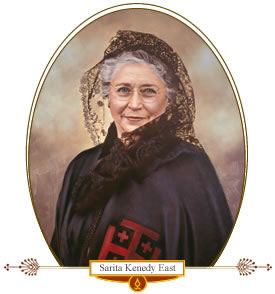
Sarita Kenedy East, 1889–1961. At the time of her husband and brother’s death, Sarita Kenedy East and her sister-in-law were in charge of 400,000-acre ranch in La Parra, Texas. In 1952 she received the Ecclesia et Pontifice medal and membership in the Ladies of the Holy Sepulchre of Jerusalem from Pope Pius XII for her service to the Church. She was also named an honorary member of the Franciscans and the Oblates of Mary Immaculate. She bequeathed La Parra ranch headquarters and 10,000 acres of land to the Oblate Fathers and 13,000 acres to the Diocese of Corpus Christi.
Right off the bat, I can think of two problems with this idea. The first is that it is unjust because it contradicts God’s designs for the family. The second is that it prevents the formation of true elites and thus encumbers much of the good that they are able to do for society.
Let’s look more closely at each of these issues. The first is that denying a privileged status to the children of an elite is fundamentally unjust. Why do I say this? At first glance, a meritocracy seems to be the height of justice, since each individual gets the benefits he personally deserves and nothing more.
However, this way of thinking profoundly denies the dynamics of the human family as God instituted it. If we look at nature, we see that most, if not all of the animals, do not constitute families in the way that humans do. For example, after a certain amount of time a mother dog no longer recognizes the scent of her pups. When this happens, she separates from them completely and they become just like any other dog to her.
We can see this same pattern with other animals as well. Once Snow Leopards, also known as ghost cats, reach maturity, they live completely solitary lives for the rest of their days, each one with a territory of at least 40 square miles where no other snow leopard is allowed outside of mating season.
Even those animals that form into packs or herds should be more likened symbolically to living in a society, but not a real family.
However, when God instituted the human family, He did so in such a way, that strong bonds are naturally formed between all its members that will last at least throughout this earthly life and perhaps persist into eternity as well. Unlike dogs, human mothers never stop recognizing their children.
Because of these bonds, one of the primary drives of the human family is to work for the well-being of all its members. I remember Dr. Plinio once said that the human family is the only institution wherein the divine precept of “love thy neighbor” is easy to practice.

Thus, it is not surprising that one of the primary desires of every good father is to leave his children in a better situation than the one in which he entered the world. In light of this, he has a right to dispose of his possessions during his life and after his death to make this desire a reality. To deny a father this right is the height of injustice.
We can see that it is also unjust if society does not favor the children of a father who has sacrificed himself for the common good of society, thus depriving his family of many goods they would have otherwise had. The greater the service the father has rendered and the more he sacrificed for this service, the more acute is the obligation of society towards his children and the greater the injustice if these benefits are withheld.
This obligation comes from the virtue of gratitude, whereby one owes retribution for the favors he has received. In fact, St. Thomas says that to truly practice the virtue of gratitude, one must give back more than he has received. He justifies this in the Summa, saying:
“Gratitude regards the favor received according the intention of the benefactor; who seems be deserving of praise, chiefly for having conferred the favor gratis without being bound to do so. Wherefore the beneficiary is under a moral obligation to bestow something gratis in return. Now he does not seem to bestow something gratis, unless he exceeds the quantity of the favor received: because so long as he repays less or an equivalent, he would seem to do nothing gratis, but only to return what he has received. Therefore gratitude always inclines, as far as possible, to pay back something more.” (Summa part 2 of part 2 question 106)
I know that is a little complicated, but the idea is that since the benefactor gave more than he was obliged to give, in giving back to him, we should follow his example and return to him more than what we are strictly obliged to give him.
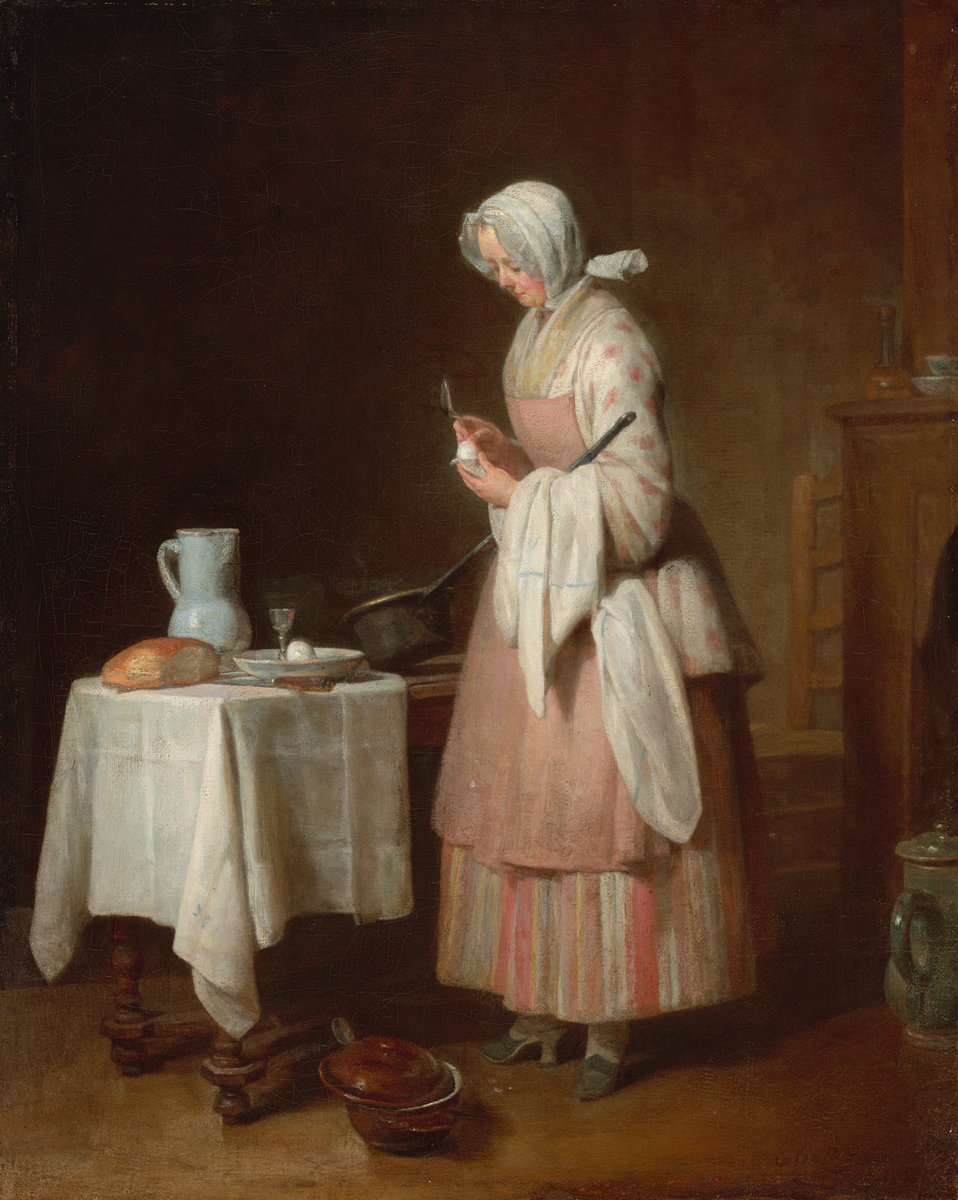
The Attentive Nurse by Jean-Baptiste-Siméon Chardin.
In justice, this gratitude must extend to the benefactor’s children as well, since they make up part of the indissoluble unit which is the family. Dr. Plinio once likened this to a dedicated nurse who devoted her life to care for a wealthy sick man. That man is obliged to give a proportional recompense to the nurse’s son for the services rendered to him. Since truly great men can be compared to the nurses of society, who maintain and even restore its health and vivacity, society owes a similar debt to his children.
So, we have seen that very strong bonds are formed between the members of a family. These bonds are so strong, they cause family members to identify with one another to an extraordinary degree. This is why they even share a last name. In addition to a name, many goods that the family has are, to a certain degree, shared by all of its members. In other words, there are certain goods of the family to which every member has a collective right.
One such good is the honors that are gained by any member of the family. In some way, these become collective property of the entire family. That is why if one of our father’s had won a Nobel prize, we would have a share in that honor as being the son of a Nobel laureate.
This is pretty obvious. What is especially noteworthy about this, is that this type of honor persists throughout generations. Ladies and Gentlemen, we have the honor of having His Imperial and Royal Highness, Prince Bertrand with us at this conference. The fact that His Highness is a direct descendant of St. Louis IX, together with several other saints and extraordinary men it should be added, is a personal distinction and honor for Prince Bertrand.
Similarly, but to a much lesser degree, if one of us were a descendant of George Washington or General Patton, that would be an honor for us which would be recognized even by the public. Just meeting a descendant of George Washington or General Patton would be something that would at least provide material for conversation.
This fact, that God intended the glory and honor of great men to pass on to their descendants is even biblical. In the book of Ecclesiasticus we read:
“Rich men in virtue, studying beautifulness: living at peace in their houses. All these have gained glory in their generations, and were praised in their days. They that were born of them have left a name behind them, that their praises might be related: … But these were men of mercy, whose godly deeds have not failed:
“Good things continue with their seed, Their posterity are a holy inheritance, and their seed hath stood in the covenants. And their children for their sakes remain forever: their seed and their glory shall not be forsaken.”
In this, we catch a beautiful glimpse at the mysterious bonds of heredity. A purely materialistic man would see in heredity nothing beyond the transmission of genes from one generation to the next. Such a notion is not Catholic because it denies the union of body and soul.

Bertrand of Orleans-Braganza, Prince Imperial of Brazil
While it is true that the qualities of a father do not always pass on to his son, most of the time they do. Just as there are many fools who have been born of wise men, it is undeniable that many social and even spiritual characteristics are transmitted throughout generations. In fact, this is the norm and when this does not happen, it is the exception. The fruit normally doesn’t fall far from the tree.

A Young man from a poor family triumphantly shows his diploma to his patroness.
F. Georg Waldmüller (1861). Belvedere Art Collections, Vienna, Austria.
This was observed by sociologist Paul Mott who wrote: “The most obvious fact about mobility in our society is that the son is very likely to have the same occupational position as his father, or to be one rank above or below him. Movement from one extreme of the occupational status to the other is very unlikely.”
A good example of this is a prominent French family of woodcutters called the Pinons. They were a family that produced the best woodcutters in France for centuries. In fact, they had been in the business of woodcutting for longer than France had been a nation, for when Rome conquered Gaul they had helped clear out the forest for the invasion.
As you can imagine, throughout the centuries, they acquired a lot of fame in the woodcutting industry. In fact, they became known as the best woodcutters in all of France. They became so renown that each year, the King of France would send a special birthday message to the family’s Patriarch.
One year, King Louis XIV decided that it was time to move this family up a notch in the social scale of France, so when he sent his yearly birthday greetings, he offered to grant the patriarch a noble title.
Very beautifully, Maitre Pinon turned him down and sent the king the following message. He said: “Thank you Your Majesty, but I must decline your generous offer, for I would rather be the greatest of the woodcutters in France than the least of her nobles.”
It’s a beautiful story, but for our purposes it proves the value of heredity. This family had consistently produced excellent woodcutters for some 1800 years. Ladies and Gentlemen, that is no coincidence. There was clearly something hereditary in the Pinons that was highly conducive to form excellence in their field.
Was it something genetic? Was it a special act of divine providence? Was it the action of a guardian angel of their family? Was it something in the way they raised their children? Was it in the water they drank? Or was it a combination of all this and more?
 I do not really know and I do not know if it is entirely knowable. However, we see this hereditary aspect alive in family lineages all throughout history. General MacArthur was the fifth generation of generals in his family. Similarly, Generals Robert E Lee and George Patton descended from a line of generals.
Prince Bertrand traces His royal lineage to Hugh Capet who was king of the Franks from 987-996. However, even Hugh’s father was a powerful duke who had descended from Charlemagne’s son Pepin. In other words, His Highness’ family has produced excellent leaders for well over a millennium. Once again, this is no coincidence.
In fact, this notion of heredity has led to innumerable dynasties throughout history. Hence, we see families of doctors, families of lawyers, families of soldiers and workmen. When this happens, these families tend to perfect their common profession is a special way.
Pope Pius XII spoke of the reality and importance of heredity in society in His Allocution to the Roman Patriciate and Nobility on January 5, 1941. This is a long quote, so you will have to bear with me a bit, but it is so beautiful that I did not want to cut anything out of it. His Holiness stated:
“The nature of this great and mysterious thing that is heredity – the passing on through a bloodline, perpetuated from generation to generation, of a rich ensemble of material and spiritual assets, the continuity of a single physical and moral type from father to son, the tradition that unites members of one same family across the centuries – the true nature of this heredity can undoubtedly be distorted by materialistic theories. But, one can, and must also, consider this reality enormously important in the fullness of its human and supernatural truth…
“Yet of greater import still is spiritual heredity, which is transmitted not so much through these mysterious bonds of material generation as by the permanent action of that privileged environment that is the family, with the slow and profound formation of souls in the atmosphere of a hearth rich in high intellectual, moral, and especially Christian traditions, with the mutual influence of those dwelling under one same roof, an influence whose beneficial effects endure well beyond the years of childhood and youth, all the way to the end of a long life, in those elect souls who are able to meld within themselves the treasures of a precious heredity with the addition of their own merits and experiences.
“Such is the most prized patrimony of all, which, illuminated by a solid faith and enlivened by a strong and loyal practice of Christian life in all its demands, will raise, refine, and enrich the souls of your children.”
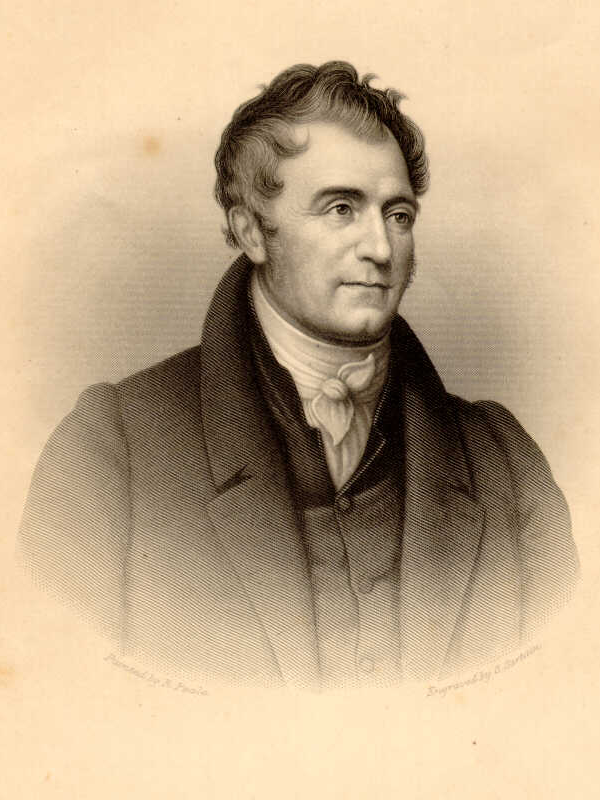
Eleuthère Irénée du Pont, founder of the du Pont business dynasty. The Du Ponts have been one of this country’s richest families since the mid-19th century, when they founded their fortune in the gunpowder business.
This then, is the first reason that meritocracy is erroneous. It is unjust because it denies the evident designs that God, in His Providence, has for the formation of lineages through heredity.
The other problem with meritocracy that we will be discussing is that it prevents the formation of true elites and thus bars the development of their role in society. To understand this, we must spend some time discussing what, exactly, is the role of elites in society.
One of the, or perhaps the greatest role that elites fulfill in society is to acquire and embody the greatest qualities of their people. They do this by developing the Catholic virtues to an eminent degree. Dr. Plinio lists the virtues in which the elites must especially shine. These include: honor, abnegation, courage, magnanimity, respect and honesty.
The elites must embody these virtues to a very high degree and then project them throughout society in their actions and ways of being. Thus, their role is to be a beacon and model of virtue that stands out and provides society with role models to be emulated.
In describing the aristocracy, the American Appendix to the book Nobility affirms that elites synthesize and augment everything good about their communities.
I quote: “In effect, every city or region has what could be called a collective personality or a “common soul” that, in a certain sense, is worth more than the collective sum of its individual personalities. This “common soul” is a synthesis of the perfections towards which its individuals, families, and classes tend. It is the collective product of their march towards perfection.
“The aristocrat best expresses this “common soul.” By elevating himself to a standard above the community, he becomes its embodiment. For this reason, he has the mission of representing its particular spirit. The superior task of the aristocrat is to conserve that spirit, elevate it, and make it progress. Thus his vocation is towards the common good.”
This is why the elite of society give definition to the best of what a people have to offer and, through their example and efforts, raise society to a higher level. They provide all society with an upward thrust. In the speech Dr. Plinio gave for the launching of the Nobility book in the United States, he described this role in the following words:
“To uplift mankind requires painful effort which most of humanity resists. This vast ascension must be accomplished on a national, regional and even family level. Its motivation are those individuals or small groups specially endowed in nature and grace, with such a desire to improve themselves and their surroundings, that they become the driving forces of individual improvement and social progress. In a word, they are the yeast, society the dough.”
Well, the formation of such a group of individuals is no easy task. In fact, it is so difficult that cannot occur in one generation. That sort of excellence is the product of generations of refinement of a family in which each successive generation has the substance to raise the family’s level one degree higher. Only after many generations of this ascensional march can the true elite appear in all his glory.
There is a common saying that you can take the boy out of the country, but you cannot take the country out of the boy. In fact, you can take the country out of the boy, it just takes many lifetimes to do it.
Again, we know this instinctively. Conversion works the same way. Individuals can convert from paganism to Catholicism and become wonderful people who personally can even become saints. However, the formation of a truly Catholic soul takes generations.

St. José de Anchieta preaching in Brazil.
There is a striking example of this in the life of St. Joseph of Anchieta, the great apostle of Brazil. One day, he came across an Indian woman he had converted. She was sitting alone in the city and was very downcast. Desirous to lift her mood, St. Joseph approached her and asked what was wrong. She responded that, while sitting there she became very hungry and was filled with the desire to grab one of the town’s children, cut off his arm and eat it. She now realized how wrong this was and so she was discouraged.
This was a good Catholic woman who was praying and frequenting the sacraments. While there was nothing sinful about her demented desire in itself, we can see that the savage roots of paganism went deep into her soul and these roots were not automatically extricated by the waters of Baptism. Being Catholic, her soul still needed a few centuries of Catholic culture before all the horrors of paganism would be weeded out. That is why it is said that a man’s education begins 500 years before he is born.
This, then, is the last problem with meritocracy that we will discuss. Since a meritocracy demands that everyone begins life with the same status, it makes the formation of true elites impossible, because the formation of a true elite takes generations of excellence and privilege. If one were to remove the privileged status of the children of great men, this slow refinement process would always be limited to a single generation and would never bear the fruits that are possible to it.
The last myth we will discuss is that elites may have had an important role in the past, but their time has come and gone. We live in the 21st Century and the type of society that is led by elites is simply no longer possible.
I would respond that one of the greatest things missing from our society is solid leadership. That is why true elites are timelier than ever. I once read a definition of aristocracy that I think says it all. It said aristocracy is leadership by the best. If there has ever been a time in the history of humanity in which we have needed the best among us to lead, it is now.
To Be Continued….



