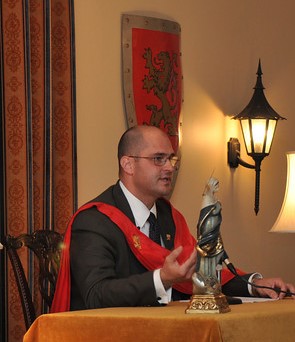
Mr. Michael Whitcraft
Talk given by Mr. Michael Whitcraft at the 2026 National Conference in Spring Grove, Pennsylvania. Due to the length of this talk, it will be given here in three parts.
Imperial and Royal Highness, TFP directors, members, supporters and friends, good afternoon. I must say that I am excited about our talk this afternoon. If you are here, the chances are very good that you already know that one of the main cultural and philosophical errors that the TFP fights against is egalitarianism – that is the notion that men and women, children and adults, peasants and elites – in a word all men are equal and, subsequently, must be afforded the same treatment and status.
In reality, nothing could be further from the truth. We are not all equal. In fact, no two men are equal. Each one of us is unique. We are different shapes and sizes. We have difference capacities and abilities – different origins and interests. We each have different levels of intelligence, culture and experience.
This should come as no surprise. We see this clearly everyday of our lives every time we interact with others. Since people are different, justice demands that they be treated differently. That’s why it would be wrong for me to treat a lady that same way I treat a gentleman. Similarly, I must treat my peers differently than I treat those of my parents’ generation.
If individually, I must treat different people differently, doesn’t it stand to reason that society should act in a similar way. Shouldn’t the state itself grant different privileges and status to the various classes of people because they are different from one another? On the other hand, since each class is different, shouldn’t the state assign different responsibilities to the different classes?
Affirming this may seem out of step with the current political climate, but it was not always that way. In fact, in 1960 Barry Goldwater published the book Conscience of a Conservative. This book, which is one of the most foundational books of modern American conservatism, did not mince its words with respect to egalitarianism. In it we find this quote:
“[Many aim to establish] an egalitarian society–an objective that does violence both to the charter of the Republic and the laws of Nature. We are all equal in the eyes of God but we are equal in no other respect. Artificial devices for enforcing equality among unequal men must be rejected if we would restore that charter and honor those laws.”

“We are not all equal. In fact, no two men are equal. Each one of us is unique.”
Top row, L to R: St. Joan of Arc, St. Nuno Álvares Pereira, St. Katherine Drexel. Bottom Row: St. Jadwiga of Poland, St. Norbert of Xanten & St. Ivo of Kermartin (also called St. Yves).
This is why throughout all of Christendom, the differences between men have always been recognized and celebrated. Each class in society had responsibilities and privileges enshrined in the laws of the states. For example: In certain areas, in addition to offering the Sacraments, the clergy were expected to educate the people free of charge. This was their responsibility. As a benefit, they were exempt from taxes.
The nobles were expected to police the streets, shoulder the burden of the entire justice system and go to war when it was necessary. In addition to this, in many places they were not allowed to engage in commerce. That was a privilege of the people. Due to this, they were also exempt from taxes.
As fair as this may seem, this idea that different classes should have different burdens and privileges is loathsome to Americans. That is why our government has anti-discrimination laws about literally everything. To contradict this notion is considered the height of injustice and ultimately un-American.
Just for a moment, imagine if a candidate were to run for any office in this country and include in his platform the abolition of universal suffrage. What chances would he have of being elected? How would he be presented by the media?
I think it is safe to say that both the right and the left in this country would ride him out on a rail and his career would be over. And yet, a large percentage of the electorate cannot even articulate the basic platform of the candidates for whom they vote. Everyone knows this. So, does it really make sense to grant every American citizen who is 18 or older the right to vote?
 As you can see, we are going to be dealing with some highly controversial issues this afternoon. This is the first reason that I am excited about this topic. The second reason I am excited can be seen in the title of my talk: Challenging American Myths About Equality. So, we will be challenging myths and that is always enjoyable.
Americans love challenging myths. There is something about getting to the bottom of a problem and uncovering the fallacies of what is purported to be common knowledge that is as American as baseball and apple pie. It is no surprise that the television program Mythbusters was so popular for so long.
So, if we think about it, we will be arguing against one of the main tenets of American cultural and political thought, but doing so in the most American way conceivable, by challenging myths, so no matter what I say, at least it shouldn’t be boring.
So, I suggest that we get right into our subject and start tackling myths. The first myth is that egalitarianism is the reason for America’s success as a nation. The reason that this is a myth is because America has never been a truly egalitarian society and elites have been the driving force of our successes since the very beginning.
That may seem like a crazy assertion considering that America was founded on egalitarian principles. In fact, both the Articles of Confederation and the Constitution itself ban the granting or accepting of titles of nobility. Common knowledge supposedly excludes the possibility of anything resembling an American nobility of any sort.

Stratford Hall Plantation. The ancestral home of four generations of the Lee family of Virginia.
To refute this, Dr. Plinio formed a study commission in the early 90s to show that America is truly an aristocratic nation living within a democratic state. The result was the so-called “American Appendix” of Dr. Plinio’s last book, Nobility and Analogous Traditional Elites. This appendix is so comprehensive, that it is longer than the book, itself. My research for this part of my talk is taken exclusively from this work.
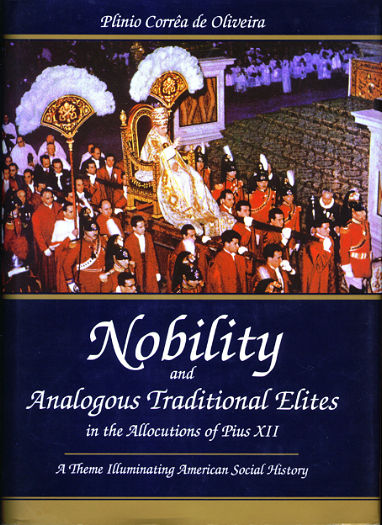
Click to order your copy today!
The appendix is very realistic in its outlook. It freely admits that its purpose frontally challenges conventional wisdom. In the introduction, it states:
“The United States is universally considered the republic par excellence, whose very Declaration of Independence consecrated the principle that “all men are created equal.” It is the nation of “self-made men,” where anyone can rise “from rags to riches”; the nation of individual liberties, where authority and hierarchy are viewed with suspicion; the New World where the Old-World elegance of aristocratic ceremony gives way to the unrestrained simplicity of democratic manners; the nation where pragmatism and “common sense” take precedence over aesthetic and spiritual considerations.”
For brevity’s sake, we will refer to this idea as the American Myth, which the American Appendix defines as: “a certain egalitarian and liberal way of perceiving the American spirit, which stems more from ideological preconceptions of Enlightenment and rationalist origin characteristic of certain currents of thought, than from an objective vision of the American situation.”
I know that is a bit of a complicated definition, let me break it down a bit: The American Myth is 1). a certain egalitarian and liberal way of perceiving the American spirit, 2) this stems from ideological preconceptions of Enlightenment and rationalist origin characteristic of certain currents of thought, 3) and not based on an objective vision of the American situation.
In a nutshell, it means that many people, spurred on by Enlightenment and rationalist preconceptions, assume that the United States is much more egalitarian than it truly is. This American Myth has been harmful to the development of the recent history of the entire world because, based largely on this myth, much of the Old World abandoned its ways of being. This myth became a type of model to which nations needed to conform in order to enter modernity.

“…Old World abandoned much of the ceremonial and reverence that had defined its hierarchical past and replaced it with a system that valued efficiency….”
Thus, the Old World abandoned much of the ceremonial and reverence that had defined its hierarchical past and replaced it with a system that valued efficiency and production above all else. This process is very evident in the aftermath of the two World Wars.
However, it has been devastating and insincere. Devastating because ceremonial and reverence are more valuable that efficiency and production. This is obvious because ceremonial and reverence are values that feed man’s soul, whereas efficiency and production are more focused on material and the body. Since, the soul is superior to the body, it stands to reason that we should favor the former over the latter.

Thomas Paine Painting by Laurent Dabos
However, it was also insincere because American egalitarianism has always been grossly exaggerated. It was, as we have said, a myth. So where did this myth come from? It originated in the writings of some of our founding fathers, like Thomas Paine who went so far as to call monarchies evil.
It was bolstered in large part by the Romantic authors of the nineteenth century. Like much of their literature, when writing about their experience of the newly born American republic, they took a good deal of poetic license in their portrayal of the equality that reigned here.
One such writer was Alexis de Tocqueville, whose 1835 book Democracy in America is considered to be the foundational text for an understanding of early American society. An aristocrat, himself, de Tocqueville lamented the destruction of hierarchy, but considered it a foregone conclusion as inevitable as fate.
While lamenting this fact, he came to appreciate the United States where he felt that at least the supposed destruction of hierarchical structures did not degenerate into anarchy or mob rule. Nevertheless, his portrayal of American society is entirely in line with the American Myth.
He wrote:
“In America the aristocratic element has always been feeble from its birth; and if at the present day it is not actually destroyed, it is at any rate so completely disabled that we can scarcely assign to it any degree of influence on the course of affairs. The democratic principle, on the contrary, has gained so much strength by time, by events, and by legislation, as to have become not only predominant, but all-powerful. No family or corporate authority can be perceived; very often one cannot even discover in it any very lasting individual influence.”

Alexis-Charles-Henri Clérel de Tocqueville
De Tocqueville’s vision of America, known as the pluralist school, was the one that dominated scholarship until around the middle of the twentieth century. However, later scholarship has shown just how off tracks this vision was.
Speaking of the pluralist school in 1973, Edward Pessen said: “This charming canvas of a crude but exhilarating social democracy has been largely demolished by modern research.” These researchers point out that, because America was not supposed to have social classes, previous scholars simply assumed that it didn’t, without doing sufficient research to demonstrate the fact. In doing so, they grossly misrepresented the American reality.
This led Vance Packard, writing in 1959, to affirm:
“Until recently, even sociologists had shrunk away from a candid exploration of social class in America. Social classes, they realized, were not supposed to exist. Furthermore, Karl Marx had made class a dirty word. As a result social scientists, until a few years ago, knew more about the social classes of New Guinea than they did about the United States of America.”
Some researchers excuse their colleagues’ poor scholarship by pointing out that, while elites do exist here, they are more hidden in American society. This makes them and their influence harder to detect. Hence Herbert von Borsh wrote:
“To the foreign observer, American life appears at first sight as egalitarian. He sees a colorful, vital, mobile surface, as compared with the old incrustations of European society…Under the surface, then, there unfolds a fascinating patchwork of consciously cultivated group distinctions, involving…deeper forces of separation.”
Other researchers point out something more nefarious at work. These claim that sociologists who affirmed the reality of a highly developed social stratification in the United States faced ridicule and even ostracism. You simply were not allowed to challenge the prevailing ideas.

Larz Anderson House. The Washington, DC residence of Ambassador Larz and Isabel Anderson from 1905 until 1937, the house now serves as the national headquarters of the Society of the Cincinnati, the nation’s oldest patriotic order.
Thus, in 1985 Peter Cookson and Caroline Hodges Persell wrote: “To propose that American society is almost as class-based as British society pushes one to the fringes of social respectability.”
However, there is a good reason why we can have the certainty that America has never been a classless society. It is because there never has been, nor could there ever be a society that truly did not develop some sort of class system. Modern sociologists are adamant about this fact.
Thus, Pierre van den Berge wrote:
“That all men are created equal may have seemed a self-evident truth to the amiable optimist who signed the United States Declaration of Independence, but it flies in the face of all evidence. That all men should be treated as if they were equal is a rather exotic and recent idea born in Western culture a little over two hundred years ago.
“In the majority of societies for nearly all of human history, inequality has been treated as axiomatic, and human relations have been ordered on the premise that any two people are seldom if ever equal…Egalitarianism may be good rhetoric, but it is bad sociology and, empirically, rank nonsense…”
Echoing this idea, Robert Nisbet says that hierarchy comes from the “functional requirements of the social bond. There is no form of community that is without some form of stratification of function and role. Wherever two or more people associate, there is bound to be some form of hierarchy.”
Summarizing these ideas, I return to Pierre ven den Berge who wrote: “The sociological ‘left-wing’ has argued that stratification is ‘dysfunctional,’ while the ‘right wing’ has held that it is ‘functional,’ meaning ‘good’ for society. Whether good or bad, inequality undeniably exists in all human societies…Other than liking it or disliking it, there is not much we can do about it.”

The Waldorf-Astoria ballroom: a Phi Gamma Delta fraternal function in 1908.
So, there has always been a class system in the United States. This holds true not just for the big cities, but in smaller ones as well. C. Wright Mills writes:
“In every town and small city of America an upper set of families stands above the middle classes and towers over the underlying population of clerks and wage workers. The members of this set possess more than do others of whatever there is locally to possess; they hold the keys to local decision; their names and faces are often printed in the local newspaper, in fact, they own the local newspaper as well as the radio station; they also own the three important local plants and most of the commercial properties on main street; they direct the banks. Mingling closely with one another, they are quite conscious of the fact that they belong to the leading class of the leading families…So it has traditionally been, and so it is today in the small towns of America.”
This is seen right here in the little town of Spring Grove. As many of you know the estate we are currently in was built by the paper magnate Philip Henry Glatfelter. When at the height of his power, he ruled Spring Grove with more power than a feudal lord.
I learned this years ago when speaking with an elderly Spring Grove native. Our conversation revolved around what life had been like in Spring Grove, when he was a boy. At that time, one of his weekly chores was to ride his bike to the Lutheran church in town on Saturday morning, where the minister would give him a copy of the sermon he planned to preach the following day. He would then peddle up to this estate and deliver the sermon to Mr. Glatfelter.
Mr. Glatfelter would read this sermon and modify it in whatever way he saw fit. The boy would then peddle back to the church and return the edited text to the minister before getting on with whatever else he planned to do that Saturday! As I said, Mr. Glatfelter had more power here than any medieval lord, who never would have dreamt of editing his local priest’s sermon before Mass on Sunday.

The American TFP Headquarters built by Philip Henry Glatfelter.
There are countless other examples we could give, however, doing so would make this talk longer than an hour and Mr. Michael Drake would not tolerate that. Suffice it to say that it is difficult to find a hospital or university that does not have a wing donated by (and named after) one or more of that city’s elites.
This is evident at Harvard wherein one of the undergraduate residences is named after the Cabot family, one of Boston’s most elite clans. However, their status is challenged by another family: the Lowells. The residents of Cabot House have immortalized their position in favor of the Cabots with the following rhyme: “Here’s to the town of Boston, The land of the bean and the cod, Where the Lowells speak only to Cabots, And the Cabots speak only to God.”
So, with this, we have busted the first myth. American is not a truly egalitarian society. It never has been, because such a society is simply a utopian dream that cannot exist in reality. So, the successes we have had as a nation did not come from our egalitarianism, but rather from the dogged work of elites, who have always dominated the American scene.
The next myth we will tackle is the that the existence of hereditary elites is unjust. This one is very important and widespread. Many do not have a problem with elite status as long as it a status that the individual has earned through his own work. These have a problem with the idea that some people are born into a privileged status.
The type of society these people favor is called a meritocracy. In a meritocracy, the only things that can determine one’s social status are his personal merits—what he has personally earned through the sweat of his own brow.
To Be Continued….