Saint Patrick, whose name (Patricius) means “noble”

March 17, 2011

Apostle of Ireland, born at Kilpatrick, near Dumbarton, in Scotland, in the year 387; died at Saul, Downpatrick, Ireland, 17 March, 493. He had for his parents Calphurnius and Conchessa. The former belonged to a Roman family of high rank and held the office of decurio in Gaul or Britain. Conchessa was a near relative […]

Read the full article →

Japan’s emperor in historic speech: ‘Never give up hope’

March 17, 2011

Tokyo (CNN) — Japan’s beloved emperor dramatically took to the national TV airwaves Wednesday and buoyed the spirits of his disaster-stricken citizens in an extraordinary address before a nation grappling with the aftermath of an epic earthquake and a devastating tsunami, and amid growing fears of a nuclear catastrophe. An address by a sitting emperor […]

Read the full article →

Doña Marina

March 14, 2011

Before telling about the great Montezuma and his famous city of Mexico and the Mexicans, I wish to give some account of Doña Marina, who from her childhood had been the mistress and Cacica of towns and vassals. It happened in this way: Her father and mother were chiefs and Caciques of a town called […]

Read the full article →

Our Lord Jesus Christ Willed to Be Born a Noble; He Himself Loved the Aristocracy

March 14, 2011

From the allocution of Pius IX to the Roman Patriciate and Nobility on December 29, 1872: Jesus Christ Himself loved aristocracy; and if I am not mistaken, I expounded upon this idea on another occasion. He too chose to be of noble birth, of the House of David; and His Gospel shows us His family […]

Read the full article →

Condolences and support to Emperor Akihito

March 14, 2011

Following the disasturous earthquake and tsunami which hit the north-eastern coast of Japan on Friday afternoon, local time, many reigning monarchs have sent messages of condolence and support to Emperor Akihito of Japan. http://www.theroyalforums.com/22379-monarchs-send-condolences-to-japanese-emperor/ The members of Nobility.org unite their fervent prayers for the Japanese people in this hour of great distress.

Read the full article →

March for Life, Brussels, March 27, 2011

March 14, 2011

Duke Paul of Oldenburg cordially invites you to march with him in defense of those who cannot defend themselves: Brussels — 27 March 2011 — Koningsplein — 3 pm In 2009, 18.870 abortions were performed in Belgium. Most women felt forced to have an abortion because of “social, economical or cultural considerations. If they would […]

Read the full article →

March 14, St. Matilda, Queen of Saxony – Patroness of Those Falsely Accused

March 14, 2011

  Queen of Germany, wife of King Henry I (The Fowler), b. at the Villa of Engern in Westphalia, about 895; d. at Quedlinburg, 14 March, 968. She was brought up at the monastery of Erfurt. Henry, whose marriage to a young widow, named Hathburg, had been declared invalid, asked for Matilda’s hand, and married […]

Read the full article →

Cromwellian vulgarity receives a noble riposte

March 10, 2011

The youthful Rosenkavanz was ambassador to the ephemeral republican government of Oliver Cromwell and heard this rebuke from the latter: “Your king chooses rather immature representatives. One can barely say you have a beard.” “And yet my beard is older than your republic,” replied the ambassador. Adolfo Padovan, Il libro degli aneddoti (Milan: Bottega di […]

Read the full article →

In Defense of the Catholic Social Order

March 10, 2011

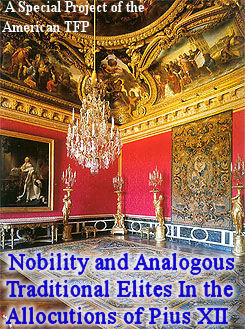
by Nelson Ribeiro Fragelli First published on Dec. 29, 2003 This year [this article was originally published in 2011] we celebrate the tenth anniversary of the launching of the book: Nobility and Analogous Traditional Elites. This last work of Professor Plinio Corrêa de Oliveira outlines a true program to bring the world out of the […]

Read the full article →

March 10, St. John Ogilvie – Noble Scot

March 10, 2011

Ogilvie, the son of a wealthy noble, was born into a Calvinist family near Keith in Banffshire, Scotland and was educated in mainland Europe where he attended a number of Roman Catholic educational establishments, under the Benedictines at Regensburg in Germany and with the Jesuits at Olomouc and Brno in the present day Czech Republic. […]

Read the full article →

Franz Joseph, Emperor of Austria-Hungary, washes the feet of the poor on Holy Thursday

March 7, 2011

In 1850, Franz Joseph participated for the first time as emperor in the second of the traditional Habsburg expressions of dynastic piety: the Holy Thursday foot-washing ceremony, part of the four-day court observance of Easter. The master of the staff and the court prelates chose twelve poor elderly men, transported them to the Hofburg, and […]

Read the full article →

Nobility is a Gift from God

March 7, 2011

From the allocution of Pius IX to the Roman Patriciate and Nobility on June 17, 1871: One day a Cardinal, a Roman prince, presented his nephew to one of my Predecessors, who on that occasion made a very true statement: that thrones should be upheld principally through the nobility and clergy. For there is no […]

Read the full article →

Every Uniform Sends a Message

March 7, 2011

Clothing sends a message, for better or for worse.

Read the full article →

Queen Blanche of France shapes the young Saint Louis IX for the trials of kingship

March 3, 2011

When young Louis inherited the French crown at the age of twelve upon Louis VIII’s premature death, he also inherited a royal domain that was greatly expanded by his grandfather, Philip Augustus…. The virtue of any young man is strengthened by grace achieved through prayer and obedience to his duties, but Saint Louis had the […]

Read the full article →

Tradition, Family, and Property by Plinio Corrêa de Oliveira

March 3, 2011

Once upon a time, there was a young man torn by a critical conflict of affections. He loved his charming spouse with all his soul. Yet at the same time, he had profound affection and respect for his mother. However, relations between mother in-law and daughter in-law were tense. The enchanting but evil young woman, […]

Read the full article →

The often thankless task of quietly preserving one’s heritage

March 3, 2011

In This Hawaiian Scavenger Hunt, A Princess Seeks Palace Treasures King’s Bed Went Missing in 1893 Revolt, But Iowa Returns a Mahogany Chair http://online.wsj.com/article/SB10001424052748704013604576104611711914484.html

Read the full article →

March 2, Saint Agnes of Prague – another noble saint

March 2, 2011

Born a Princess, the daughter of King Ottokar I and Queen Constance of Bohemia. Relative of Saint Elizabeth of Hungary. Educated by Cistercian nuns at Trebnitz, Germany. Though she early perceived a call to religious life, Agnes was for years promised into a series of arranged marriages for political reasons. At age three she was […]

Read the full article →

Pinon: “I prefer to be the first logger of France, than the last of its barons”

February 28, 2011

In the French region of Auvergne there was a logging family called Pinon who could prove descent from loggers of the time of Charlemagne.* The family was respected highly, and Louis XIV himself would send greetings to the patriarch on his birthday. Wishing to grant the head of the family a nobiliary title, the King […]

Read the full article →

A Monument Raised from a Ruin, an Institution from a Custom

February 28, 2011

by Plinio Correa de Oliveira “Consider the diversity of the Middle Ages: on the one hand, there is the razing of cities, the fall of empires, the struggle between races, the confusion of peoples, violence and lamentations; there is corruption, barbarianism; institutions fall and institutions rise; men disperse and make nations, whole peoples are led […]

Read the full article →

Prince Kaunitz: sacrificing personal feelings for the good of the State

February 24, 2011

Prince Kaunitz, Chancellor of State and Minister of Foreign Affairs of the Empress Maria Theresa, encouraged her to appoint a personal enemy of his to the post of Minister of War. The Empress was surprised at the suggestion, so he explained: “He is indeed my personal enemy, but he is a friend of the State.” […]

Read the full article →

Although Equal by Nature, Men Should Not Occupy the Same Position in Social Life

February 24, 2011

From Benedict XV’s encyclical Ad beatissimi Apostolorum, of November 11, 1914: Face to face with those to whom either fortune or their own activity  has brought an abundance of wealth stand the proletaires and the workers, inflamed with hatred and jealousy because, although they share the same nature, they are not in the same condition. […]

Read the full article →

“God wills it!”—Blessed Pope Urban II launches the First Crusade

February 21, 2011

The intellectual and moral leadership of Europe passed into the hands of Blessed Urban II, a Pope who was uniquely qualified to bring the crusading idea into reality. As a Frenchman and former Cluniac prior, he had the gift to awaken the religious fervor of the French, Lorraine, and Norman knights that formed the core […]

Read the full article →

Regionalism, Tradition and Good Taste

February 21, 2011

by Plinio Corrêa de Oliveira In the field of art, two equally erroneous extremes should be avoided. One is cosmopolitanism, which strives to establish only one art form for the whole world without considering the characteristics proper to each people and each region. The other is nationalism, which rejects any outside influence, even when legitimate […]

Read the full article →

Don Pelayo rejects the call to surrender and triumphs at Covadonga

February 17, 2011

The great succession of Spanish warriors like El Cid, Saint Ferdinand, the Duke of Alva, and Don Juan of Austria would not have existed if Don Pelayo, the first nobleman in that heroic tradition, had not had the courage and fortitude to risk all to defy the Mohammedan occupation of his homeland. Pelayo gathered about […]

Read the full article →

Saint Clotilda’s suffering prayers secure the conversion of Clovis

February 14, 2011

Two great saints, Clovis’s wife Clotilda and Bishop Remigius, worked with energy and tact to bring Clovis into the Church, attesting that few of the great works of Christian civilization are the products of power or genius but rather the result of sanctity. Clotilda, a Catholic Burgundian princess, brought to their marriage an indomitable faith […]

Read the full article →

In Society There Should be Princes and Vassals, Proprietors and Proletarians, Rich and Poor, Learned and Ignorant, Nobles and Plebeians

February 14, 2011

In the motu proprio Fin dalla prima, of December 18, 1903, Saint Pius X summarizes the doctrine of Leo XIII on social inequalities: 1. Human society, as God established it, is composed of unequal elements, just as the members of the human body are unequal. To make them all equal would be impossible, and would […]

Read the full article →

Marshall Osório gives the corrupt horsetrader a lesson on honor

February 10, 2011

During the Paraguayan War (1864-1870), General Osório was approached by a horse dealer wanting to supply the Army. Most of his horses were worthless, but he wanted the general to give him a letter of recommendation to the Commission responsible for purchasing. The general replied: “Man, you understand the trade and know well the Government’s […]

Read the full article →

The Church Loves All the Classes and the Harmonious Inequality Among Them

February 10, 2011

Leo XIII teaches in his allocution to the Roman Patriciate and Nobility on January 24, 1903: The Roman Pontiffs have always taken care to equally protect and ameliorate the lot of the humble, and to support and augment the honor of the upper classes. For they carry on the mission of Jesus Christ, not only […]

Read the full article →

Saint Thomas More’s great love for his father and authority

February 7, 2011

Whensoever [Sir Thomas More] passed through Westminster Hall to his place in the Chancery by the Court of the King’s Bench, if his father, one of the judges there, had been sat [before] he came, he would go into the same court, and there reverently kneeling down in the sight of them all, duly ask […]

Read the full article →

When Society is Corrupt, Is There a Solution?

February 7, 2011

by Plinio Corrêa de Oliveira A while back, the Italian Parliament voted to overturn prison sentences for politicians convicted of receiving illegal campaign contributions in light of unprecedented scandals. The legislation established that illegal contributions to political campaigns were no longer crimes but simply “civil offenses,” where those convicted would no longer be arrested but […]

Read the full article →

Larochejacquelein is killed by the men whose life he spared

February 3, 2011

While Turreau was thus devastating La Vendée, where were Larochejacquelein, Stofflet, and Charette? Had they forgotten their country and its cause—were they deaf to her cries of distress? Charette still fought in the depths of the Marais; Stofflet in the recesses of the Bocage; but Larochejacquelein, the young, the brave, the chivalrous, the peasants’ idol […]

Read the full article →

Just as the Diverse Members in the Human Body Are Arranged Among Themselves, So Also the Social Classes Should Integrate in Society

February 3, 2011

[In the encyclical Rerum Novarum, of May 15, 1891, Pope Leo XIII affirms]: The great mistake made in regard to the matter now under consideration is to take up with the notion that class is naturally hostile to class, and that the wealthy and the workingmen are intended by nature to live in mutual conflict. […]

Read the full article →

Jean Chouan’s feudal love for the Prince of Talmont

January 31, 2011

Jean Chuoan had been aware of the expected passage of the Loire, although not of the precise point at which it would be effected; and one day he had given a rendezvous to Puisaye, in the forest of Pertre, with a view to concert measures for a coalition of the Breton with the Vendean insurgents, […]

Read the full article →

Jean Chouan rises for the King in Brittany

January 27, 2011

It was the 15th August 1792. An order from the directory of the district had summoned to St. Ouen-des-toits all the young men of the neighboring parishes, to enroll themselves in the national guard by voluntary enlistment. Most of them obeyed the summons; but the very sight of the officers with their registers inspired them […]

Read the full article →

Social Inequality Redounds to the Advantage of All

January 27, 2011

Leo XIII returns to the subject of social inequality in the encyclical Rerum Novarum, of May 15, 1891:   Let it, then, be taken as granted, in the first place, that the condition of things human must be endured, for it is impossible to reduce civil society to one dead level. Socialists may in that […]

Read the full article →

The capture and death of the indomitable Charette

January 24, 2011

On the 21st February his troop, now reduced to less than two hundred men, was attacked by General Travot, one of the ablest officers of Hoche. The Vendeans behaved with the greatest courage, but they were overwhelmed with numbers. The eldest brother of the general, Charette la Colinière, and several officers fell; and he himself […]

Read the full article →

Clothing, Mirror of an Epoch

January 24, 2011

By Plinio Corrêa de Oliveira This article was written in 1952 at a time when fashions were changing to casual workplace styles. Since then, many companies have reversed their casual dress code perhaps realizing that dress definitely affects work. Some schools have done likewise. From a material point of view, clothing serves only as a […]

Read the full article →

Death of the Vendean generalissimo Maurice d’Elbee

January 20, 2011

[Charette] was far away on his road to Noirmoutiers. During his absence in Anjou, General Haxo had traversed the Marais in all directions without effect, and Turreau, a man forever execrated as the organizer of the infernal columns, had been sent to supersede him. Upon this Haxo determined to attack the isle of Noirmoutiers, an […]

Read the full article →

The Marquise de Lescure escapes from the Vendean army’s destruction at Savenay

January 17, 2011

During the darkness, some of the officers warned the women to make their escape with their children. “All is lost,” said [Gaspard de Bernard de] Marigny to Madame de Lescure, who had followed the army through all its troubles. “It is impossible to stand tomorrow’s attack. In twelve hours the army will be exterminated. For […]

Read the full article →

Small Symptoms of a Great Transformation

January 17, 2011

by Prof. Plinio Correa de Oliveira It used to be that the only uniform the Civil Guard of Sao Paulo wore was a jacket, pants and cap of navy blue wool. Later, a summer uniform of grayish linen was introduced, generally following the same pattern of the former with the exception of the white helmet […]

Read the full article →

Henri du Vergier, Count de la Rochejacquelein, turns a Vendean rout at Dol into victory

January 13, 2011

The battle commenced towards midnight. Thanks to Larochejacquelein’s activity, the Catholic forces were all under arms; for Westermann had counted on surprising them, and there would have ensued the same dark scene of slaughter in which he had exulted at Châtillon. But it was a terrible night, nevertheless; the cries of the soldiers, the roll […]

Read the full article →

Nothing Is So Repugnant To Reason as a Mathematical Equality Among Men

January 13, 2011

From Leo XIII’s encyclical Humanum genus, of April 20, 1884:   In like manner, no one doubts that all men are equal, one to another, so far as regards their common origin and nature, or the last end which each one has to attain, or the rights and duties which are thence derived. But, as […]

Read the full article →

The Marquis of Bonchamps’ dying order: “Show clemency to the captured”

January 10, 2011

Before pursuing the flying army, the republicans returned to Chollet, and committed terrible outrages at that place; after which, Westermann, followed by a small division, came upon the rear-guard of the Vendeans during the night, and massacred the whole. The remains of the defeated army hurried away to St. Florent, where they joined their four […]

Read the full article →

Equalizing Everything: A Mania, Not a Necessity

January 10, 2011

by Plinio Correa de Oliveira While the horse is increasingly abandoned as a means of transportation, it continues to be in vogue in sport. Everywhere, horsemanship continues to be an object of lively interest. Football and boxing champions have not destroyed the popularity of the jockey. Indeed, the qualities that an authentic horseman should embody […]

Read the full article →

The Marquis of Lescure destroys two thirds of Westermann’s army and saves the lives of captured enemy soldiers

January 6, 2011

While the grand army were under the walls of Nantes, several engagements had taken place in La Vendée. Westermann, at the head of a German legion, advanced into the heart of the Bocage, after making himself master of Parthenay, on the 20th June. On the 1st July he burned the town of Amaillon; he then […]

Read the full article →

Monarchy, Republic, and Religion

January 6, 2011

[previous] To avoid any misunderstanding, it is necessary to emphasize that this exposition does not contain the assertion that the republic is necessarily a revolutionary regime. When speaking of the various forms of government, Leo XIII made it quite clear that “each of them is good, as long as it moves honestly toward its end, […]

Read the full article →

“The saint of Anjou” storms Saumur for a fourth Catholic victory in five days

January 3, 2011

Cathelineau, from his elevated position on the heights near the castle, observed attentively the situation of the various corps engaged. The want of plan with which the eager peasants had rushed to the attack was now beginning to tell upon the fortunes of the day; and he saw that, if the assault was to be […]

Read the full article →

The Socialists Declare That the Right of Property Is a Human Invention Opposed to the Innate Equality of Man

January 3, 2011

The Socialists Declare That the Right of Property Is a Human Invention Opposed to the Innate Equality of Man [From Leo XIII’s encyclical Quod Apostolici muneris, of December 28, 1878]: But Catholic wisdom, sustained by the precepts of natural and divine law, provides with especial care for public and private tranquility in its doctrines and […]

Read the full article →

The Wall Street Journal: the “Princess” archetype is powerful because it is adaptable

December 27, 2010

The “princess dream shares the mixture of openness and elitism that gives princesses their contemporary appeal. Like the superhero, the princess has a special identity and destiny. She is more than an ordinary girl. But her value is not determined by playground hierarchies. You don’t have to be popular to be a princess. You can […]

Read the full article →

The Incarnation and Birth of Our Lord: More Audacious Than Any Utopia

December 25, 2010

Nothing proves how grace makes utopias possible than the thought of Christmas. As Prof. Plinio Corrêa de Oliveira observed: “Something happens on Christmas night. It is as if through the power of God an immense impossibility becomes possible, and a shower of graces flows from Heaven to earth, turning into marvelous realities all of our […]

Read the full article →

The Dauphin’s gift to the Queen on New Year’s Day

December 23, 2010

At Marie Antoinette’s insistence, the four-year-old Dauphin promised: “By the end of the year, I will learn how to read. It will be my New Year’s gift to you.” Soon after he asked his tutor, Father Avaux, “How long is it before the end of the year?” “A little more than a month,” the priest […]

Read the full article →

Spiritual Richness in the Common Life of the People

December 23, 2010

by Plinio Corrêa de Oliveira The National Museum of Ancient Art in Portugal preserves, among other valuable works, the nativity scene from the church of St. Vincent de Fora sculpted by Joaquim Machado de Castro in the eighteenth century. In our photograph, we present one detail from this nativity scene: the shepherds coming to adore […]

Read the full article →

Abortion greater threat to Europe than Islamic terrorism: Duke of Kent’s son

December 22, 2010

Lord Nicholas Windsor, the son of the Duke and Duchess of Kent,  studied theology at Oxford University and is patron of the Right to Life Charitable Trust and the Catholic National Library. Great-grandson of King George V of the United Kingdom, Windsor is the first blood member of the British royal family to be received […]

Read the full article →

Marie Antoinette teaches her children to sacrifice themselves for the poor

December 20, 2010

As a loving mother, Marie Antoinette bought Christmas presents for her children at the end of every year. One year that the winter was harsh and the poor were suffering much hardship, she ordered the best toys, dolls and games Paris had for sale and laid them out in a room for her children to […]

Read the full article →

Excerpt from Pope Pius XII’s Allocution to the Pontifical Noble Guard on December 26, 1942

December 20, 2010

“None can be envious upon seeing that We bear you such special affection. To whom, in truth, is the immediate protection of Our person entrusted, if not to you? And are you not the first of Our guards? “Guard! What lofty resonance there is in this word: the soul trembles therewith; thoughts take wing. An […]

Read the full article →

Henry V’s St. Crispian’s Day speech

December 16, 2010

Short Stories on Honor, Chivalry, and the World of Nobility—no. 34

Read the full article →

The Machine, Crude and Deformed Idol of a Materialistic World

December 16, 2010

by Plinio Corrêa de Oliveira We begin with a well-known truth. Since God is the author of nature, all laws governing the universe are an image of His wisdom and goodness. Among these laws are those of physics, among which are those of mechanics. Thus, one who dedicates himself to the study of the mechanical […]

Read the full article →

The courtesy of a prince meets the graciousness of a king

December 13, 2010

The Prince of Condé, having won numerous battles, was coming to greet Louis XIV, who awaited him at the top of a staircase. As he suffered from gout he walked slowly. “Please excuse me Sire if I make you wait. My gout…” “Take your time, cousin. One cannot walk briskly when arriving loaded with so […]

Read the full article →

The Universe, the Church, and Civil Society Reflect the Love of God in an Organic Inequality

December 13, 2010

The Universe, the Church, and Civil Society Reflect the Love of God in an Organic Inequality [From Leo XIII’s encyclical Quod Apostolici muneris, of December 28, 1878]: For, He who created and governs all things has, in His wise providence, appointed that the things which are lowest should attain their ends by those which are […]

Read the full article →

Louis XIV: Face wrinkles kept count of the wars he waged

December 9, 2010

Mignard was painting Louis XIV’s portrait for the tenth time, when the king asked: “Hasn’t my appearance aged somewhat?” “Sire,” the artist answered, “in truth, I do perceive a few additional wars on Your Majesty’s face.” Edmond Guérard, Dictionnaire encyclopédique d’anecdotes (Paris: Firmin Didot, 1872), Vol. I, p. 267. (Nobility.org translation.) Short Stories on Honor, […]

Read the full article →