St. Edward the Confessor
King of England, born in 1003; died 5 January, 1066.
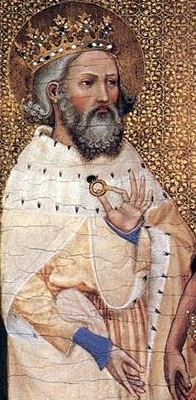
St. Edward the confessor
God often gives bad princes in his wrath; but in a good king he bestows a great public blessing on a nation. A wise king is the upholding of his people. (1) As the judge of the people is himself, so are his officers: and what manner of man the ruler of the city is, such also are they that dwell therein. An unwise king destroyeth his people; but through the prudence of them that are in authority, the city shall be inhabited. (2) The happiness of the reign of St. Edward the Confessor is itself a panegyric of his virtue.
This prince was son of King Ethelred II who left by Elgiva, his first wife, Edmund Ironside, who was his successor; and, by his second wife, Emma, daughter to Richard I and sister to Richard II the third and fourth Dukes of Normandy, he had Alfred and Edward. In his unhappy and weak reign, the Danes, who from the time of King Athelstan had, for about sixty years, left this island unmolested, committed in all parts of it most horrible ravages. To redeem the country from these vexations, Ethelred engaged to pay them a tax, called Danegelt, of forty thousand pounds a-year, which was raised at the rate of twelve pence upon each hide of land, or as much as could be tilled with one plough in a year. Swein or Sweno, King of the Danes, conquered all England soon after, in 1015; but died the same year, leaving here his son Knute or Canute.
Ethelred, who had fled into Normandy, returned upon his death and recovered his kingdom; but, dying in 1016, left Mercia and some other parts in the hands of the Danes. Edmund Ironside, after several battles, came to an agreement, which was concluded in the isle Alney, in the Severn, near Gloucester, by which he consented to divide the kingdom with Canute, yielding up to him the kingdoms of Mercia, Northumberland, and the East-Angles. Shortly after, he was treacherously assassinated by the contrivance of Edric Strean, a Dane, Count of Mercia, on whom he had bestowed the greatest favours, and by whom he had been before often betrayed.
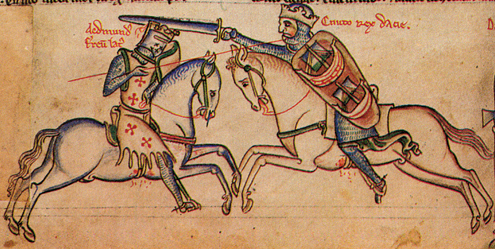
Combat between Canute the Dane and Edmund Ironside.
Canute took this opportunity to seize the whole kingdom, and ordered the late king’s two infant sons, Edmund and Edward, to be conveyed into Denmark, there to be privately made away with. The officer who conducted them was moved to compassion, and carried them into Sweden, where the king sent them to his cousin Solomon, king of Hungary. When they were grown up, Solomon gave in marriage to Edmund one of his own daughters, and to Edward his sister-in-law Agatha. Emma was retired with her two sons, Alfred and Edward, into Normandy. Canute demanded her of her brother, Duke Richard, in marriage, and his request was agreed to. But the two princes remained in Normandy, where Richard II. was succeeded, 1026, by his son Richard III. He reigned only one year, and by his death his brother Robert became duke of Normandy, who, at his death left no other issue than a bastard, known afterwards by the name of William the Conqueror.

Edith of Wessex, wife of St. Edward the Confessor
Canute reigned in England nineteen years, and was magnificent, liberal, valiant, and religious, though no virtues could excuse his ambition. Dying in 1036, he left Norway to his eldest son, Sweno, England to his son Harold, and Denmark to his son Hardicanute, whom he had by Emma. The two Saxon princes, Alfred and Edward, came over from Normandy to see their mother at Winchester. Godwin, duke or general of West-Sex, who had been the chief instrument in establishing Harold’s interest in that part of England, agreed with the king that the two princes should be invited to court, in order to be secretly made away with. Emma was startled at this message, which was sent to them at Winchester, and was apprehensive of a snare; she therefore contrived to send only Alfred, and, upon some pretences, to keep Edward with her. Godwin met Alfred at Guilford, where the young prince was seized, put first into the castle, and thence conducted to Ely, where his eyes were pulled out: he was shut up in a monastery, and died a few days after.