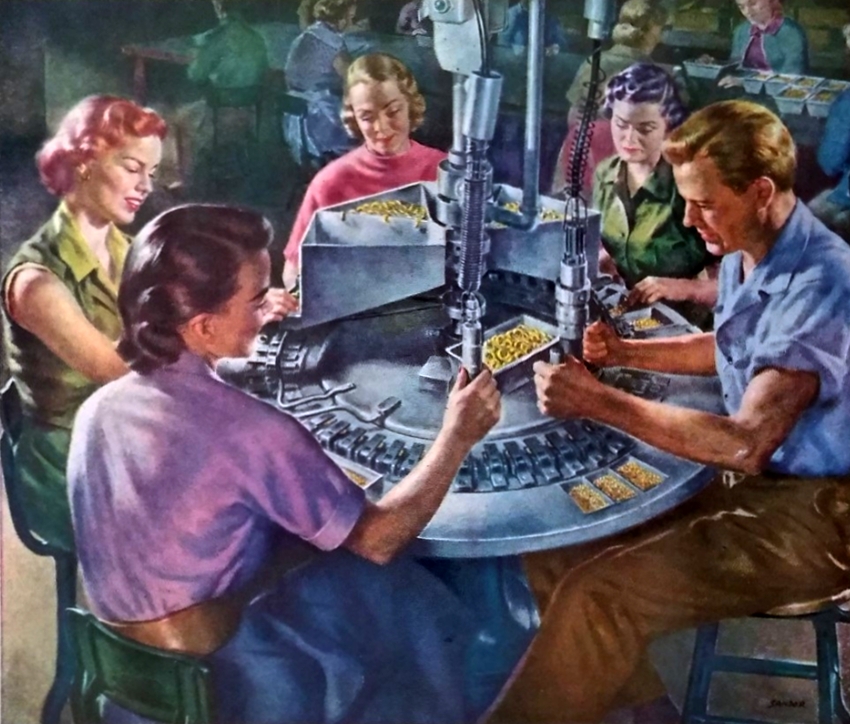
 Completely relaxed physiognomies. Smiles on every face. Appearances that express a high degree of physical and psychological well-being. Their subdued, solid-colored clothing reinforces this impression.
And what are these young people doing? If they were all gathered for tea around a table in a ‘cozy’ salon, their way of being would be no different. But what is this table? Are they playing some new and peculiar game that provides a relaxing diversion? Far from this. They are workers who work in a factory.
This vision of work is obviously false. All work requires effort. And this effort fatigues, wearies and exhausts. However, in this picture, those very ideas of fatigue, weariness and exhaustion are completely eliminated. One could say that there were no original sin, and that perspiration, that terrible symbol of arduous exertion, is not inherent to work.
Clearly, in special circumstances, professional activity can be supremely pleasurable and relaxing. But these circumstances are fleeting. As the work is prolonged or repeated, the fatigue and the painful impression of the fight begin to appear.
That an artist has decided to portray work in this false light is not the point of major importance. What is important is that his picture typifies a very generalized tendency of our epoch, which is a fundamental horror of all suffering. This leads to trying to conceal pain and present the universe like a paradise of delights. Thus pain is just a subjective product of the mind. If a man will only smile in face of everything, he will have eliminated suffering —if not totally, then at least for the most part.
This gave rise to the famous phrase: “Break your leg but keep smiling.”
The picture expresses this trivial and false conception of life, which is convincing only for the simple-minded. It can be summed up in two words: naturalistic neo-paganism.
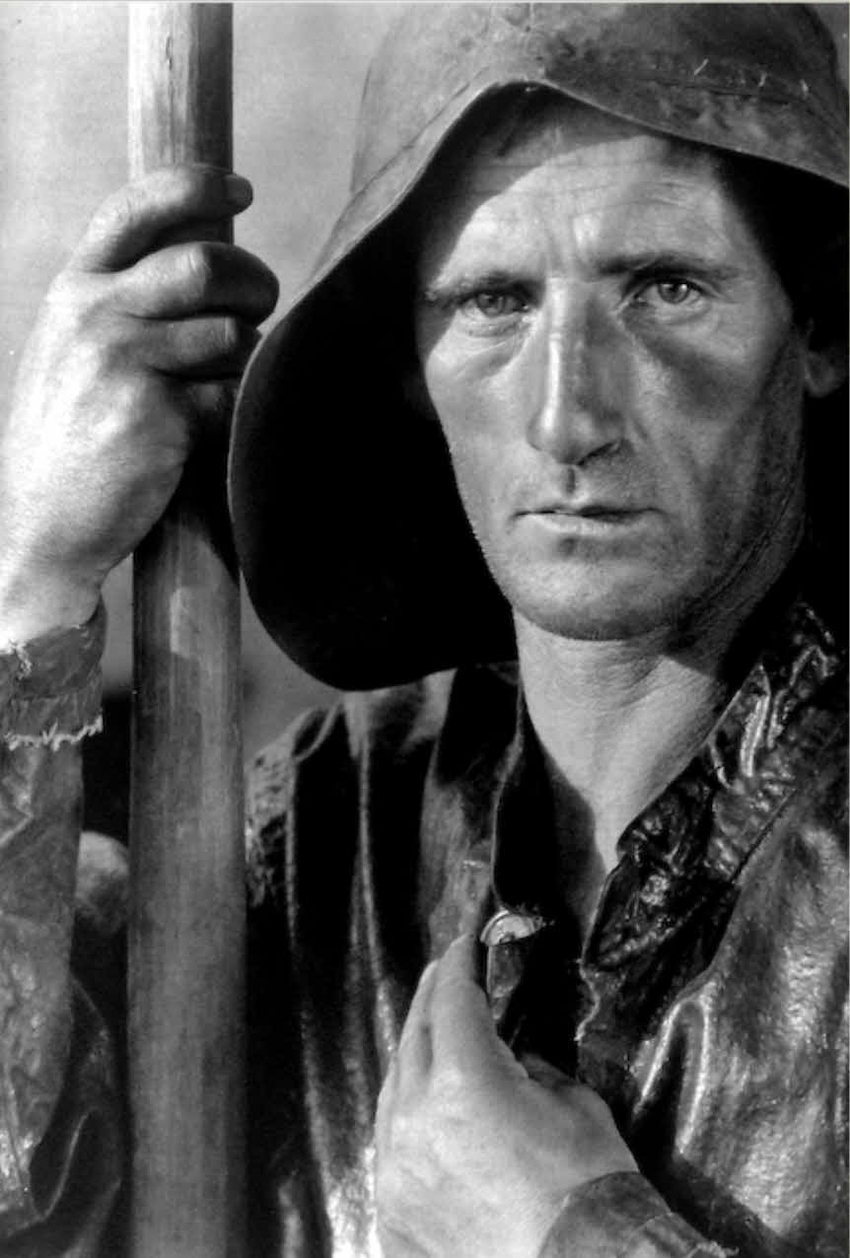
Long face, distinct and strong features, penetrating and resolute gaze, this Basque fisherman who holds his large oar with a manly vigor has a harsh profession that shapes and ennobles his soul. He is a man in every sense of the word. He is a man who has the noble chivalry of a true Christian, of an authentic Catholic. His whole personality reflects the struggle, the fight and the risk. One sees that he has confronted and has overcome the furor and treachery of the ocean innumerable times and that he is still completely ready for a countless series of other bold undertakings.
Underlying the physiognomy of this worker and the ambience he embodies is a whole Catholic conception of work and pain. Suffering exists. But it is an admirable gift from God so that man”, aided by grace, can temper and elevate his personality. Saint Frances de Sales called suffering the Eighth Sacrament. To conceal suffering is to hide one of the most noble and important aspects of existence. If one analyzes life well, he will see that almost all — or all — of the beauty that it contains results from sufferings boldly confronted and nobly borne to the end. What would this fisherman be without the great struggles of his existence? Are they not his true and shining glory?
Obviously, without the help of grace man can not righteously and totally support the thousand types of efforts and sacrifices that life imposes. But, when the soul corresponds to grace, it is capable of that grand and glorious conformity to suffering.
Thus we have the Catholic conception of work, that its most intrinsically beautiful aspect is what it possesses of the painful.
Ambience Customs & Civilization, No. 87 — March 1958