May 2 – Economist

April 30, 2026

St. Antoninus

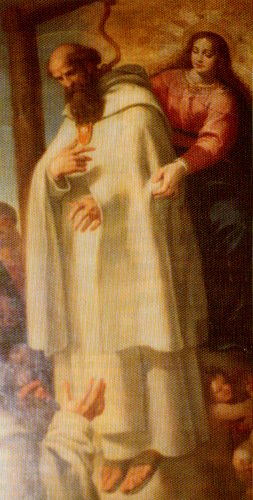
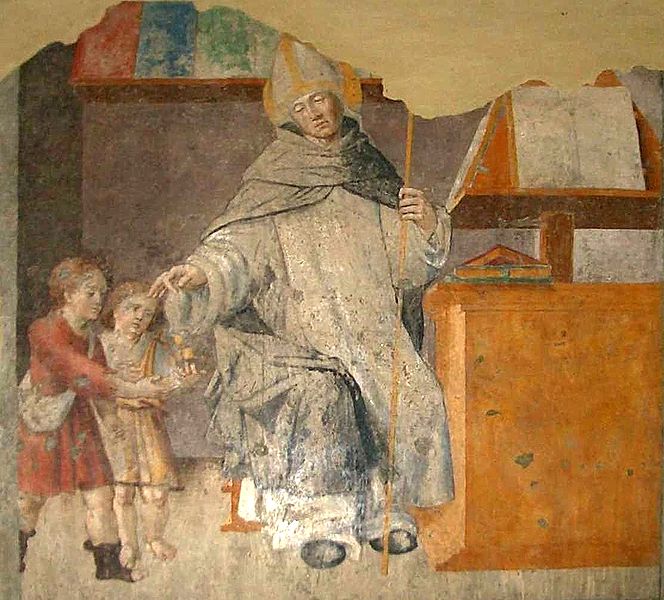
Fresco of The alms of Sant'Antonio Pierozzi in the Church of San Domenico, Torino, Italy.

Fresco of The alms of Sant’Antonio Pierozzi in the Church of San Domenico, Torino, Italy.

Archbishop of Florence, b. at Florence, 1 March, 1389; d. 2 May, 1459; known also by his baptismal name Antoninus (Anthony), which is found in his autographs, in some manuscripts, in printed editions of his works, and in the Bull of canonization, but which has been finally rejected for the diminutive form given him by his affectionate fellow-citizens. His parents, Niccolò and Thomasina Pierozzi, were in high standing, Niccolò being a notary of the Florentine Republic. At the age of fifteen (1404) Antoninus applied to Bl. John Dominic, the great Italian religious reformer of the period, then at the Convent of Santa Maria Novella in Florence, for admission to the Dominican Order. It was not until a year later that he was accepted, and he was the first to receive the habit for the Convent of Fiesole about to be constructed by Bl. John Dominic. With Fra Angelico and Fra Bartolommeo, the one to become famous as a painter, the other as a miniaturist, he was sent to Cortona to make his novitiate under Bl. Lawrence of Ripafratta. Upon the completion of his year in the novitiate, he returned to Fiesole, where he remained until 1409, when with his brethren, all faithful adherents of Pope Gregory XII, he was constrained by the Florentines, who had refused obedience, to take shelter in the Convent of Foligno. A few years later he began his career as a zealous promoter of the reforms inaugurated by Bl. John Dominic. In 1414 he was vicar of the convent of Foligno, then in turn sub-prior and prior of the convent of Cortona, and later prior of the convents of Rome (Minerva), Naples (Saint Peter Martyr), Gaeta, Sienna,and Fiesole (several times). From 1433 to 1446 he was vicar of the Tuscan Congregation formed by Bl. John Dominic of convents embracing a more rigorous discipline. During this period he established (1436) the famous convent of St. Mark in Florence, where he formed a remarkable community from the brethren of the convent of Fiesole. It was at this time also that he built with the munificent aid of Cosimo de’ Medici, the adjoining church, at the consecration of which Pope Eugene IV assisted (Epiphany, 1441). As a theologian he took part in the Council of Florence (1439) and gave hospitality in St. Mark’s to the Dominican theologians called to the council by Eugene IV.

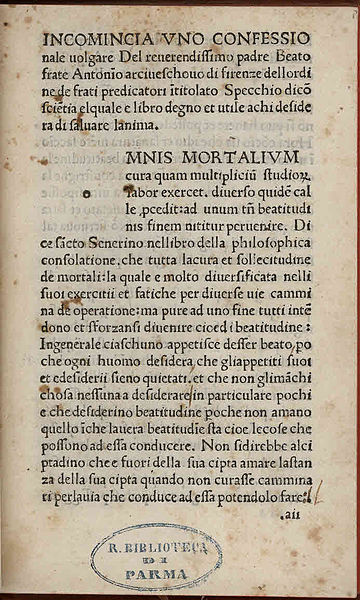
Summa confessionalis, Curam illius habes, written by St. Antoninus.

Summa confessionalis, Curam illius habes, written by St. Antoninus.

Despite all the efforts of St. Antoninus to escape ecclesiastical dignities, he was forced by Eugene IV, who had personal knowledge of his saintly character and administrative ability, to accept the Archbishopric of Florence. He was consecrated in the convent of Fiesole, 13 march, 1446, and immediately took possession of the see over which he ruled until his death. As he had laboured in the past for the upbuilding of the religious life throughout his Order, so he henceforth laboured for it in his diocese, devoting himself to the visitation of parishes and religious communities, the remedy of abuses, the strengthening of discipline, the preaching of the Gospel, the amelioration of the condition of the poor, and the writing of books for clergy and laity. These labours were interrupted several times that he might act as ambassador for the Florentine Republic. Ill health prevented him from taking part in an embassy to the emperor in 1451, but in 1455 and again in 1458 he was at the head of embassies sent by the government to the Supreme Pontiff. He was called by Eugene IV to assist him in his dying hours. He was frequently consulted by Nicholas V on questions of Church and State, and was charged by Pius II to undertake, with several cardinals, the reform of the Roman Court. When his death occurred, 2 May, 1459, Pius II gave instructions for the funeral, and presided at it eight days later. He was canonized by Adrian VI, 31 May, 1523.

The literary productions of St. Antoninus, while giving evidence of the eminently practical turn of his mind, show that he was a profound student of history and theology. His principal work is the “Summa Theologica Moralis, partibus IV distincta”, written shortly before his death, which marked a new and very considerable development in moral theology. It also contains a fund of matter for the student of the history of the fifteenth century. Sowell developed are its juridical elements that it has been published under the title of “Juris Pontificii et Caesarei Summa”. An attempt was lately made by Crohns (Die Summa theologica des Antonin von Florenz und die Schätzung des Weibes im Hexenhammer, Helsingfors, 1903) to trace the fundamentals principles of misogony, so manifest in the “Witchammer” of the German Inquisitors, to this work of Antoninus. But Paulus (Die Verachtung der Frau beim hl. Antonin, in Historisch-Politische Blätter, 1904, pp. 812-830) has shown more clearly than several others, especially the Italian writers, that this hypothesis is untenable, because based on a reading of only a part of the “Summa” of Antoninus. Within fifty years after the first appearance of the work (Venice, 1477), fifteen editions were printed at Venice, Spires, Nuremberg, Strasburg, Lyons, and Basle. Other editions appeared in the following century. In 1740 it was published at Verona in 4 folio volumes edited by P. Ballerini; and in 1841, at Florence by Mamachi and Remedelli, O.P.

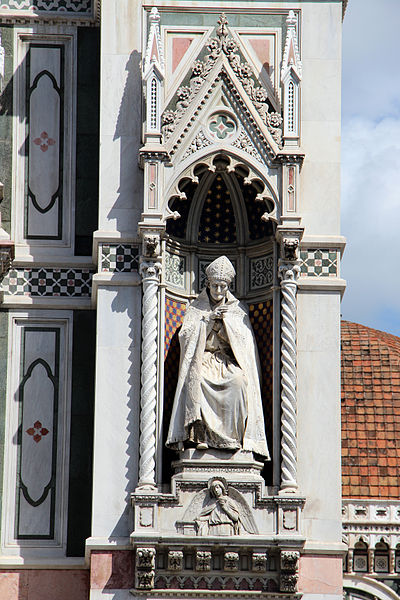
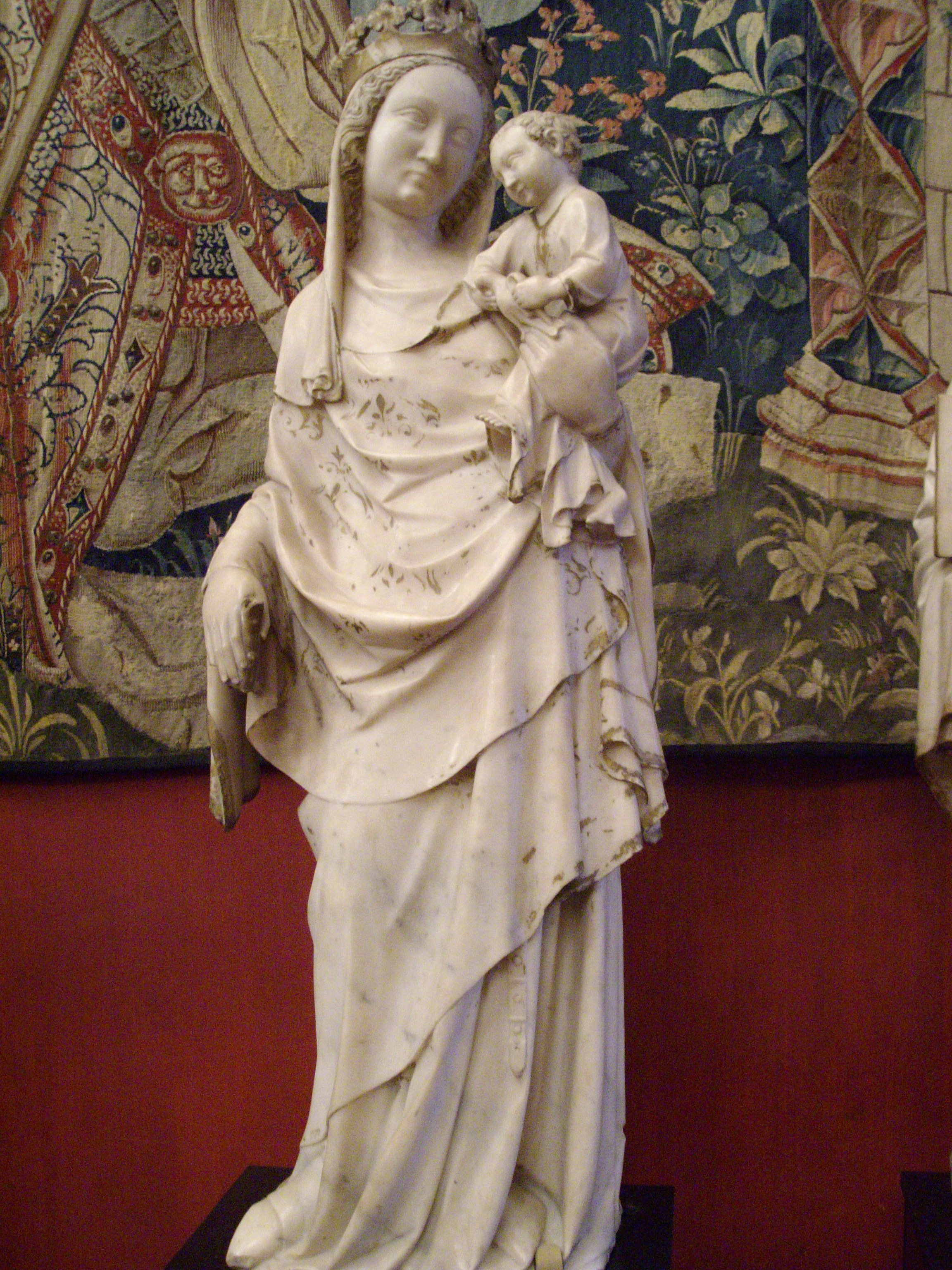
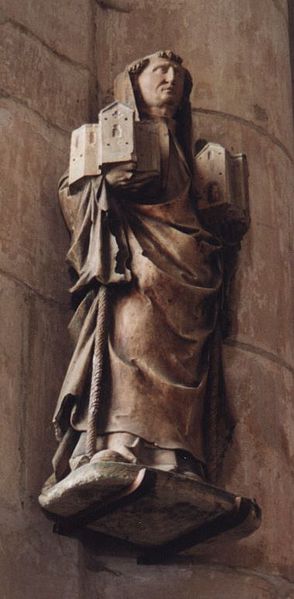
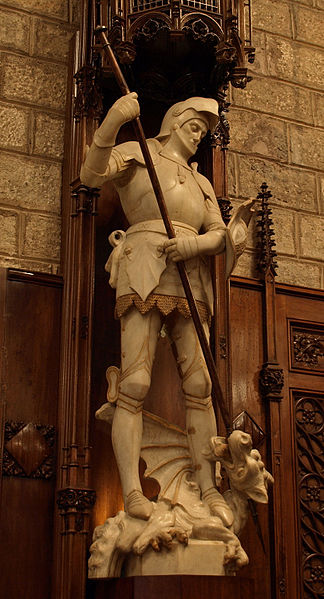
Statue of St. Antoninus. Photo by Sailko

Statue of St. Antoninus. Photo by Sailko

Of considerable importance are the manuals for confessors and penitents containing abridgments, reproductions, and translations from the “Summa” and frequently published in the fifteenth and sixteenth centuries under the name of St. Antoninus. An unsuccessful attempt has been made to show that he was not the author of the Italian editions. At the most is should be granted that he committed to others the task of editing one or two. The various editions and titles of the manuals have caused confusion, and made it appear that there were more than four distinct works. A careful distinction and classification is given by Mandonnet in the “Dictionnaire de théologie catholique”. Of value as throwing light upon the home life of his time are his treatises on Christian life written for women of the Medici family and first published in the last century under the titles:—(1) “Opera a ben vivere…Con altri ammaestramenti”, ed. Father Palermo, one vol. (Florence, 1858) (2) “Regola di vita cristiana”, one vol. (Florence, 1866). His letters (Lettere) were collected and edited, some for the first time by Tommaso Corsetto, O.P., and published in one volume, at Florence, 1859.

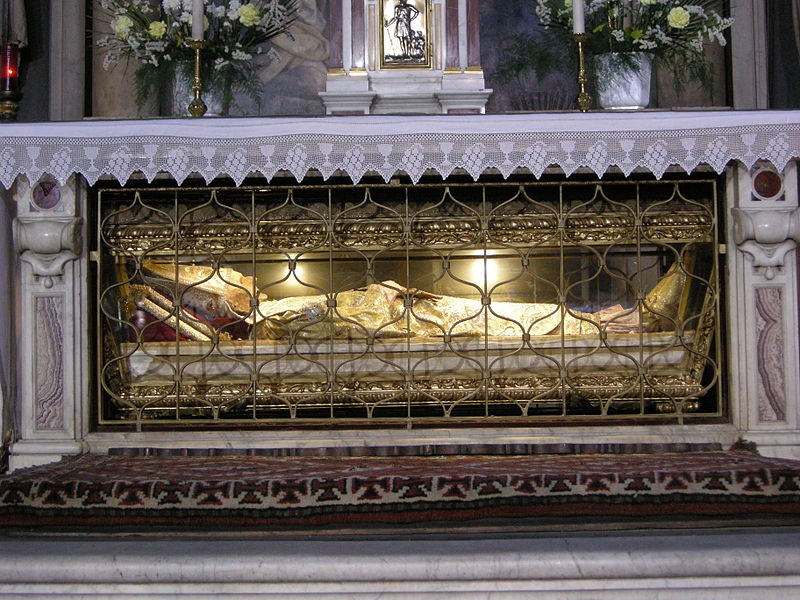
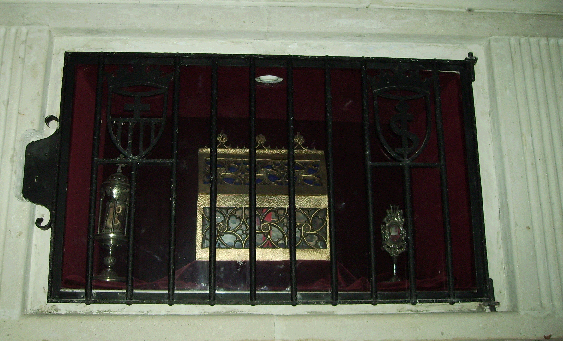
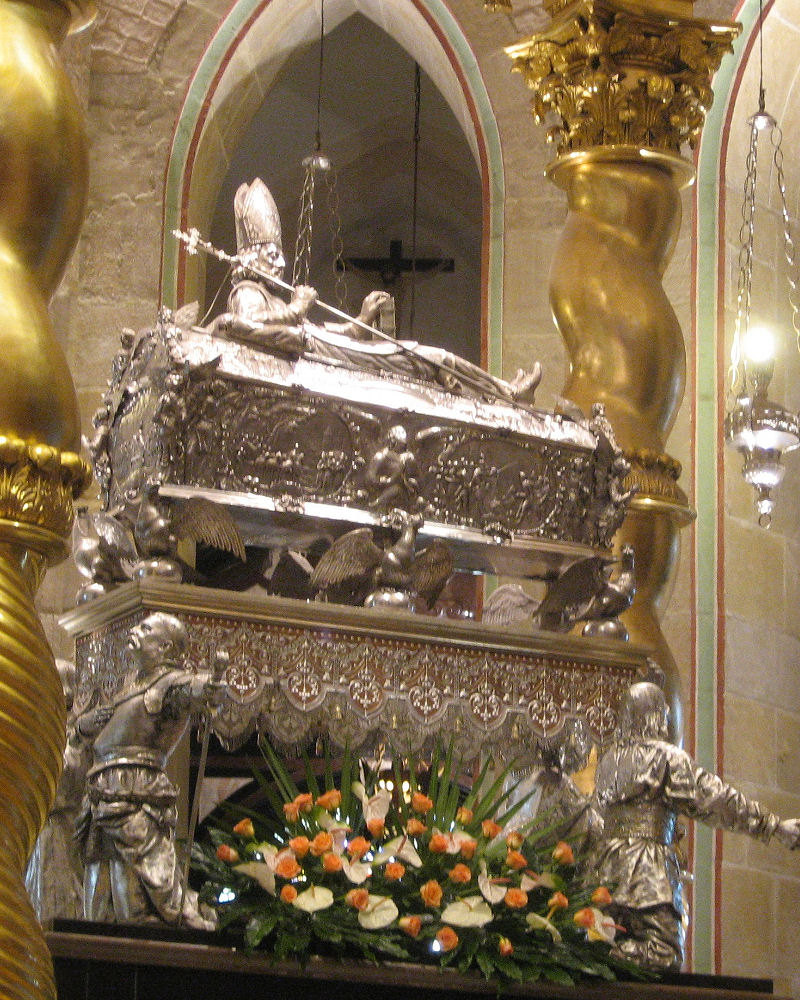
The relic of St. Antoniunus in Salviati Chapel of St. Mark's Church. Photo by Sailko

The relic of St. Antoniunus in Salviati Chapel of St. Mark’s Church. Photo by Sailko

Under the title, “Chronicon partibus tribus distincta ab initio mundi ad MCCCLX” (published also under the titles “Chronicorum opus” and “Historiarum opus”), he wrote a general history of the world with the purpose of presenting to his readers a view of the workings of divine providence. While he did not give way to his imagination or colour facts, he often fell into the error, so common among the chroniclers of his period, of accepting much that should historical criticism has since rejected as untrue or doubtful. But this can be said only of those parts in which he treated of early history. When writing of the events and politics of his own age he exercised a judgment that has been of the greatest value to later historians. The history was published at Venice, 1474-79, in four volumes of his “Opera Omnia” (Venice, 1480; Nuremberg, 1484; Basle, 1491; Lyons, 1517, 1527, 1585, 1586,1587). A work on preaching (De arte et vero modo praedicandi) ran through four editions at the close of the fifteenth century. The volume of sermons (Opus quadragesimalium et de sanctis sermonum, sive flos florum) is the work of another, although published under the name of St. Antoninus.

Subscription14.1

Unedited chronicles of the convents of St. Mark, Florence and St. Dominic, Fiesole: Quétif and Echard, SS. Ord. Praed.; Touron, Histoire des hommes illustres de l’ordre de S. Dominique; Maccarani, Vita di S. Antonino (Florence, 1708); Bartoli, Istoria dell’ arcivescovo S. Antonino e de suoi più illustri discepoli (Florence, 1782); Moro, Di S. Antonino in relazione alla riforma cattolica nel sec. XV (Florence, 1899); Schaube, Die Quellen der Weltchronik des heiligen Antoninus (Hirschberg, 1880).

A.L. MCMAHON (Catholic Encyclopedia)

{ 0 comments }

May 2 – St. Athanasius

April 30, 2026

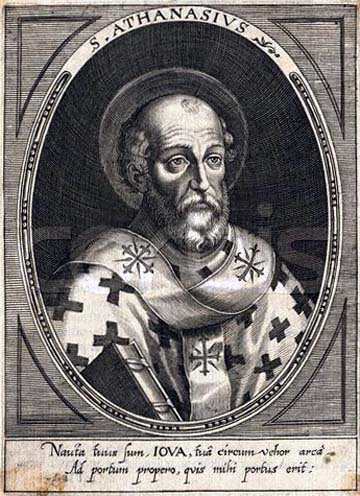
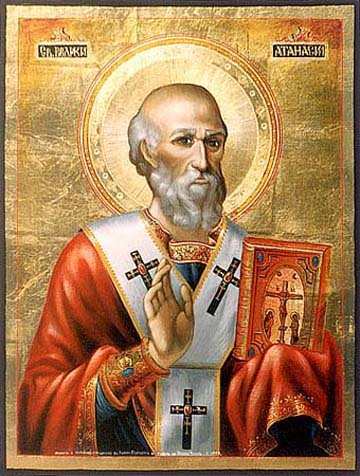
St. Athanasius

Bishop of Alexandria; Confessor and Doctor of the Church; born c. 296; died 2 May, 373. Athanasius was the greatest champion of Catholic belief on the subject of the Incarnation that the Church has ever known and in his lifetime earned the characteristic title of “Father of Orthodoxy”, by which he has been distinguished every since. While the chronology of his career still remains for the most part a hopelessly involved problem, the fullest material for an account of the main achievements of his life will be found in his collected writings and in the contemporary records of his time. He was born, it would seem, in Alexandria, most probably between the years 296 and 298. An earlier date, 293, is sometimes assigned as the more certain year of his birth; and it is supported apparently by the authority of the “Coptic Fragment” (published by Dr. O. von Lemm among the Mémoires de l’académie impériale des sciences de S. Péterbourg, 1888) and corroborated by the undoubted maturity of judgement revealed in the two treatises “Contra Gentes” and “De Incarnatione”, which were admittedly written about the year 318 before Arianism as a movement had begun to make itself felt. It must be remembered, however, that in two distinct passages of his writings (Hist. Ar., lxiv, and De Syn., xviii) Athanasius shrinks from speaking as a witness at first hand of the persecution which had broken out under Maximian in 303; for in referring to the events of this period he makes no direct appeal to his own personal recollections, but falls back, rather, on tradition. Such reserve would scarcely be intelligible, if, on the hypothesis of the earlier date, the Saint had been then a boy fully ten years old. Besides, there must have been some semblance of a foundation in fact for the charge brought against him by his accusers in after-life (Index to the Festal Letters) that at the times of his consecration to the episcopate in 328 he had not yet attained the canonical age of thirty years. These considerations, therefore, even if they are found to be not entirely convincing, would seem to make it likely that he was born not earlier than 296 nor later than 298.
St. AthanasiusIt is impossible to speak more than conjecturally of his family. Of the claim that it was both prominent and well-to-do, we can only observe that the tradition to the effect is not contradicted by such scanty details as can be gleaned from the saint’s writings. Those writings undoubtedly betray evidences of the sort of education that was given, for the most part, only to children and youths of a better class. It began with grammar, went on to rhetoric, and received its final touches under some one of the more fashionable lecturers in the philosophic schools. It is possible, of course, that he owed his remarkable training in letters to his saintly predecessor’s favour, if not to his personal care. But Athanasius was one of those rare personalities that derive incomparably more from their own native gifts of intellect and character than from the fortuitousness of descent or environment. His career almost personifies a crisis in the history of Christianity; and he may be said rather to have shaped the events in which he took part than to have been shaped by them. Yet it would be misleading to urge that he was in no notable sense a debtor to the time and place of his birth. The Alexandria of his boyhood was an epitome, intellectually, morally, and politically, of that ethnically many-coloured Graeco-Roman world, over which the Church of the fourth and fifth centuries was beginning at last, with undismayed consciousness, after nearly three hundred years of unwearying propagandism, to realize its supremacy. It was, moreover, the most important centre of trade in the whole empire; and its primacy as an emporium of ideas was more commanding than that of Rome or Constantinople, Antioch or Marseilles. Already, in obedience to an instinct of which one can scarcely determine the full significance without studying the subsequent development of Catholicism, its famous “Catechetical School”, while sacrificing no jot or tittle or that passion for orthodoxy which it had imbibed from Pantaenus, Clement, and Origen, had begun to take on an almost secular character in the comprehensiveness of its interests, and had counted pagans of influence among its serious auditors (Eusebius, Hist. Eccl., VI, xix).

To have been born and brought up in such an atmosphere of philosophizing Christianity was, in spite of the dangers it involved, the timeliest and most liberal of educations; and there is, as we have intimated, abundant evidence in the saint’s writings to testify to the ready response which all the better influences of the place must have found in the heart and mind of the growing boy. Athanasius seems to have been brought early in life under the immediate supervision of the ecclesiastical authorities of his native city. Whether his long intimacy with Bishop Alexander began in childhood, we have no means of judging; but a story which pretends to describe the circumstances of his first introduction to that prelate has been preserved for us by Rufinus (Hist. Eccl., I, xiv). The bishop, so the tale runs, had invited a number of brother prelates to meet him at breakfast after a great religious function on the anniversary of the martyrdom of St. Peter, a recent predecessor in the See of Alexandria. While Alexander was waiting for his guests to arrive, he stood by a window, watching a group of boys at play on the seashore below the house. He had not observed them long before he discovered that they were imitating, evidently with no thought of irreverence, the elaborate ritual of Christian baptism. (Cf. Bunsen’s “Christianity and Mankind”, London, 1854, VI, 465; Denzinger, “Ritus Orientalium” in verb.; Butler’s “Ancient Coptic Churches”, II, 268 et sqq.; “Bapteme chez les Coptes”, “Dict. Theol. Cath.”, Col. 244, 245). He therefore sent for the children and had them brought into his presence. In the investigation that followed it was discovered that one of the boys, who was no other than the future Primate of Alexandria, had acted the part of the bishop, and in that character had actually baptized several of his companions in the course of their play. Alexander, who seems to have been unaccountably puzzled over the answers he received to his inquiries, determined to recognize the make-believe baptisms as genuine; and decided that Athanasius and his playfellows should go into training in order to fit themselves for a clerical career. The Bollandists deal gravely with this story; and writers as difficult to satisfy as Archdeacon Farrar and the late Dean Stanley are ready to accept it as bearing on its face “every indication of truth” (Farrar, “Lives of the Fathers”, I, 337; Stanley, “East. Ch.” 264). But whether in its present form, or in the modified version to be found in Socrates (I, xv), who omits all reference to the baptism and says that the game was “an imitation of the priesthood and the order of consecrated persons”, the tale raises a number of chronological difficulties and suggests even graver questions.

Perhaps a not impossible explanation of its origin may be found in the theory that it was one of the many floating myths set in movement by popular imagination to account for the marked bias towards an ecclesiastical career which seems to have characterized the early boyhood of the future champion of the Faith. Sozomen speaks of his “fitness for the priesthood”, and calls attention to the significant circumstance that he was “from his tenderest years practically self-taught”. “Not long after this,” adds the same authority, the Bishop Alexander “invited Athanasius to be his commensal and secretary. He had been well educated, and was versed in grammar and rhetoric, and had already, while still a young man, and before reaching the episcopate, given proof to those who dwelt with him of his wisdom and acumen” (Soz., II, xvii). That “wisdom and acumen” manifested themselves in a various environment. While still a levite under Alexander’s care, he seems to have been brought for a while into close relations with some of the solitaries of the Egyptian desert, and in particular with the great St. Anthony, whose life he is said to have written. The evidence both of the intimacy and for the authorship of the life in question has been challenged, chiefly by non-Catholic writers, on the ground that the famous “Vita” shows signs of interpolation. Whatever we may think of the arguments on the subject, it is impossible to deny that the monastic idea appealed powerfully to the young cleric’s temperament, and that he himself in after years was not only at home when duty or accident threw him among the solitaries, but was so monastically self-disciplined in his habits as to be spoken of as an “ascetic” (Apol. c. Arian., vi). In fourth-century usage the word would have a definiteness of connotation not easily determinable today.

It is not surprising that one who was called to fill so large a place in the history of his time should have impressed the very form and feature of his personality, so to say, upon the imagination of his contemporaries. St. Gregory Nazianzen is not the only writer who has described him for us (Orat. xxi, 8). A contemptuous phrase of the Emperor Julian’s (Epist., li) serves unintentionally to corroborate the picture drawn by kindlier observers. He was slightly below the middle height, spare in build, but well-knit, and intensely energetic. He had a finely shaped head, set off with a thin growth of auburn hair, a small but sensitively mobile mouth, an aquiline nose, and eyes of intense but kindly brilliancy. He had a ready wit, was quick in intuition, easy and affable in manner, pleasant in conversation, keen, and, perhaps, somewhat too unsparing in debate. (Besides the references already cited, see the detailed description given in the January Menaion quotes in the Bollandist life. Julian the Apostate, in the letter alluded to above sneers at the diminutiveness of his person — mede aner, all anthropiokos euteles, he writes.) In addition to these qualities, he was conspicuous for two others to which even his enemies bore unwilling testimony. He was endowed with a sense of humour that could be as mordant — we had almost said as sardonic — as it seems to have been spontaneous and unfailing; and his courage was of the sort that never falters, even in the most disheartening hour of defeat. There is one other note in this highly gifted and many-sided personality to which everything else in his nature literally ministered, and which must be kept steadily in view, if we would possess the key to his character and writing and understand the extraordinary significance of his career in the history of the Christian Church. He was by instinct neither a liberal nor a conservative in theology. Indeed the terms have a singular inappropriateness as applied to a temperament like his. From first to last he cared greatly for one thing and one thing only; the integrity of his Catholic creed. The religion it engendered in him was obviously — considering the traits by which we have tried to depict him — of a passionate and consuming sort. It began and ended in devotion to the Divinity of Jesus Christ. He was scarcely out of his teens, and certainly not in more than deacon’s orders, when he published two treatises, in which his mind seemed to strike the keynote of all its riper after-utterances on the subject of the Catholic Faith. The “Contra Gentes” and the “Oratio de Incarnatione” — to give them the Latin appellations by which they are more commonly cited — were written some time between the years 318 and 323. St. Jerome (De Viris Illust.) refers to them under a common title, as “Adversum Gentes Duo Libri”, thus leaving his readers to gather the impression which an analysis of the contents of both books certainly seems to justify, that the two treatises are in reality one.
St. AthanasiusAs a plea for the Christian position, addressed chiefly to both Gentiles and Jews, the young deacon’s apology, while undoubtedly reminiscential in methods and ideas of Origen and the earlier Alexandrians, is, nevertheless, strongly individual and almost pietistic in tone. Though it deals with the Incarnation, it is silent on most of those ulterior problems in defence of which Athanasius was soon to be summoned by the force of events and the fervour of his own faith to devote the best energies of his life. The work contains no explicit discussion of the nature of the Word’s Sonship, for instance; no attempt to draw out the character of Our Lord’s relation to the Father; nothing, in short, of those Christological questions upon which he was to speak with such splendid and courageous clearness in time of shifting formularies and undetermined views. Yet those ideas must have been in the air (Soz., I, xv) for, some time between the years 318 and 320, Arius, a native of Libya (Epiph., Haer., lxix) and priest of the Alexandrian Church, who had already fallen under censure for his part in the Meletian troubles which broke out during the episcopate of St. Peter, and whose teachings had succeeded in making dangerous headway, even among “the consecrated virgins” of St. Mark’s see (Epiph. Haer., lxix; Soc., Hist. Eccl., I, vi), accused Bishop Alexander of Sabellianism. Arius, who seems to have presumed on the charitable tolerance of the primate, was at length deposed (Apol. c. Ar., vi) in a synod consisting of more than one hundred bishops of Egypt and Libya (Depositio Ar., 3). The condemned heresiarch withdrew first to Palestine and afterwards to Bithynia, where, under the protection of Eusebius of Nicomedia and his other “Collucianists”, he was able to increase his already remarkable influence, while his friends were endeavouring to prepare a way for his forcible reinstatement as priest of the Alexandrian Church. Athanasius, though only in deacon’s order, must have taken no subordinate part in these events. He was the trusted secretary and advisor of Alexander, and his name appears in the list of those who signed the encyclical letter subsequently issued by the primate and his colleagues to offset the growing prestige of the new teaching, and the momentum it was beginning to acquire from the ostentatious patronage extended to the deposed Arius by the Eusebian faction. Indeed, it is to this party and to the leverage it was able to exercise at the emperor’s court that the subsequent importance of Arianism as a political, rather than a religious, movement seems primarily to be due.

The heresy, of course, had its supposedly philosophic basis, which has been ascribed by authors, ancient and modern, to the most opposite sources. St. Epiphanius characterizes it as a king of revived Aristoteleanism (Haer., lxvii and lxxvi); and the same view is practically held by Socrates (Hist. Eccl., II, xxxv), Theodoret (Haer. Fab., IV, iii), and St. Basil (Adv. Eunom., I, ix). On the other hand, a theologian as broadly read as Petavius (De Trin., I, viii, 2) has no hesitation in deriving it from Platonism; Newman in turn (Arians of the Fourth Cent., 4 ed., 109) sees in it the influence of Jewish prejudices rationalized by the aid of Aristotelean ideas; while Robertson (Sel. Writ. and Let. of Ath. Proleg., 27) observes that the “common theology”, which was invariably opposed to it, Subscription5“borrowed its philosophical principles and method from the Platonists.” These apparently conflicting statements could, no doubt, be easily adjusted; but the truth is that the prestige of Arianism never lay in its ideas. From whatever school it may have been logically derived, the sect, as a sect, was cradled and nurtured in intrigue. Save in some few instances, which can be accounted for on quite other grounds, its prophets relied more upon curial influence than upon piety, or Scriptural knowledge, or dialectics. That must be borne constantly in mind, if we would not move distractedly through the bewildering maze of events that make up the life of Athanasius for the next half-century to come. It is his peculiar merit that he not only saw the drift of things from the very beginning, but was confident of the issue down to the last (Apol. c. Ar., c.). His insight and courage proved almost as efficient a bulwark to the Christian Church in the world as did his singularly lucid grasp of traditional Catholic belief. His opportunity came in the year 325, when the Emperor Constantine, in the hope of putting an end to the scandalous debates that were disturbing the peace of the Church, met the prelates of the entire Catholic world in council at Nicaea.

The great council convoked at this juncture was something more than a pivotal event in the history of Christianity. Its sudden, and, in one sense, almost unpremeditated adoption of a quasi-philosophic and non-Scriptural term — homoousion — to express the character of orthodox belief in the Person of the historic Christ, by defining Him to be identical in substance, or co-essential, with the Father, together with its confident appeal to the emperor to lend the sanction of his authority to the decrees and pronouncements by which it hoped to safeguard this more explicit profession of the ancient Faith, had consequences of the gravest import, not only to the world of ideas, but to the world of politics as well. By the official promulgation to the term homoöusion, theological speculation received a fresh but subtle impetus which made itself felt long after Athanasius and his supporters had passed away; while the appeal to the secular arm inaugurated a policy which endured practically without change of scope down to the publication of the Vatican decrees in our own time. In one sense, and that a very deep and vital one, both the definition and the policy were inevitable. It was inevitable in the order of religious ideas that any break in logical continuity should be met by inquiry and protest. It was just as inevitable that the protest, to be effective, should receive some countenance from a power which up to that moment had affected to regulate all the graver circumstances of life (cf. Harnack, Hist. Dog., III, 146, note; Buchanan’s tr.). As Newman has remarked: “The Church could not meet together in one, without entering into a sort of negotiation with the power that be; who jealousy it is the duty of Christians, both as individuals and as a body, if possible, to dispel” (Arians of the Fourth Cent., 4 ed., 241). Athanasius, though not yet in priest’s orders, accompanied Alexander to the council in the character of secretary and theological adviser. He was not, of course, the originator of the famous homoösion. The term had been proposed in a non-obvious and illegitimate sense by Paul of Samosata to the Father at Antioch, and had been rejected by them as savouring of materialistic conceptions of the Godhead (cf. Athan., “De Syn.,” xliii; Newman, “Arians of the Fourth Cent.,” 4 ed., 184-196; Petav. “De Trin.,” IV, v, sect. 3; Robertson, “Sel. Writ. and Let. Athan. Proleg.”, 30 sqq.).
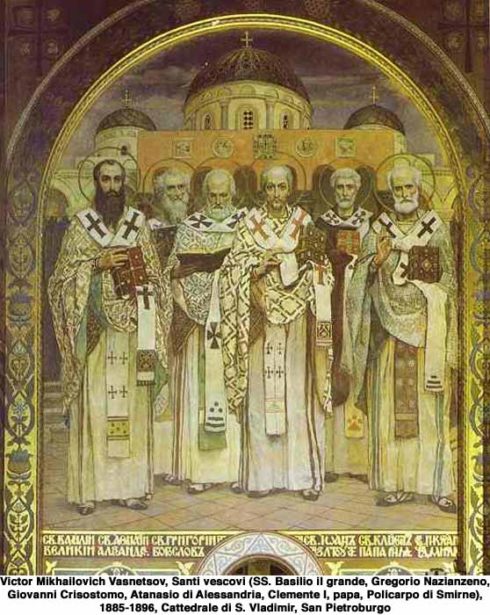
L to R: St. Basil, St. Gregory of Nazianzus, St. John Chrysostom, Painting (Icon) by by Viktor Vasnetsov

St. Athanasius is the fourth Saint from the left. Painting (Icon) by by Viktor Vasnetsov

It may even be questioned whether, if left to his own logical instincts, Athanasius would have suggested an orthodox revival of the term at all (“De Decretis”, 19; “Orat. c. Ar.”, ii, 32; “Ad Monachos”, 2). His writings, composed during the forty-six critical years of his episcopate, show a very sparing use of the word; and though, as Newman (Arians of the Fourth Cent., 4 ed., 236) reminds us, “the authentic account of the proceedings” that took place is not extant, there is nevertheless abundant evidence in support of the common view that it had been unexpectedly forced upon the notice of the bishops, Arian and orthodox, in the great synod by Constantine’s proposal to account the creed submitted by Eusebius of Caesarea, with the addition of the homoösion, as a safeguard against possible vagueness. The suggestion had in all probability come from Hosius (cf. “Epist. Eusebii.”, in the appendix to the “De Decretis”, sect. 4; Soc., “Hist. Eccl.”, I, viii; III, vii; Theod. “Hist. Eccl.”, I, Athan.; “Arians of the Fourth Cent.”, 6, n. 42; outos ten en Nikaia pistin exetheto, says the saint, quoting his opponents); but Athanasius, in common with the leaders of the orthodox party, loyally accepted the term as expressive of the traditional sense in which the Church had always held Jesus Christ to be the Son of God. The conspicuous abilities displayed in the Nicaean debates and the character for courage and sincerity he won on all sides made the youthful cleric henceforth a marked man (St. Greg. Naz., Orat., 21). His life could not be lived in a corner. Five months after the close of the council the Primate of Alexandria died; and Athanasius, quite as much in recognition of his talent, it would appear, as in deference to the deathbed wishes of the deceased prelate, was chosen to succeed him. His election, in spite of his extreme youth and the opposition of a remnant of the Arian and Meletian factions in the Alexandrian Church, was welcomed by all classes among the laity (“Apol. c. Arian”, vi; Soz., “Hist. Eccl.”, II, xvii, xxi, xxii).

The opening years of the saint’s rule were occupied with the wonted episcopal routine of a fourth-century Egyptian bishop. Episcopal visitations, synods, pastoral correspondence, preaching and the yearly round of church functions consumed the bulk of his time. The only noteworthy events of which antiquity furnishes at least probable data are connected with the successful efforts which he made to provide a hierarchy for the newly planted church in Ethiopia (Abyssinia) in the person of St. Frumentius (Rufinus I, ix; Soc. I, xix; Soz., II, xxiv), and the friendship which appears to have begun about this time between himself and the monks of St. Pachomius. But the seeds of disaster which the saint’s piety had unflinchingly planted at Nicaea were beginning to bear a disquieting crop at last. Already events were happening at Constantinople which were soon to make him the most important figure of his time. Eusebius of Nicomedia, who had fallen into disgrace and been banished by the Emperor Constantine for his part in the earlier Arian controversies, had been recalled from exile. After an adroit campaign of intrigue, carried on chiefly through the instrumentality of the ladies of the imperial household, this smooth-mannered prelate so far prevailed over Constantine as to induce him to order the recall of Arius likewise from exile. He himself sent a characteristic letter to the youthful Primate of Alexandria, in which he bespoke his favour for the condemned heresiarch, who was described as a man whose opinions had been misrepresented. These events must have happened some time about the close of the year 330. Finally the emperor himself was persuaded to write to Athanasius, urging that all those who were ready to submit to the definitions of Nicaea should be re-admitted to ecclesiastical communion. This Athanasius stoutly refused to do, alleging that there could be no fellowship between the Church and the one who denied the Divinity of Christ.

The Bishop of Nicomedia thereupon brought various ecclesiastical and political charges against Athanasius, which, though unmistakably refuted at their first hearing, were afterwards refurbished and made to do service at nearly every stage of his subsequent trials. Four of these were very definite, to wit: that he had not reached the canonical age at the time of his consecration; that he had imposed a linen tax upon the provinces; that his officers had, with his connivance and authority, profaned the Sacred Mysteries in the case of an alleged priest names Ischyras; and lastly that he had put one Arenius to death and afterwards dismembered the body for purposes of magic. The nature of the charges and the method of supporting them were vividly characteristic of the age. The curious student will find them set forth in picturesque detail in the second part of the Saint’s “Apologia”, or “Defense against the Arians”, written long after the events themselves, about the year 350, when the retractation of Ursacius and Valens made their publication triumphantly opportune. The whole unhappy story at this distance of time reads in parts more like a specimen of late Greek romance than the account of an inquisition gravely conducted by a synod of Christian prelates with the idea of getting at the truth of a series of odious accusations brought against one of their number. Summoned by the emperor’s order after protracted delays extended over a period of thirty months (Soz., II, xxv), Athanasius finally consented to meet the charges brought against him by appearing before a synod of prelates at Tyre in the year 335. Fifty of his suffragans went with him to vindicate his good name; but the complexion of the ruling party in the synod made it evident that justice to the accused was the last thing that was thought of. It can hardly be wondered at, that Athanasius should have refused to be tried by such a court. He, therefore, suddenly withdrew from Tyre, escaping in a boat with some faithful friends who accompanied him to Byzantium, where he had made up his mind to present himself to the emperor.
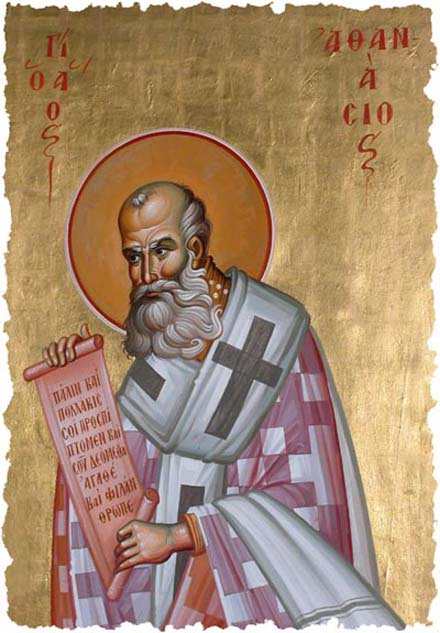
St. AthanasiusThe circumstances in which the saint and the great catechumen met were dramatic enough. Constantine was returning from a hunt, when Athanasius unexpectedly stepped into the middle of the road and demanded a hearing. The astonished emperor could hardly believe his eyes, and it needed the assurance of one of the attendants to convince him that the petitioner was not an impostor, but none other than the great Bishop of Alexandria himself. “Give me”, said the prelate, “a just tribunal, or allow me to meet my accusers face to face in your presence.” His request was granted. An order was peremptorily sent to the bishops, who had tried Athanasius and, of course, condemned him in his absence, to repair at once to the imperial city. The command reached them while they were on their way to the great feast of the dedication of Constantine’s new church at Jerusalem. It naturally caused some consternation; but the more influential members of the Eusebian faction never lacked either courage or resourcefulness. The saint was taken at his word; and the old charges were renewed in the hearing of the emperor himself. Athanasius was condemned to go into exile at Treves, where he was received with the utmost kindness by the saintly Bishop Maximinus and the emperor’s eldest son, Constantine. He began his journey probably in the month of February, 336, and arrived on the banks of the Moselle in the late autumn of the same year. His exile lasted nearly two years and a half. Public opinion in his own diocese remained loyal to him during all that time. It was not the least eloquent testimony to the essential worth of his character that he could inspire such faith. Constantine’s treatment of Athanasius at this crisis in his fortunes has always been difficult to understand. Affecting, on the one hand, a show of indignation, as if he really believed in the political charge brought against the saint, he, on the other hand, refused to appoint a successor to the Alexandrian See, a thing which he might in consistency have been obliged to do had he taken seriously the condemnation proceedings carried through by the Eusebians at Tyre.

Meanwhile events of the greatest importance had taken place. Arius had died amid startlingly dramatic circumstances at Constantinople in 336; and the death of Constantine himself had followed, on the 22nd of May the year after. Some three weeks later the younger Constantine invited the exiled primate to return to his see; and by the end of November of the same year Athanasius was once more established in his episcopal city. His return was the occasion of great rejoicing. The people, as he himself tells us, ran in crowds to see his face; the churches were given over to a kind of jubilee; thanksgivings were offered up everywhere; and clergy and laity accounted the day the happiest in their lives. But already trouble was brewing in a quarter from which the saint might reasonably have expected it. The Eusebian faction, who from this time forth loom large as the disturbers of his peace, managed to win over to their side the weak-minded Emperor Constantius to whom the East had been assigned in the division of the empire that followed on the death of Constantine. The old charges were refurbished with a graver ecclesiastical accusation added by way of rider. Athanasius had ignored the decision of a duly authorized synod. He had returned to his see without the summons of ecclesiastical authority (Apol. c. Ar., loc. cit.). In the year 340, after the failure of the Eusebian malcontents to secure the appointment of an Arian candidate of dubious reputation names Pistus, the notorious Gregory of Cappadocia was forcibly intruded into the Alexandrian See, and Athanasius was obliged to go into hiding. Within a very few weeks he set out for Rome to lay his case before the Church at large. He had made his appeal to Pope Julius, who took up his cause with a whole-heartedness that never wavered down to the day of that holy pontiff’s death. The pope summoned a synod of bishops to meet in Rome. After a careful and detailed examination of the entire case, the primate’s innocence was proclaimed to the Christian world.
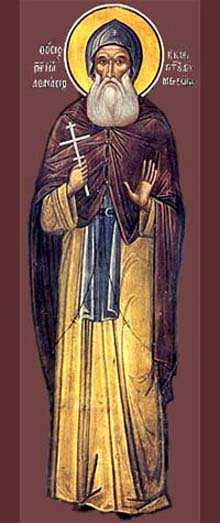
St. AthanasiusMeanwhile the Eusebian party had met at Antioch and passed a series of decrees framed for the sole purpose of preventing the saint’s return to his see. Three years were passed at Rome, during which time the idea of the cenobitical life, as Athanasius had seen it practised in the deserts of Egypt, was preached to the clerics of the West (St. Jerome, Epistle cxxvii, 5). Two years after the Roman synod had published its decision, Athanasius was summoned to Milan by the Emperor Constans, who laid before him the plan which Constantius had formed for a great reunion of both the Eastern and Western Churches. Now began a time of extraordinary activity for the Saint. Early in the year 343 we find the undaunted exile in Gaul, whither he had gone to consult the saintly Hosius, the great champion of orthodoxy in the West. The two together set out for the Council of Sardica which had been summoned in deference to the Roman pontiff’s wishes. At this great gathering of prelates the case of Athanasius was taken up once more; and once more was his innocence reaffirmed. Two conciliar letters were prepared, one to the clergy and faithful of Alexandria, and the other to the bishops of Egypt and Libya, in which the will of the Council was made known. Meanwhile the Eusebian party had gone to Philippopolis, where they issued an anathema against Athanasius and his supporters. The persecution against the orthodox party broke out with renewed vigour, and Constantius was induced to prepare drastic measures against Athanasius and the priests who were devoted to him. Orders were given that if the Saint attempted to re-enter his see, he should be put to death. Athanasius, accordingly, withdrew from Sardica to Naissus in Mysia, where he celebrated the Easter festival of the year 344. After that he set out for Aquileia in obedience to a friendly summons from Constans, to whom Italy had fallen in the division of the empire that followed on the death of Constantine. Meanwhile an unexpected event had taken place which made the return of Athanasius to his see less difficult than it had seemed for many months. Gregory of Cappadocia had died (probably of violence) in June, 345. The embassy which had been sent by the bishops of Sardica to the Emperor Constantius, and which had at first met with the most insulting treatment, now received a favourable hearing. Constantius was induced to reconsider his decision, owing to a threatening letter from his brother Constans and the uncertain condition of affairs of the Persian border, and he accordingly made up his mind to yield. But three separate letters were needed to overcome the natural hesitation of Athanasius. He passed rapidly from Aquileia to Treves, from Treves to Rome, and from Rome by the northern route to Adrianople and Antioch, where he met Constantius. He was accorded a gracious interview by the vacillating Emperor, and sent back to his see in triumph, where he began his memorable ten years’ reign, which lasted down to the third exile, that of 356. These were full years in the life of the Bishop; but the intrigues of the Eusebian, or Court, party were soon renewed. Pope Julius had died in the month of April, 352, and Liberius had succeeded him as Sovereign Pontiff. For two years Liberius had been favourable to the cause of Athanasius; but driven at last into exile, he was induced to sign an ambiguous formula, from which the great Nicene test, the homoöusion, had been studiously omitted. In 355 a council was held at Milan, where in spite of the vigorous opposition of a handful of loyal prelates among the Western bishops, a fourth condemnation of Athanasius was announced to the world. With his friends scattered, the saintly Hosius in exile, the Pope Liberius denounced as acquiescing in Arian formularies, Athanasius could hardly hope to escape. On the night of 8 February, 356, while engaged in services in the Church of St. Thomas, a band of armed men burst in to secure his arrest (Apol. de Fuga, 24). It was the beginning of his third exile.

Through the influence of the Eusebian faction at Constantinople, an Arian bishop, George of Cappadocia, was now appointed to rule the see of Alexandria. Athanasius, after remaining some days in the neighbourhood of the city, finally withdrew into the deserts of upper Egypt, where he remained for a period of six years, living the life of the monks and devoting himself in his enforced leisure to the composition of that group of writings of which we have the rest in the “Apology to Constantius”, the “Apology for his Flight”, the “Letter to the Monks”, and the “History of the Arians”. Legend has naturally been busy with this period of the Saint’s career; and we may find in the “Life of Pachomius” a collection of tales brimful of incidents, and enlivened by the recital of “deathless ‘scapes in the breach.” But by the close of the year 360 a change was apparent in the complexion of the anti-Nicene party. The Arians no longer presented an unbroken front to their orthodox opponents. The Emperor Constantius, who had been the cause of so much trouble, died 4 November, 361, and was succeeded by Julian. The proclamation of the new prince’s accession was the signal for a pagan outbreak against the still dominant Arian faction in Alexandria. George, the usurping Bishop, was flung into prison and murdered amid circumstances of great cruelty, 24 December (Hist. Aceph., VI). An obscure presbyter of the name of Pistus was immediately chosen by the Arians to succeed him, when fresh news arrived that filled the orthodox party with hope. An edict had been put forth by Julian (Hist. Aceph., VIII) permitting the exiled bishops of the “Galileans” to return to their “towns and provinces”. Athanasius received a summons from his own flock, and he accordingly re-entered his episcopal capital 22 February, 362. With characteristic energy he set to work to re-establish the somewhat shattered fortunes of the orthodox party and to purge the theological atmosphere of uncertainty. To clear up the misunderstandings that had arisen in the course of the previous years, an attempt was made to determine still further the significance of the Nicene formularies. In the meanwhile, Julian, who seems to have become suddenly jealous of the influence that Athanasius was exercising at Alexandria, addressed an order to Ecdicius, the Prefect of Egypt, peremptorily commanding the expulsion of the restored primate, on the ground that he had never been included in the imperial act of clemency. The edict was communicated to the bishop by Pythicodorus Trico, who, though described in the “Chronicon Athanasianum” (xxxv) as a “philosopher”, seems to have behaved with brutal insolence. On 23 October the people gathered about the proscribed bishop to protest against the emperor’s decree; but the saint urged them to submit, consoling them with the promise that his absence would be of short duration. The prophecy was curiously fulfilled. Julian terminated his brief career 26 June, 363; and Athanasius returned in secret to Alexandria, where he soon received a document from the new emperor, Jovian, reinstating him once more in his episcopal functions. His first act was to convene a council which reaffirmed the terms of the Nicene Creed. Early in September he set out for Antioch, bearing a synodal letter, in which the pronouncements of this council had been embodied. At Antioch he had an interview with the new emperor, who received him graciously and even asked him to prepare an exposition of the orthodox faith. But in the following February Jovian died; and in October, 364, Athanasius was once more an exile.
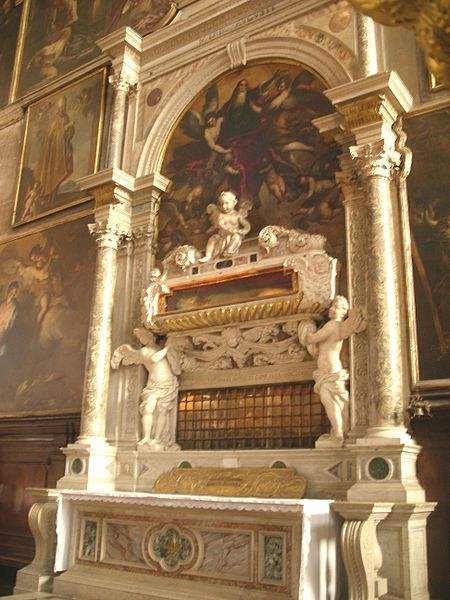
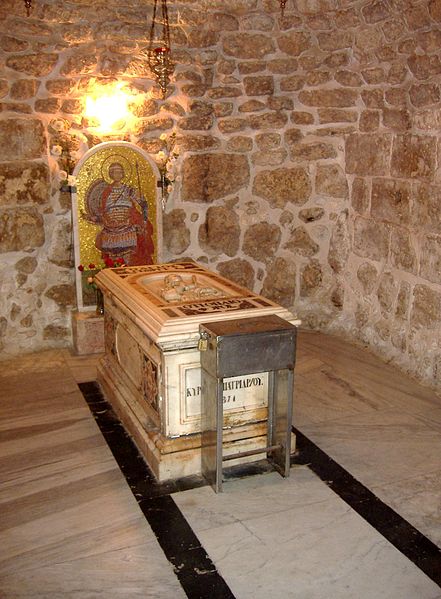
Double reliquary with the tomb of St. Zechariah, father of John the Baptist and Saint Athanasius in the Church of San Zaccaria Venice.

Double reliquary with the tomb of St. Zechariah, father of John the Baptist and Saint Athanasius in the Church of San Zaccaria Venice.

With the turn of circumstances that handed over to Valens the control of the East this article has nothing to do; but the accession of the emperor gave a fresh lease of life to the Arian party. He issued a decree banishing the bishops who has been deposed by Constantius, but who had been permitted by Jovian to return to their sees. The news created the greatest consternation in the city of Alexandria itself, and the prefect, in order to prevent a serious outbreak, gave public assurance that the very special case of Athanasius would be laid before the emperor. But the saint seems to have divined what was preparing in secret against him. He quietly withdrew from Alexandria, 5 October, and took up his abode in a country house outside the city. It was during this period that he is said to have spent four months in hiding in his father’s tomb (Soz., “Hist. Eccl.”, VI, xii; Doc., “Hist. Eccl.”, IV, xii). Valens, who seems to have sincerely dreaded the possible consequences of a popular outbreak, gave order within a very few weeks for the return of Athanasius to his see. And now began that last period of comparative repose which unexpectedly terminated his strenuous and extraordinary career. He spent his remaining days, characteristically enough, in re-emphasizing the view of the Incarnation which had been defined at Nicaea and which has been substantially the faith of the Christian Church from its earliest pronouncement in Scripture down to its last utterance through the lips of Pius X in our own times. “Let what was confessed by the Fathers of Nicaea prevail”, he wrote to a philosopher-friend and correspondent in the closing years of his life (Epist. lxxi, ad Max.). That that confession did at last prevail in the various Trinitarian formularies that followed upon that of Nicaea was due, humanly speaking, more to his laborious witness than to that of any other champion in the long teachers’ roll of Catholicism. By one of those inexplicable ironies that meet us everywhere in human history, this man, who had endured exile so often, and risked life itself in defence of what he believed to be the first and most essential truth of the Catholic creed, died not by violence or in hiding, but peacefully in his own bed, surrounded by his clergy and mourned by the faithful of the see he had served so well. His feast in the Roman Calendar is kept on the anniversary of his death.

[Note on his depiction in art: No accepted emblem has been assigned to him in the history of western art; and his career, in spite of its picturesque diversity and extraordinary wealth of detail, seems to have furnished little, if any, material for distinctive illustration. Mrs. Jameson tells us that according to the Greek formula, “he ought to be represented old, bald-headed, and with a long white beard” (Sacred and Legendary Art, I, 339).]

All the essential materials for the Saint’s biography are to be found in his writings, especially in those written after the year 350, when the Apologia contra Arianos was composed. Supplementary information will be found in ST. EPIPHANIUS, Hoer., loc. cit.; in ST. GREGORY OF NAZIANZUS, Orat., xxi; also RUFINUS, SOCRATES, SOZMEN, and THEODORET. The Historia Acephala, or Maffeian Fragment (discovered by Maffei in 1738, and inserted by GALLANDI in Bibliotheca Patrum, 1769), and the Chronicon Athanasianum, or Index to the Festal Letters, give us data for the chronological problem. All the foregoing sources are included in MIGNE, P. G. and P. L. The great PAPEBROCH’S Life is in the Acta SS., May, I. The most important authorities in English are: NEWMAN, Arians of the Fourth Century, and Saint Athanasius; BRIGHT, Dictionary of Christian Biography; ROBERTSON, Life, in the Prolegomena to the Select Writings and Letters of Saint Athanasius (re-edited in Library of the Nicene and post-Nicene Fathers, New York, 1903); GWATKIN, Studies of Arianism (2d ed., Cambridge, 1900); MOHLER, Athanasius der Grosse; HERGENROTHER and HEFELE.

CORNELIUS CLIFFORD (Catholic Encyclopedia)
{ 0 comments }

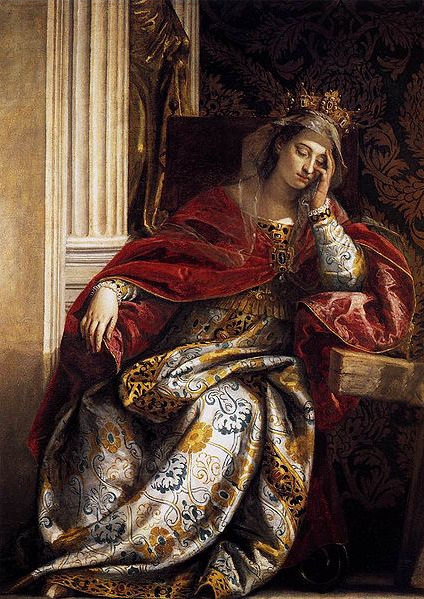
The Vision of Saint Helena by Paolo Veronese

The Vision of Saint Helena by Paolo Veronese

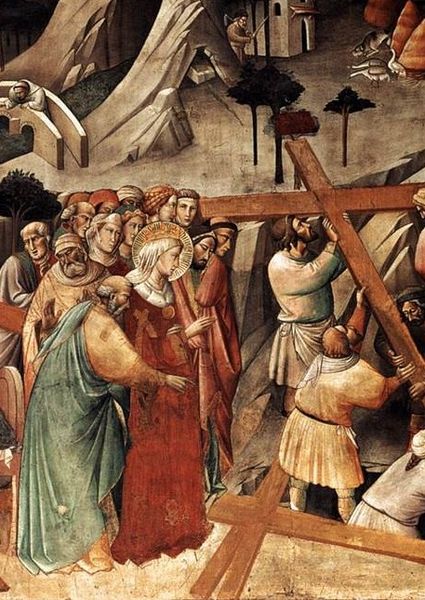
In the year 326 the mother of Constantine, Helena, then about 80 years old, having journeyed to Jerusalem, undertook to rid the Holy Sepulchre of the mound of earth heaped upon and around it, and to destroy the pagan buildings that profaned its site. Some revelations which she had received gave her confidence that she would discover the Saviour’s Tomb and His Cross. The work was carried on diligently, with the co-operation of St. Macarius, bishop of the city. The Jews had hidden the Cross in a ditch or well, and covered it over with stones, so that the faithful might not come and venerate it. Only a chosen few among the Jews knew the exact spot where it had been hidden, and one of them, named Judas, touched by Divine inspiration, pointed it out to the excavators, for which act he was highly praised by St. Helena. Judas afterwards became a Christian saint, and is honoured under the name of Cyriacus.

Finding the True Cross Painted by Agnolo Gaddi

Finding the True Cross Painted by Agnolo Gaddi

During the excavation three crosses were found, but because the titulus was detached from the Cross of Christ, there was no means of identifying it. Following an inspiration from on high, Macarius caused the three crosses to be carried, one after the other, to the bedside of a worthy woman who was at the point of death. The touch of the other two was of no avail; but on touching that upon which Christ had died the woman got suddenly well again. From a letter of St. Paulinus to Severus inserted in the Breviary of Paris it would appear that St. Helena herself had sought by means of a miracle to discover which was the True Cross and that she caused a man already dead and buried to be carried to the spot, whereupon, by contact with the third cross, he came to life. From yet another tradition, related by St. Ambrose, it would seem that the titulus, or inscription, had remained fastened to the Cross.

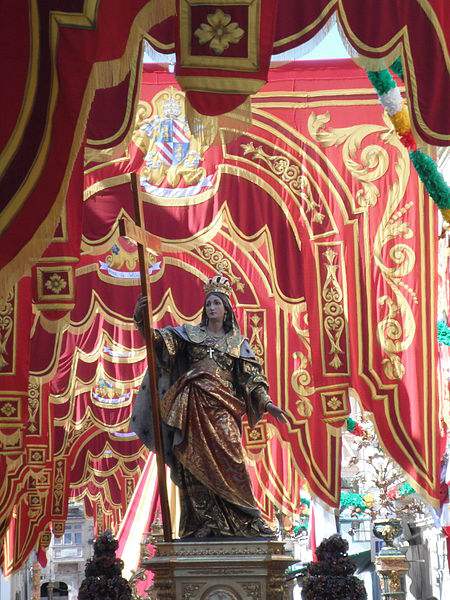
Statue of Saint Helena in procession in Birkirkara, Malta. Photo by Daniel Laus

Statue of Saint Helena in procession in Birkirkara, Malta. Photo by Daniel Laus

After the happy discovery, St. Helena and Constantine erected a magnificent basilica over the Holy Sepulchre, and that is the reason why the church bore the name of St. Constantinus. The precise spot of the finding was covered by the atrium of the basilica, and there the Cross was set up in an oratory, as appears in the restoration executed by de Vogüé. When this noble basilica had been destroyed by the infidels, Arculfus, in the seventh century, enumerated four buildings upon the Holy Places around Golgotha, and one of them was the “Church of the Invention” or “of the Finding”. This church was attributed by him and by topographers of later times to Constantine. The Frankish monks of Mount Olivet, writing to Leo III, style it St. Constantinus. Perhaps the oratory built by Constantine suffered less at the hands of the Persians than the other buildings, and so could still retain the name and style of Martyrium Constantinianum. (See De Rossi, Bull. d’ arch. crist., 1865, 88.)

(cfr. Catholic Encyclopedia: Cross and Crucifix)

Subscription6.1


{ 3 comments }

St. Ansfried of Utrecht

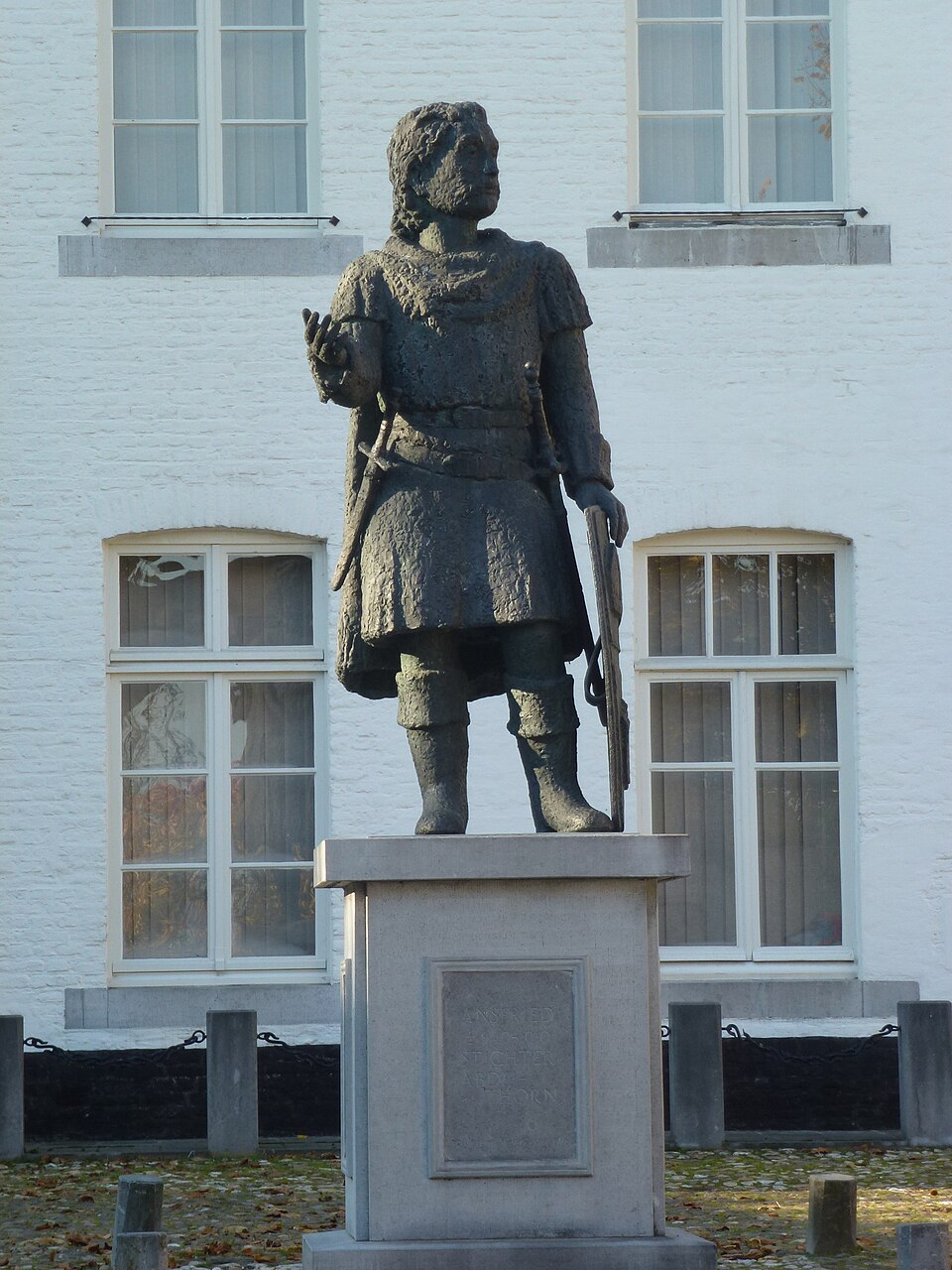
Ansfried (aka Ansfridus or Aufridus) was born ca. 940, and died May 3, 1010 near Leusden.) He was a nobleman in the Holy Roman Empire and sword-bearer for Otto I, Holy Roman Emperor. Till 995 he was Count of Huy, then he became bishop of Utrecht. He is also the founder of monasteries in Thorn (990) and Hohorst in Leusden. He has been canonized and is celebrated on the day he died, May 3.

Statue of St. Ansfried of Utrecht in the square next to St. Michael’s church of Thorn in the Netherlands. The Church is usually called Abdijkerk Thorn. Photo by Rosemoon.

Ansfried was born about 940 in a Frankish noble family. First he was raised to 956 by his uncle Ruotbert of Trier and then by Archbishop Bruno of Cologne. He went along with King Otto I, when they besieged Rome in 961 to be there to be crowned emperor.

Subscription16

He married in 966 Lady Heresuint or Hilsondis and together they founded the Abbey of Thorn. Their daughter, Benedicta, was its first abbess. Ansfried became Count of Huy and became known as the knight with the great sense of justice, who subdued and prosecuted highwaymen without pity. He was praised for his character and education. Many came to him for advice.

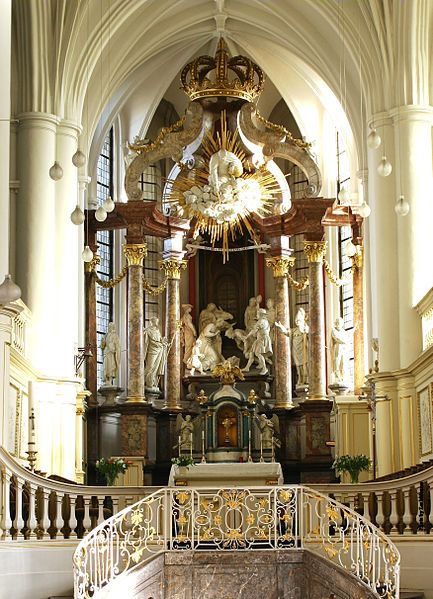
Choir section of the Abbey Church in Thorn.

Choir section of the Abbey Church in Thorn.

After a few years of marriage the pious spouses both made a vow of chastity. They were increasingly free from the worldly goods and gave substantial gifts to the churches and monasteries.

After the death of his wife in 994, Ansfried wanted to withdraw as a simple monk in a monastery, but Otto III made an urgent appeal to him to join the clergy and fill the vacant bishopric of Utrecht. Ansfried initially refused pleading old age, but after the insistence of the bishop of the principality of Liège, Ansfried accepted the appointment. He was consecrated bishop in the cathedral of Aachen. Then he laid his sword on the altar of the Blessed Virgin Mary and received the symbols of episcopal dignity. He donated his county to the Principality of Liège.

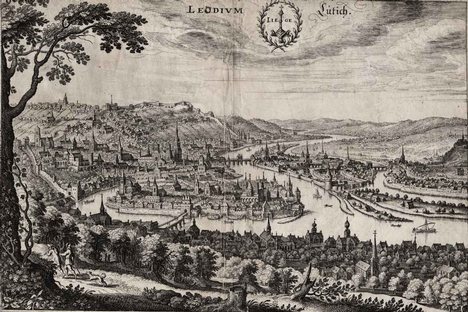
Principality of Liège

Principality of Liège

From 1006 he lived alternately in Utrecht, where he fulfilled his episcopal duties, and Heiligenberg, where he lived as a monk. In Utrecht he especially nursed the sick. His possessions, he made available to the poor, of whom he is said to have fed 72 daily. Also known is the story that he washed a leper, put him to sleep in his own bed, and sent him away the next day with clean clothes. His own blindness apparently not hindered him in these activities. He was even happy that his blindness could do penance for his sins.

{ 0 comments }

Élisabeth Leseur

Servant of God
Born     16 October 1866
Paris, France
Died     3 May 1914 (aged 47)
Paris, France

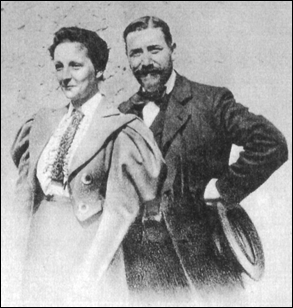
Élisabeth Arrighi Leseur (October 16, 1866–May 3, 1914), born Pauline Élisabeth Arrighi, was a French mystic best known for her spiritual diary and the conversion of her husband, Félix Leseur (1861–1950), a medical doctor and well known leader of the French anti-clerical, atheistic movement. The cause for the beatification of Elisabeth Leseur was started in 1934. Her current status in the process is that of a Servant of God.

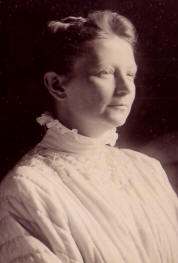
Élisabeth Arrighi Leseur

Élisabeth Arrighi Leseur

Contents

1 Life
2 Spirituality
3 Legacy
4 References

Life

Élisabeth was born in Paris to a wealthy bourgeois French family of Corsican descent. She had had hepatitis as a child, and it recurred throughout her life with attacks of varying severity. She met medical doctor Félix Leseur (1861–1950), also from an affluent, Catholic family in 1887. Shortly before they married on July 31, 1889, Élisabeth discovered that Félix was no longer a practicing Catholic. Dr. Félix Leseur soon became well known as the editor of an anti-clerical, atheistic newspaper in Paris.[citation needed] Well-to-do by birth and marriage, she was a part of a social group that was cultured, educated, and generally antireligious. The attachment of the couple was strong, though overshadowed by the childlessness of the marriage and their ever-growing religious disagreement.

Rather conventionally religious in her younger years, Élisabeth Leseur was prompted by the attacks of her husband against Christianity and religion to probe deeper into her faith. She thus underwent a religious conversion at the age of thirty-two. From this time on, she saw her major task in praying for the conversion of her husband, while remaining patient with his constant attacks on her faith.

Élisabeth Leseur & Dr. Felix Leseur

Élisabeth Leseur & Dr. Felix Leseur

When she was able, she worked on charitable projects for poor families and funded other charitable activities. Largerly unknown by her husband, she had a vast spiritual correspondence for many years. She was concerned about the “poor” or the “least,” but her deteriorating health restricted her ability to respond to this concern. In 1907 her health deteriorated to the extent that she was forced to lead a primarily sedentary life, receiving visitors and directing her household from a chaiselonge. In 1911 she had surgery and radiation for a malignant tumor, recovered, and then was bedridden by July 1913. She died from generalized cancer in May 1914.
Spirituality

From the beginning, she organized her spiritual life around a disciplined pattern of prayer, meditation, reading, sacramental practice, and writing. Charity was the organizing principle of her asceticism. In her approach to mortification, she followed Francis de Sales who recommended moderation and internal, hidden strategies instead of external practices.

Élisabeth Leseur

Élisabeth Leseur

Legacy

After her death, her husband found a note by her addressed to himself, that prophesied about his conversion and him becoming a priest. In order to get rid of such “superstition”, Félix left for the Marian shrine of Lourdes, wanting to expose the reports of the healings there as fake. At the Lourdes grotto however, he experienced a religious conversion. Félix subsequently published his wife’s journal, Journal et pensées pour chaque jour; and due to its favorable reception, a year later in 1918, published some of his wife’s letters under the title of Lettres sur la Souffrance. In the fall of 1919 he became a Dominican novice. He was ordained a priest in 1923 and spent much of his remaining twenty seven years publicly speaking about his wife’s spiritual writings. He was instrumental in opening the cause for Elisabeth’s beatification in 1934.

In the year 1924, Fulton J. Sheen, who would later become an archbishop and popular American television and radio figure, made a retreat under the direction of Fr. Leseur. During many hours of spiritual direction, Sheen learned of the life of Elisabeth and the conversion of Félix. Sheen subsequently repeated this conversion story in many of his presentations.

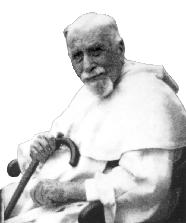
Fr. Felix Leseur, O.P.

Fr. Felix Leseur, O.P.

References

Leseur O.P., Fr. Felix, “In Memoriam”, Journal et pensees de chaque jour, Paris, 2005
Ruffing R.S.M. , Janet K., “Physical Illness: A Mystically Transformative Element in the Life of Elizabeth Leseur”, Spiritual Life, Vol.40, Number 4, Winter 1994
Ruffing R.S.M., Janet K., “Elizabeth Laseur: A Strangely Forgotten Modern Saint”, in Lay Sanctity, Medieval and Modern, Ann W. Astrell, ed.

* Sheen, Fulton J. “Marriage Problems” (part 40 of a recorded catechism, available online]

Subscription21

{ 0 comments }

Giacomo Rho

Imperial Obsrvatory in Beijing, China

Missionary, born at Milan, 1593; died at Peking 27 April, 1638. He was the son of a noble and learned jurist, and at the age of twenty entered the Society of Jesus. While poor success attended his early studies, he was later very proficient in mathematics. After his ordination at Rome by Cardinal Bellarmine, he sailed in 1617 for the Far East with forty-four companions. After a brief stay at Goa he proceeded to Macao where, during the siege of that city by the Dutch, he taught the inhabitants the use of artillery and thus brought about its deliverance. This service opened China to him. He rapidly acquired the knowledge of the native language and was summoned in 1631 by the emperor to Peking for the reform of the Chinese calendar. With Father Schall he worked to the end of his life at this difficult task. When he died, amidst circumstances exceptionally favourable to the Catholic mission, numerous Chinese officials attended his funeral. He left works relative to the correction of the Chinese calendar, to astronomical and theological questions.

DE BACKER-SOMMERVOGEL, Biblioth. de la Comp. de Jésus, VI (9 vols., Brussels and Paris, 1890-1900), 1709-11; HUC, Christianity in China, Tartary and Thibet, II (tr. New York, 1884), 265-66.

N. A. WEBER (Catholic Encyclopedia)
{ 0 comments }

St. Zita

Painting of St. Zita by Arnould de Vuez and photographed by Velvet at the Hospice Comtesse.

Model and heavenly patroness of domestic servants, born early in the thirteenth century of a poor family at Montsegradi, a little village near Lucca, in Tuscany; died at Lucca, 27 April, 1271. A naturally happy disposition and the teaching of a virtuous mother, aided by Divine grace, developed in the child’s soul that sweetness and modesty of character and continual and conscientious application to work which constituted her especial virtues. At the age of twelve she entered the service of the Fatinelli family of Lucca. Her piety and the exactitude with which she discharged her domestic duties, in which she regarded herself as serving God rather than man, even supplying the deficiencies of her fellow servants, far from gaining for her their love and esteem and that of her employers rather brought upon her every manner of ill-treatment of both the former and, through their accusations, of the latter. The incessant ill-usage, however, was powerless to deprive her of her inward peace, her love of those who wronged her, and her respect for her employers. By this meek and humble self-restraint she at last succeeded in overcoming the malice of her fellow-servants and her employers, so much so that she was placed in charge of all the affairs of the house.

In her position of command over all the servants she treated all with kindness, not exacting from them any reckoning for the wrongs she had for so many years suffered from them. She was always circumspect, and only severe when there was a question of checking the introduction of vice among the servants. On the other hand, if any of them had been guilty of shortcomings, she took upon herself to excuse or defend them to their employers. Using the ample authority given her by her employers, she was generous in almsgiving, but careful to assist only those really in need. After her death numerous miracles were wrought at her intercession, so that she came to be venerated as a saint in the neighbourhood of Lucca, and the poets Fazio degli Uberti (Dittamonde, III, 6) and Dante (Inferno, XI, 38) both designate the city of Lucca simply as “Santa Zita”. The office in her honour was approved by Leo X.

Miracle of St Zita by Bernardo Strozzi.

In 1580 her tomb was discovered in the Church of S. Frediano; thus was suggested the solemn approbation of her cult, which was granted by Innocent XII in 1696. The earliest biography of the saint is preserved in an anonymous manuscript belonging to the Fatinelli family which was published at Ferrara in 1688 by Monsignor Fatinelli, “Vita beatf Zitf virginis Lucensis ex vetustissimo codice manuscripto fideliter transumpta”. For his fuller “Vita e miracoli di S. Zita vergine lucchese” (Lucca, 1752) Bartolomeo Fiorito has used this and other notices, especially those taken from the process drawn up to prove the immemorial cult.

U. BENIGNI (Catholic Encyclopedia)
{ 0 comments }

Nicolò Albertini

(Aubertini)

Medieval statesman, b. at Prato in Italy, c. 1250; d. at Avignon, 27 April, 1321. His early education was directed by his parents, both of whom belonged to illustrious families of Tuscany. At the age of sixteen (1266) he entered the Dominican Order in the Convent of Santa Maria Novella at Florence, and was sent to the University of Paris to complete his studies. He preached in Italy with success, and his theological lectures were especially well attended at Florence and at Rome. He was entrusted by his superiors with various important duties and governed several houses. He was made Procurator-General of the whole order of St. Dominic by Blessed Nicolò Bocassini, then Master General, and was afterwards elected Provincial of the Roman Province. In 1299, Boniface VIII made him Bishop of Spoleto and soon afterwards sent him as Papal Legate to the Kings of France and England, Philip IV and Edward I, with a view to reconciling them, a seemingly hopeless task. Albertini succeeded in his mission. The Pope in full consistory thanked him, and made him Vicar of Rome. Benedict XI was particularly attached to Albertini, with whom he had lived a long time in the same cloister. Shortly after his accession to the Papacy (22 October, 1303) he made Albertini Cardinal-Bishop of Ostia and Dean of the Sacred College, which office he held for eighteen or nineteen years. The civil wars that in the thirteenth and fourteenth centuries had devastated a great part of Italy, especially Tuscany, Romagna, and the March of Trevi, caused the Pope again to invest the new Cardinal with the dignity of Apostolic Legate, and to send him to restore peace in those disturbed provinces. His authority was also extended to the Dioceses of Aquila, Ravenna, Ferara, and those in the territory of Venice. He was well received by the people of Florence, but after many futile efforts to effect a reconciliation between the Guelphs and the Ghibellines he left the city and placed it under interdict. On the 29th of June (1312), in the name of Clement V, he crowned Henry VII of Luxembourg at Rome. Albertini is the leading figure in the trial that exonerated the Dominican, Bernardo da Montepulciano, from the charge of killing this king by giving him a poisoned host for Communion. He crowned King Robert of Sicily, son and successor of Charles II. The Cardinal of Ostia was known for his great love for the poor, especially for the poor of the City of Prato. He also gave generously to religious houses and towards the erection of churches. At Avignon he established a community of nuns similar to those founded by St. Dominic at San Sisto in Rome. He obtained for his Order the office of “Master of the Sacred Palace”, that has always been held by a Dominican. Two small works are all that are known of his writings. One is a treatise on Paradise, the other on the manner of holding assemblies of Bishops. He was buried in the Dominican Church at Avignon.

Quétif and Echard, S.S. Ord. Præd., I, 546; Corner, Chronicon rerum Saxonicarum, in Seelen, De II. Kornero cujusque M.S. commentario (Lübeck, 1720); Cartellieri, in Neue Heidelberger Jahrbücher (1904), XIII, 121, 129.

Timothy Leonard Crowley (Catholic Encyclopedia)
{ 0 comments }

Ferdinand Magellan

(Portuguese Fernão Magalhaes).

The first circumnavigator of the real world; born about 1480 at Saborosa in Villa Real, Province of Traz os Montes, Portugal; died during his voyage of discovery on the Island of Mactan in the Philippines, 27 April 1521.

Ferdinand Magellan at the Naval Museum of Madrid.

He was the son of Pedro Ruy de Magalhaes, mayor of the town, and of Alda de Mezquita. He was brought up at the Court of Portugal and learned astronomy and the nautical sciences under good teachers, among whom may have been Martin Behaim. These studies filled him at an early age with enthusiasm for the great voyages of discovery which were being made at that period.

In 1505, he took part in the expedition of Francisco d’Almeida, which was equipped to establish the Portuguese viceroyalty in India, and in 1511 he performed important services in the Portuguese conquest of Malacca. He returned home in 1512 and took part in the Portuguese expedition to Morocco, where he was severely wounded. On account of a personal disagreement with the commander-in-chief, he left the army without permission. This and an unfavourable report that had been made upon him by Almeida led to his disgrace with the king.

Detail from a map of Ortelius – Magellan’s ship Victoria.

Condemned to inactivity and checked in his desire for personal distinction, he once more devoted himself to studies and projects to which he was mainly stimulated by the reports of the recently discovered Moluccas sent by his friend Serrão. Serrão so greatly exaggerated the distance of the Moluccas to the east of Malacca that the islands appeared to lie within the half of the world granted by the pope to Spain. Magellan therefore resolved to seek the Moluccas by sailing to the west around South America. As he could not hope to arouse interest for the carrying out of his plans in Portugal, and was himself, moreover misjudged and ignored, he renounced his nationality and offered his services to Spain. He received much aid from Diego Barbosa, warden of the castle of Seville, whose daughter he married, and from the influential Juan de Aranda, agent of the Indian office, who at once desired to claim the Moluccas for Spain. King Charles I of Spain (afterwards the Emperor Charles V) gave his consent as early as 22 March 1518, being largely influenced to do this by the advice of Cardinal Juan Rodriguez de Fonseca. The king made an agreement with Magellan which settled the different shares of ownership in the new discoveries, and the rewards to be granted the discoverer, and appointed him commander of the fleet. This fleet consisted of five vessels granted by the government; two 130 tons each, two of 90 tons each and one of 60 tons. They were provisioned for 234 persons for two years. Magellan commanded the chief ship, the Trinidad; Juan de Cartagena, the San Antonio; Gaspar de Quesada, the Conception; Luis de Mendoza, the Victoria; Juan Serrano, the Santiago. The expedition also included Duarte Barbosa, Barbosa’s nephew, the cosmographer Andrés de San Martín, and the Italian Antonio Pigafetta of Vicenza, to whom the account of the voyage is due.

Magellan took the oath of allegiance in the church of Santa María de la Victoria de Triana in Seville, and received the imperial standard. He also gave a large sum of money to the monks of the monastery in order that they might pray for the success of the expedition. The fleet sailed 20 September, 1519, from San Lucar de Barameda. They steered by way of the Cape Verde Islands to Cape St. Augustine in Brazil, then along the coast to the Bay of Rio Janerio (13 December), thence to the mouth of the Plata (10 January, 1520). In both these bodies of water a vain search was made for a passage to the western ocean. On 31 March Magellan decided to spend the winter below 49°15′ south latitude, and remained nearly five months in the harbour of San Julian. While in winter quarters here a mutiny broke out, so that Magellan was forced to execute Quesada and Mendoza, and put Cartagena ashore.

The voyage was resumed on 24 August, and on 21 October the fleet reached Cape Virgenes and, with it, the entrance to the long-sought straits. Those straits, which are 373 miles long, now bear the name of the daring discoverer, though he himself called them Canal de Todos los Santos (All Saints’ Channel). The San Antonio with the pilot Gomez on board secretly deserted and returned to Spain, while Magellan went on with the other ships. He entered the straits on 21 November and at the end of three weeks reached the open sea on the other side. As he found a very favourable wind, he gave the name of Mar Pacifico to the vast ocean upon which he now sailed for more than three months, suffering great privation during that time from lack of provisions. Keeping steadily to a northwesterly course, he reached the equator 13 February, 1521, and the Ladrones 6 March.

Magellan’s Cross is the cross planted by Portuguese and Spanish explorers as ordered by Ferdinand Magellan upon arriving in Cebu in the Philippines on 16( American Date)17( Philippines Date) March 1521. This cross is housed in a chapel next to the Basilica Minore del Santo Niño on Magallanes Street just in front of the city center of Cebu City. Photo by shankar s.

On 16 March Magellan discovered the Archipelago of San Lazaro, afterwards called the Philippines. He thought to stay here for a time, safe from the Portuguese, and rest his men and repair his ships, so as to arrive in good condition at the now not distant Moluccas. He was received in a friendly manner by the chief of the island of Cebú, who, after eight days, was baptized along with several hundred other natives. Magellan wished to subdue the neighbouring Island of Mactan and was killed there, 27 April, by the poisoned arrows of the natives. After both Duarte Barbosa and Serrano had also lost their lives on the island of Cebú, the ships Trinidad and Victoria set sail under the guidance of Carvalho and Gonzalo Vaz d’Espinosa and reached the Moluccas 8 November, 1521. Only the Victoria, with Sebastian del Cano as captain, and a crew of eighteen men, reached Spain (8 September, 1522). The ship brought back 533 hundredweight of cloves, which amply repaid the expenses of the voyage.

The death of Magellan

Magellan himself did not reach his goal, the Spice Islands; yet he had accomplished the most difficult part of his task. He had been the first to undertake the circumnavigation of the world, had carried out his project completely, and had thus achieved the most difficult nautical feat of all the centuries. The voyage proved most fruitful for science. It gave the first positive proof of the earth’s rotundity and the first true idea of the distribution of land and water.

Thanks to Magellan, the King and Queen of Cebu are baptized as Christians

Amoretti, Primo viaggio intorno al globo terracqueo (Milan, 1800) (a publication of the original MSS. of Pigafetta’s account, preserved in the Ambrosian Library, Milan, the Bibl. Nationale, Paris, and T. Fitzroy-Fenwick’s — formerly Sir T. Philipps’s — library, Cheltenham); Pigafetta, tr. and ed. Robertson, Magellan’s Voyage around the World, Original and Complete Text of the Oldest and Best MS. (the Ambrosian MS. of Milan of the early sixteenth century. Italian text with page for page of English and notes) (Cleveland, Ohio, 1905); Nunhez de Carvalho in Noticias para la historia e geographia das nacoes ultramarinas (6 vols., Lisbon, 1831), gives an extract from the diary of another member of the expedition, Mestro Bautista; Burck, Magellan oder erste Reise um die Erde (Leipzig, 1844); Barras Arama, Vida y viajes de Magellanes (Santiago, 1864); Stanley, The First Voyage Round the World (London, 1874); Wieser, Magalhaesstrasse u. austral-Continent (Innsbruck, 1881); Guillemard, Life of Ferdinand Magellan (London, 1890); Butterworth, The Story of Magellan and the Discovery of the Philippines (New Your, 1988); Kolliker, Die erste Umsegelung der Erde durch Fernando de Magellanes und Juan Sebastian del Cano, 1519-1522 Munich, 1908).

OTTO HARTIG (Catholic Encyclopedia)

{ 0 comments }

St. Peter Armengol was born in Guárdia dels Prats, a small village in the archdiocese of Tarragon, Spain in 1238. He belonged to the house of the barons of Rocafort, descendants of the counts of Urgel, whose ancestors were directly linked to the counts of Barcelona and the monarchs of Aragon and Castile.

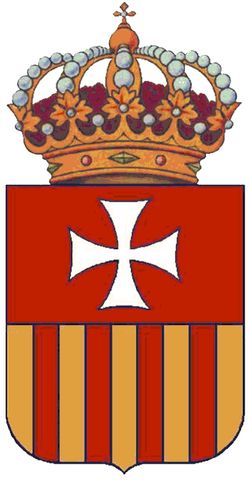
The emblem of Mercedarians (Order of Our Lady of Mercy).

The emblem of Mercedarians (Order of Our Lady of Mercy).

From Brigand to Convert
Despite the great care taken by his parents regarding his education, young Peter gave himself over to a life of total dissipation in the company of other dissolute youths who led him on the wide road of vice and caprice. “Abyssus abyssum invocat” – deep calleth on deep – say the Scriptures. Thus Peter joined a gang of criminals who, pursued by justice, led the life of bandits in the mountains. Soon the young Armengol became the leader of that gang.

On account of this bad behavior of his son, Arnold Armengol de Moncada moved to the kingdom of Valencia, recently conquered from the Moors by King Jaime.

This monarch had to embark upon a trip to Montpellier in order to deal with the King of France on grave matters of interest to both crowns. To travel safely, he commissioned Arnold to go before him on the road in order to rout any of the assailants who often robbed and even killed travelers in the region of the Pyrenees.

Subscription18

At the most dangerous part of the journey, the retinue of the noble Spaniard saw itself surrounded by brigands. Arnold rushed at them with his troops, wounding some and apprehending others. Warned that at a certain point the evildoers would defend themselves with particular energy, he spurred his horse forward with sword in hand and urged his men to attack with greater ardor in order to defeat the leader of the bandits. Indeed, Arnold himself was the first to encounter the leader, engaging him in hand-to-hand combat. Grief came upon both noble and brigand, however, when each realized whom he had wounded. Bathed in tears, Peter prostrated himself at the feet of his father, surrendering to him his sword, with it, his heart.

Penance for His Misdeeds
Filled with confusion and shame, the repentant youth retired to a Mercedarian monastery in Barcelona. With an ardent desire to repair the injuries done to God, he resolved the resolution to become a monk in that religious order founded by Saint Peter Nolasco to ransom Catholics captured by the Mohammedans. He requested the habit with such insistence and gave such conclusive proofs of his vocation that he was received there by the Venerable William de Bas, the French-born successor of the holy founder in the government of the Order.

St. Peter Armengol

St. Peter Armengol

The passions that had previously revolted with violence were now repressed with violence by Peter Armengol in religious life. He understood how to subdue them with such promptitude, through rigorous penances, mortification of the senses and continual prayer, that even before the end of his novitiate he had managed to subject them to the dominion of his will and reason.

During the eight years of his profession, he was entrusted with the important task of dealing directly with the ransom of captives. He carried out this function in the kingdoms of Granada and Murcia, provinces of Spain that were still in the power of the Saracens. Nonetheless, his greatest desire was to go to Africa and become a captive for the ransom of Christians.

On an expedition to that continent, he arrived in Bugia in the company of Friar William Florentino. There they ransomed 119 captives without any incident that would impede their return to their country. However, before departing, Friar Armengol learned of a prison with 18 children who, impelled by the threats of punishments of the barbarous Mohammedans, remained exposed to the danger of denying the Faith. The religious happily offered himself for the ransom of the innocent captives. His release was promised in exchange for a stipulated sum, but if the payment did not arrive within the set time he would suffer harsh punishments. Divine Providence had disposed that this man of God would thus give proof of his special confidence in the omnipotent mediation of the Blessed Virgin, to whom he was deeply devoted.

Saint_Peter_Armengol.jpg
Saint Peter Armengol, a model of unshakable confidence, sustained by the Blessed Virgin Mary.

Flaming Torch of Confidence
In captivity, Friar Armengol worked prodigies of charity among the infidels, converting many by the efficacy of his preaching, which was confirmed by many miracles.

The time prescribed for the delivery of the money came and passed without payment being made, so the infidels threw him into prison. There they denied him even the food necessary for his sustenance, but Our Lord, by means of His angels, miraculously provided for His most faithful servant.

Eventually tired of tormenting him, the Moors then conspired to take his life. They accused him of blaspheming and cursing Mohammed and of being a spy sent by the Christian kings, thus raising the ire of the Saracen judge who oversaw his case. The judge condemned Friar Peter to death by hanging.

Friar Armengol prayed to Our Lady and confided in her. In the hands of the infidels he could not defend himself, for he was nothing; he was mere dust. But, in truth, he was a flaming torch of confidence in Our Lady!

The unjust sentence was executed. Due to a prohibition imposed by the Moors, who wanted Peter’s body to serve as food for birds of prey, no one dared to take it down, so the body of the holy man remained suspended on the gallows. Six days went by; then Friar William arrived with the ransom money. Learning what had happened, he went with great sorrow and emotion, in the company of some captives, to see the lamentable sight. Upon approaching the site of the punishment he noted that the body, after so long a time, did not emit a bad odor but rather exhaled a heavenly fragrance. To the shock of all, Friar Armengol then spoke to him, telling him that the Blessed Mother had conserved his life in these circumstances so that this might be a perpetual reminder of her marvels. Astounded by the stupendous miracle, some pagans converted to the Catholic religion.

Conversations with the Queen of Angels
Barcelona, learning of the portentous miracle, impatiently awaited the return of the unconquerable martyr of Jesus Christ. In the city, they received him with indescribable joy, accompanying him from the port to his monastery, giving thanks to Our Lord for His marvels. The religious wanted to hear from Friar Peter’s mouth what had happened, but despite their earnest pleas, he would not speak. Finally, the superior ordered him to tell all that had occurred. Not resisting the voice of obedience, the man of God spoke these words: “The Virgin Mary, Mother of God and our own mother, asked her most holy Son to conserve my life. Having obtained this favor, this same sovereign Queen sustained me with her most holy hands, so that the weight of my body would not hang upon the rope by which I was suspended.” Upon saying these words he felt such a sweetness in his heart that he became enraptured in an admirable ecstasy.

The tomb of St. Peter Armengol in the church of St. Jaume at La Guàrdia dels Prats.

The tomb of St. Peter Armengol in the church of St. Jaume at La Guàrdia dels Prats.


Friar Peter Armengol thereafter always had a twisted neck and a pale color, most authentic signs of what had taken place. He retired to the monastery of Our Lady de los Prados, where his life was a continuous series of heroic virtues and familiar conversations with the Queen of Angels, whom he loved so dearly that it would be impossible to imagine a more reverent devotion or a more filial tenderness. Always remembering those days of his hanging, he told the religious of the monastery on the various occasions when he spoke to them of this marvel: “Believe me, my dear brothers, that I do not believe myself to have lived, except for those few but most happy days when, hanging from the gallows, I was held to be dead.”

Later assailed by a serious illness, he was given prophetic knowledge of the time of his death. He delivered his spirit into the hands of his Creator on April 27, 1304. Our Lord deigned to give proofs of the glorification of His servant with seven miracles, the cures of three men and four women, even before his venerable body could be buried. On March 28, 1686, Pope Innocent XI approved the public cult to the saint, and, in the eighteenth century, Pope Benedict XIV inscribed the name of Saint Peter Armengol in the Roman Martyrology.

The Tomb of the Saint
Today the remains of Saint Peter Armengol can be found in Guárdia dels Prats. The small village still preserves much of its ancient medieval character: tortuous, narrow streets; stone pavements; buildings that recall ancient palaces or noble residences; and a charming Romanesque-style church whose principal nave dates from the time of the Mercedarian saint.

The body of Saint Peter Armengol, as well as that of an illustrious contemporary, Blessed Oliva, were incorrupt until 1936. During the Spanish Civil War, communist militia invaded and sacked the church, carrying off the two venerable bodies to the public square where, burning them, they reduced them to ashes. Some children gathered up what they could of these ashes and took the precious remains to their homes, where their mothers kept them with great care. Later, after the communists were vanquished, the precious relics were returned to the church. These remains are today conserved together in a reliquary over the main altar of the church. Forgotten by the progressivism that has infiltrated and intoxicated so many Catholic circles, these ashes await better days, in silent testimony of the sanctity of the Catholic Church and Christian civilization.

{ 0 comments }

April 28 – Saint Egbert

April 27, 2026

Saint Egbert

Northumbrian monk, born of noble parentage c. 639; d. 729. In his youth he went for the sake of study to Ireland, to a monastery, says the Venerable Bede, “called Rathmelsigi”, identified by some with Mellifont in what is now County Louth. There, when in danger of death from pestilence, he prayed for time to do penance, vowing amongst other things to live always in exile from his own country. In consequence he never returned to England, though he lived to the age of ninety, and always fasted rigorously. Having become a priest, he was filled with zeal for the conversion of the still pagan German tribes related to the Angles, and would himself have become their apostle, if God had not shown him that his real calling was to other work. It was he, however, who dispatched to Friesland St. Wigbert, St. Willibrord, and other saintly missionaries. St. Egbert’s own mission was made known to him by a monk, who, at Melrose, had been a disciple of St. Boisil. Appearing to this monk, St. Boisil sent him to tell Egbert that the Lord willed him instead of preaching to the heathen to go to the monasteries of St. Columba, “because their ploughs were not going straight”, in consequence of their schismatic practice in the celebration of Easter. Leaving Ireland therefore in 716, Egbert crossed over to Iona, where the last thirteen years of his life were spent. By his sweetness and humility he induced the Iona monks to relinquish their erroneous mode of computation; in 729 they celebrated Easter with the rest of the Church upon April 24, although their old rule placed it that year upon an earlier day. On the same day, after saying Mass and joining joyfully in their celebration, the aged Egbert died. Though he is now honored simply as a confessor, it is probable that St. Egbert was a bishop. By Alcuin he is expressly called antistes and episcopus, and an Irish account of a synod at Birra names him “Egbert Bishop”, whilst the term sacerdos used by the Venerable Bede, is sometimes applied by him to bishops.

G. E. PHILLIPS (Catholic Encyclopedia)
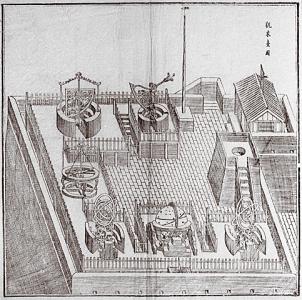
{ 0 comments }

The Burgundian town of Semur where St. Hugh the Great was born. Photo by Christophe Finot

Saint Hugh the Great, Abbot of Cluny, born at Semur (Brionnais in the Diocese of Autun), 1024; died at Cluny, 28 April, 1109.

His early life

The eldest son of Count Dalmatius of Semur and Aremberge (Aremburgis) of Vergy, Hugh was descended from the noblest families in Burgundy. Dalmatius, devoted to war and the chase, desired that Hugh should adopt the knightly calling and succeed to the ancestral estates; his mother, however, influenced it is said by a vision vouchsafed to a priest whom she consulted, wished her son to dedicate himself to the service of God. From his earliest years Hugh gave indication of such extraordinary earnestness and piety that his father, recognizing his evident aversion from the so-called gentle pursuits, entrusted him to his grand-uncle Hugh, Bishop of Auxerre, for preparation for the priesthood. Under the protection of this relative, Hugh received his early education at the monastery school attached to the Priory of St. Marcellus.

Statue of the Blessed Virgin Mary with the Christ Child, from the Abbey of Cluny. Photo by Harmonia Armand.

At the age of fourteen he entered the novitiate at Cluny, where he displayed such religious fervor that he was allowed to make his vows in the following year without completing the severe novitiate usual at this monastery. The special privilege of the Cluniac Congregation enabled him to become deacon at eighteen and priest at twenty. In recognition of his wonderful zeal for the discipline of the order, and of the confidence awakened by his conspicuous talent for government, he was quickly, in spite of his youth, chosen grand prior. In this capacity he was charged with the whole domestic direction of the cloister in both spiritual and temporal affairs, and represented the abbot during his absence (Cfr. D’Achery, “Spicilegium”, 2nd ed., I, 686). On the death of St. Odilo on 1 January, 1049, after a prolonged administration of nigh on half a century, Hugh was unanimously elected abbot, and was solemnly installed by Archbishop Hugh of Besançon on the Feast of the Chair of Peter at Antioch (22 February), 1049.

Very little of the original Abbey of Cluny survived the ravages of the French Revolution. This reconstructed model is by Hannes72

Hugh as abbot

Hugh’s character bears many points of resemblance to that of his great contemporary and friend, St. Gregory VII. Both were animated with a burning zeal to extirpate the abuses then prevalent among the clergy, to crush investiture with its corollaries, simony and clerical incontinence, and to rescue Christian society from the confusion into which the reckless ambition and avarice of rulers and the consequent political instability had thrown it. The emperor claimed the right to appoint bishops, abbot, even the Pope himself, and in too many cases his selection was swayed entirely by political motives to the exclusion of every thought of religious fitness. To prevent the Church from lapsing into a mere appanage of the State and to re-establish ecclesiastical discipline were the great objects alike of Gregory and Hugh, and if, in certain cases, Gregory allowed his zeal to outstrip his discretion, he found in Hugh an unflinching ally, and to the Benedictine Order, particularly the Cluniac branch, belongs the chief credit of promulgating among the people and carrying into effect in Western Europe the many salutary reforms emanating from the Holy See. In founding Cluny in 910, and endowing it with his entire domains, William the Pious of Aquitaine had placed it under the direct protection of Rome. Thus Cluny, with its network of daughter-foundations (see Cluny, Congregation of; Gallia Christ., II, 374), was a formidable weapon for reform in the hands of the successive Popes. Hugh entrusted the election of the superiors of all cloisters and churches subject to him into spiritual hands, promised them — in addition to the privileges of the congregation — the support and protection of Cluny, and thus saved hundreds of cloisters from the cupidity of secular lords, who were very loath to interfere with the rights of a congregation so powerful and enjoying such high favor with emperors and kings. To secure this protection numbers of cloisters became affiliated with Cluny; new houses were opened in France, Germany, Spain, and Italy, while under Hugh was also founded at St. Pancras near Lewes the first Benedictine house in England. (See, however, St. Augustine of Canterbury; St. Dunstan.) Since the superiors of most of these homes were either directly or indirectly nominated by Hugh, and since, as abbot, he had to ratify the elections, it is easy to understand how important a role he played in the great struggle between imperialism and the Holy See.

Simony was widespread and was one of the evils being addressed by the Church in the Investiture Question. In this woodcut, a king invests a bishop with the crozier and other insignia of his episcopal office, usurping the Pope’s sole right to do this.

As early as 1049, at the age of twenty-five, Hugh appeared at the Council of Reims. Here, at the request, and in the presence of Leo IX, he expressed so energetically against the reigning abuses that even the simoniacal bishops could not withstand his zeal. This advocacy contributed largely to the passing of many remedial ordinances concerning church discipline (cfr. Labbe, “Conc.”, IX, 1045-6), and led Leo IX to take Hugh with him to Rome that he might have the assistance and advice of the young abbot at the great council to be held in 1050, at which the question of clerical discipline was to be decided and the heresy of Berengarius condemned (cfr. Hefele, “Conciliengesch.”, IV, 741). Leo’s successor, Victor II, also held Hugh in the highest esteem, and confirmed in 1055 all the privileges of Cluny. On Hildebrand’s arrival in France as papal legate (1054), he hastened first to Cluny to consult with Hugh and secure his assistance at the Council of Tours. Stephen IX, immediately on his elevation, summoned Hugh to Rome, made him the companion of his journeys, and finally died in his arms at Florence (1058). Hugh was also the companion of Nicholas II, and under him took part in the Council of Rome which promulgated the important decree concerning papal elections (Easter, 1059). He was then sent to France with Cardinal Stephan, a Monk of Monte Cassino, to effect the execution of the decrees of the Roman synod, and proceeded to Aquitaine, while his colleague repaired to the northwest. The active support of the numerous cloisters subject to Cluny enabled him to discharge his mission with the greatest success. He assembled councils at Avignon and Vienne, and managed to win the support of the bishops for many important reforms. In the same year (1059) he presided over the Synod of Toulouse. At the Council of Rome in 1063 he defended the privileges of Cluny which had been recklessly attacked in France. Alexander II sent St. Peter Damian, Cardinal Bishop of Ostia, as legate to France to adjudicate in this and other matters, meanwhile ratifying all the privileges held by Hugh’s predecessors. After a stay at Cluny, during which he conceived the high admiration and veneration for the monastery and its abbot reflected in his letters (cfr. “Epist.”, VI, 2, 4, 5 in P.L., XCLIV, 378), the legate held a council at Châlons, which decided in favor of Hugh.

Pope Saint Gregory VII

Scarcely had Hildebrand ascended the Chair of Peter as Gregory VII when he wrote to Cluny to secure Hugh’s cooperation in promoting his various reforms. Hugh was entrusted to deal with the delicate case of the unworthy Archbishop Manasse of Reims, as well as with commissions in connection with the expedition of Count Evroul of Roucy against the Saracens in Spain. Frequently urged by Gregory to come to Rome, Hugh was unable to leave France until after the lamentable occurrences of 1076, but then hastened to visit the Pope at Canossa. With the assistance of Countess Mathilda, he managed to bring about the reconciliation — unfortunately of short duration — between Gregory and Henry IV, who had already addressed a letter full of affection declaring his great desire for the peace of the Church (cfr. “Hist. Lit. de la France”, loc. cit. infra). Hugh was subsequently engaged with the papal legate in Spain in the matter of ecclesiastical reform, and, as a result of his diligence and the high favor he enjoyed with Alphonsus VI of Castille, the Mozarabic was replaced by the Roman Ritual throughout that monarch’s realm. Thanks to the assistance of the many Cluniac foundations in Catalonia, Castille, Leon, Aragon, etc., and the many bishops chosen from their inmates, he was also enabled to give a great impetus to ecclesiastical reform in these countries. In 1077 he was commissioned to presides over the Council of Langres, and later to undertake the removal of the Bishop of Orleans and the Archbishop of Reims. Gregory wrote him many affectionate letters, and at the Roman synod in 1081 referred to Hugh in terms of praise seldom used by a successor of Peter concerning a living person. That this appreciation was not confined to the Holy Father is evident from the fact that, when asked by Gregory whether his opinion was shared by them, all present answered: “Placet, laudamus” (Bullar. Clun., p. 21).

Read More Here

{ 0 comments }

We must confess that the Tenth Commandment of chivalry has not been clearly formulated by our poets, and that we owe it to the Church as a matter of fact. “To combat all evil, to defend all good,” would not have come naturally to the minds of those descendants of Germans who had not been affected by the water of their baptism.

It would be quite possible to show, by a series of texts scientifically chosen and wisely graduated, that this philosophical and definitive formula only introduced itself by slow degrees into the current of our ancestors’ ideas. They did not reach such an astonishing height at a bound, and some of these apothegms—like certain poems, the Dies Irae for example—had to submit to a long incubation of four or five centuries.

TFP Protest against SatanCon in Boston, April 29-30.

In our old songs the maxim, “Combat all evil, defend all that is good,” presents itself principally, curiously enough, in a negative form. When the author of Gaydon sets himself to put forth the infernal Contra Code of Chivalry, he does not hesitate to put this abominable advise in the mouth of one of his traitors—


“Le Mal hauciez, et le Bien abatez.”

Elevate Evil and abase Good.

Nevertheless humanity could not be satisfied with these negative counsels; it had need of clear decisions, and it is the Church which has furnished them to mankind. The liturgy here rises on golden wings, and we rise with it to the highest summits. When William Durand collected, in the thirteenth century, the elements of that pontifical to which his name is attached, he took care to choose for the Benedictio novi militis this magnificent prayer:—

Kenai, Alaska Satanic Invocation Protest

“O God, Thou hast only permitted the use of the sword to curb the malice of the wicked and to defend the right. Grant, therefore, that Thy new knight may never use his sword to injure, unjustly, anyone, whoever he may be; but that he may use it always in defense of all that is just and right!”

“Omnia cum gladio suo justa et recta defendat.”

There exists a text still more characteristic, still more beautiful, which belongs also to the same epoch in which William Durand lived. When a new knight was dubbed at Rome in the splendid  basilica of St. Peter, which was the center of the Christian World, a sword was very solemnly handed to the warrior, “So that he may energetically exercise justice, and that he might overturn the triumphant edifice of iniquity, ‘ut vim aequitatis exerceret, et molem iniquitatis destrueret.’”

Protest against a Drag Queen Story Hour.

And again, farther on: “Remember, O knight, that you are to act as the defender of Order and as the avenger of Injustice. ‘Ulciscaris injusta, confirmes bene disposita.’” And the conclusion addressed to him in a grave voice, was, “It is on this condition, living here below as a copy of Christ, that you will reign eternally above with your Divine Model.”


That is the language they held at Rome, in the most august sanctuary in the world. Imagine, if you can, anything more elevated.

In any case, there it was; and the grand formula was definitively found.

León Gautier, Chivalry, trans. Henry Frith (London: George Routledge and Sons, Ltd., 1891), 72–3.

{ 0 comments }

St. Robert of Molesme

Born about the year 1029, at Champagne, France, of noble parents who bore the names of Thierry and Ermengarde; died at Molesme, 17 April, 1111.

Statue of St Robert of Molesme in Germany

Statue of St Robert of Molesme in Germany

When fifteen years of age, he commenced his novitiate in the Abbey of Montier-la-Celle, or St. Pierre-la-Celle, situated near Troyes, of which he became later prior. In 1068 he succeeded Hunaut II as Abbot of St. Michael de Tonnerre, in the Diocese of Langres.

About this time a band of seven anchorites who lived in the forest of Collan, in the same diocese, sought to have Robert for their chief, but the monks, despite their constant resistance to his authority, insisted on keeping their abbot who enjoyed so great a reputation, and was the ornament of their house. Their intrigues determined Robert to resign his charge in 1071, and seek refuge in the monastery of Montier-la-Celle. The same year he was placed over the priory of St. Ayoul de Provins, which depended on Montier-la-Celle. Meantime two of the hermits of Collan went to Rome and besought Gregory VII to give them the prior of Provins for their superior. The pope granted their request, and in 1074 Robert initiated the hermits of Collan in the monastic life. As the location at Collan was found unsuitable, Robert founded a monastery at Molesme in the valley of Langres at the close of 1075.

St. Robert of Molesme

To Molesme as a guest came the distinguished canon and doctor (écolâtre) of Reims, Bruno, who, in 1082, placed himself under the direction of Robert, before founding the celebrated order of the Chartreux. At this time the primitive discipline was still in its full vigor, and the religious lived by the labor of their hands. Soon, however, the monastery became wealthy through a number of donations, and with wealth, despite the vigilance of the abbot, came laxity of discipline. Robert endeavored to restore the primitive strictness, but the monks showed so much resistance that he abdicated, and left the care of his community to his prior, Alberic, who retired in 1093. In the following year he returned with Robert to Molesme. On 29 Nov., 1095, Urban II confirmed the institute of Molesme. In 1098 Robert, still unable to reform his rebellious monks, obtained from Hugues, Archbishop of Lyons and Legate of the Holy See, authority to found a new order on new lines. Twenty-one religious left Molesme and set out joyfully for a desert called Citeaux in the Diocese of Chalons, and the Abbey of Citeaux (q.v.) was founded 21 March, 1098.

Subscription15

The diffusion of the new order was chiefly effected by means of foundations. Nevertheless several congregations and monasteries, which had existed before the Order of Cîteaux, became affiliated to it, among them the Congregations of Savigny and Obazine, which were incorporated in the order in 1147. St. Bernard and other Cistercians took a very active part, too, in the establishment of the great military orders, and supplied them with their constitutions and their laws. Among these various orders of chivalry may be mentioned the Templars, the Knights of Calatrava, of St. Lazarus, of Alcantara, of Avis, of St. Maurice, of the Wing of St. Michael, of Montessa, etc.

(cfr. Catholic Encyclopedia)

{ 0 comments }

St. Adalbert of Bohemia

Born 939 of a noble Bohemian family; died 997.

Statue of St. Adalbert of Prague. Part of Wenceslas Monument on the Wenceslas Square in Prague. National Museum in the background.

Statue of St. Adalbert of Prague. Part of Wenceslas Monument on the Wenceslas Square in Prague. National Museum in the background.

He assumed the name of the Archbishop Adalbert (his name had been Wojtech), under whom he studied at Magdeburg. He became Bishop of Prague, whence he was obliged to flee on account of the enmity he had aroused by his efforts to reform the clergy of his diocese. He betook himself to Rome, and when released by Pope John XV from his episcopal obligations, withdrew to a monastery and occupied himself in the most humble duties of the house. Recalled by his people, who received him with great demonstrations of joy, he was nevertheless expelled a second time and returned to Rome.

Subscription24

The people of Hungary were just then turning towards Christianity. Adalbert went among them as a missionary, and probably baptized King Geysa and his family, and King Stephen. He afterwards evangelized the Poles, and was made Archbishop of Gnesen. But he again relinquished his see, and set out to preach to the idolatrous inhabitants of what is now the Kingdom of Prussia. Success attended his efforts at first, but his imperious manner in commanding them to abandon paganism irritated them, and at the instigation of one of the pagan priests he was killed. This was in the year 997.

His feast is celebrated 23 April, and he is called the Apostle of Prussia. Boleslas I, Prince of Poland, is said to have ransomed his body for an equivalent weight of gold. He is thought to be the author of the war-song, “Boga-Rodzica”, which the Poles used to sing when going to battle.

T.J. CAMPBELL (Catholic Encyclopedia)
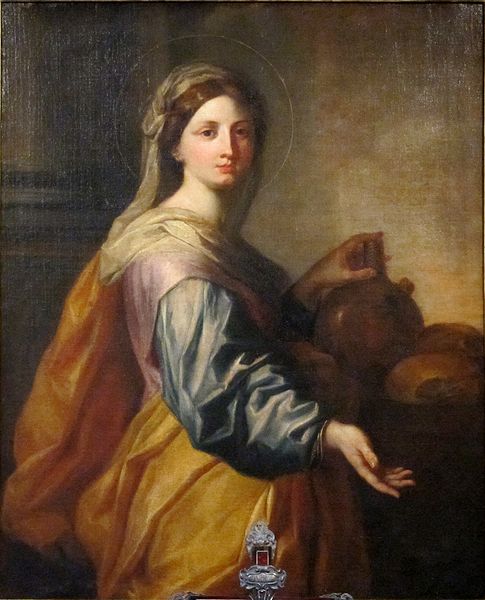
Listen to the song of Boga-Rodzica with lyrics.

Silver coffin of St. Adalbert in Gniezno

{ 0 comments }

St. George

Statue of St. George inside the City Hall, "Saló de Cent", Barcelona.

Statue of St. George inside the City Hall, “Saló de Cent”, Barcelona.

Martyr, patron of England, suffered at or near Lydda, also known as Diospolis, in Palestine, probably before the time of Constantine. According to the very careful investigation of the whole question recently instituted by Father Delehaye, the Bollandist, in the light of modern sources of information, the above statement sums up all that can safely be affirmed about St. George, despite his early cultus and preeminent renown both in East and West.

Saint George and the dragon

The best known form of the legend of St. George and the Dragon is that made popular by the “Legenda Aurea”, and translated into English by Caxton.

Fountain of Saint George and the Dragon, located at the "Pati dels Tarongers" (Orange trees courtyard) in the Palace of the Generalitat de Catalunya, Barcelona. By sculptor Frederic Galcerà Alabart (1926) Photo by Generalitat de Catalunya.

Fountain of Saint George and the Dragon, located at the “Pati dels Tarongers” (Orange trees courtyard) in the Palace of the Generalitat de Catalunya, Barcelona. By sculptor Frederic Galcerà Alabart (1926) Photo by Generalitat de Catalunya.

According to this, a terrible dragon had ravaged all the country round a city of Libya, called Selena, making its lair in a marshy swamp. Its breath caused pestilence whenever it approached the town, so the people gave the monster two sheep every day to satisfy its hunger, but, when the sheep failed, a human victim was necessary and lots were drawn to determine the victim. On one occasion the lot fell to the king’s little daughter. The king offered all his wealth to purchase a substitute, but the people had pledged themselves that no substitutes should be allowed, and so the maiden, dressed as a bride, was led to the marsh.  Subscription6.1 There St. George chanced to ride by, and asked the maiden what she did, but she bade him leave her lest he also might perish. The good knight stayed, however, and, when the dragon appeared, St. George, making the sign of the cross, bravely attacked it and transfixed it with his lance. Then asking the maiden for her girdle (an incident in the story which may possibly have something to do with St. George’s selection as patron of the Order of the Garter), he bound it round the neck of the monster, and thereupon the princess was able to lead it like a lamb. They then returned to the city, where St. George bade the people have no fear but only be baptized, after which he cut off the dragon’s head and the townsfolk were all converted. The king would have given George half his kingdom, but the saint replied that he must ride on, bidding the king meanwhile take good care of God’s churches, honor the clergy, and have pity on the poor. The earliest reference to any such episode in art is probably to be found in an old Roman tombstone at Conisborough in Yorkshire, considered to belong to the first half of the twelfth century. Here the princess is depicted as already in the dragon’s clutches, while an abbot stands by and blesses the rescuer.

St. George and the Dragon statuette was commissioned by Duke Wilhelm V. Duke Wilhelm’s son, Maximilian I, had the original ebony base replaced with the present sumptuous pedestal. The entire statuette consists of 2,291 diamonds, 406 rubies, and 209 pearls. At the base, the inscription in gold letters reads: “Maximilian, Count Palatine on the Rhine, Duke of the two Bavarias, Elector of the Holy Roman Empire, dedicated this to the great martyr St. George, patron and protector of his house and family.” Well concealed by this lavish decoration is a tiny drawer containing a reliquary of St. George jeweled as elaborately as all the rest. This statue is housed in the Residenz Museum in Munich, Germany. The tiny statuette is barely 20″ high from its base to the pearl on the knights helmet.

St. George and the Dragon statuette was commissioned by Duke Wilhelm V. Duke Wilhelm’s son, Maximilian I, had the original ebony base replaced with the present sumptuous pedestal. The entire statuette consists of 2,291 diamonds, 406 rubies, and 209 pearls. At the base, the inscription in gold letters reads: “Maximilian, Count Palatine on the Rhine, Duke of the two Bavarias, Elector of the Holy Roman Empire, dedicated this to the great martyr St. George, patron and protector of his house and family.” Well concealed by this lavish decoration is a tiny drawer containing a reliquary of St. George jeweled as elaborately as all the rest. This statue is housed in the Residenz Museum in Munich, Germany. The tiny statuette is barely 20″ high from its base to the pearl on the knights helmet.

From a sermon of St. Peter Damian about St. George

Saint George was a man who abandoned one army for another. He gave up the rank of tribune to enlist as a soldier for Christ. Eager to encounter the enemy, he first stripped away his worldly wealth by giving all he had to he poor. Then, free and unencumbered, bearing the shield of faith, he plunged into the think of the battle, an ardent soldier for Christ. Clearly what he did serves to teach us a valuable lesson: if we are afraid to strip ourselves of out worldly possessions, then we are unfit to make a strong defense of the faith.

Statue of St. George in Léon, Spain, which is over the entrance to a bank, a former castle.

Statue of St. George in Léon, Spain, which is over the entrance to a bank, a former castle.

Dear brothers, let us not only admire the courage of this fighter in heaven’s army, but follow his example. Let us be inspired to strive for the reward of heavenly glory. We must now cleanse ourselves, as Saint Paul tells us, from all defilement of body and spirit, so that one day we too may deserve to enter that temple of blessedness to which we now aspire.

The tomb of Saint George in Lod, Israel

The tomb of Saint George in Lod, Israel

(cfr Catholic Encyclopedia)
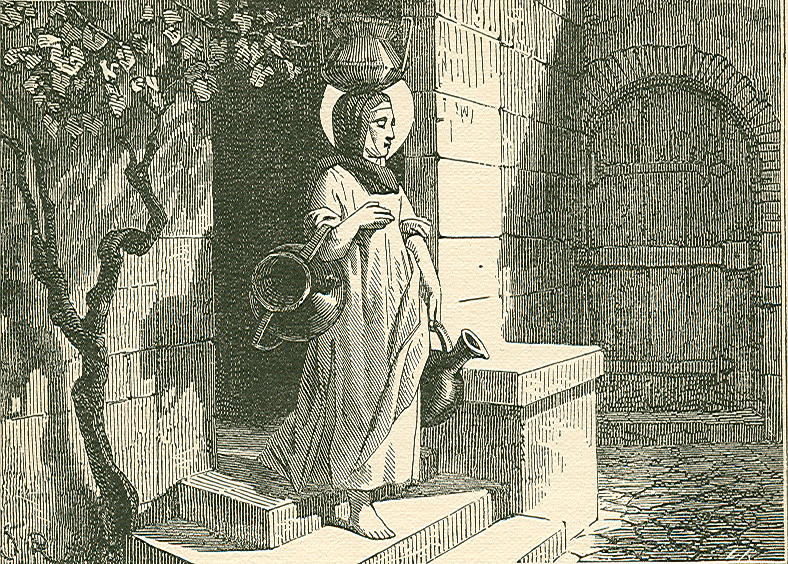
Also of Interest

Reliquary of Chivalry

St. George Slaying the Dragon coin


{ 0 comments }

April 24 – St. Mellitus

April 23, 2026

St. Mellitus

Bishop of London and third Archbishop of Canterbury, d. 24 April, 624. He was the leader of the second band of missionaries whom St. Gregory sent from Rome to join St. Augustine at Canterbury in 601. Venerable Bede (Hist. Eccl., II, vii) describes him as of noble birth, and as he is styled abbot by the pope (Epp. Gregorii, xi, 54, 59), it is thought he may have been Abbot of the Monastery of St. Andrew on the Coelian Hill, to which both St. Gregory and St. Augustine belonged. Several commendatory epistles of the pope recommending Mellitus and his companions to various Gallic bishops have been preserved (Epp., xi, 54-62). With the band he sent also “all things needed for divine worship and the Church’s service, viz. sacred vessels and altar cloths, vestments for priests and clerics, and also relics of the holy apostles and martyrs, with many books” (Bede, “Hist. Eccl.”, I, 29).

The consecration of Mellitus as bishop by Augustine took place soon after his arrival in England, and his first missionary efforts were among the East Saxons. Their king was Sabert, nephew to Ethelbert, King of Kent, and by his support, Mellitus was able to establish his see in London, the East Saxon capital, and build there the church of St. Paul. On the death of Sabert his sons, who had refused Christianity, gave permission to their people to worship idols once more. Moreover, on seeing Mellitus celebrating Mass one day, the young princes demanded that he should give them also the white bread which he had been wont to give their father. When the saint answered them that this was impossible until they had received Christian baptism, he was banished from the kingdom. Mellitus went to Kent, where similar difficulties had ensued upon the death of Ethelbert, and thence retired to Gaul about the year 616.

After an absence of about a year, Mellitus was recalled to Kent by Laurentius, Augustine’s successor in the See of Canterbury. Matters had improved in that kingdom owing to the conversion of the new king Eadbald, but Mellitus was never able to regain possession of his own See of London. In 619, Laurentius died, and Mellitus was chosen archbishop in his stead. He appears never to have received the pallium, though he retained the see for five years-a fact which may account for his not consecrating any bishops. During this time, he suffered constantly from ill-health. He consecrated a church to the Blessed Mother of God in the monastery of SS. Peter and Paul at Canterbury, and legend attributes to him the foundation of the Abbey of St. Peter at Westminster, but this is almost certainly incorrect. Among the many miracles recorded of him is the quelling of a great fire at Canterbury which threatened to destroy the entire city. The saint, although too ill to move, had himself carried to the spot where the fire was raging and, in answer to his prayer, a strong wind arose which bore the flames southwards away from the city. Mellitus was buried in the monastery of SS. Peter and Paul, afterwards St. Augustine’s, Canterbury. Some relics of the saint were preserved in London in 1298. The most reliable account of his life is that given by Bede in “Hist. Eccl.”, I, 29, 30; II, 3-7. Elmham in his “Historia Monasterii S. Augustini Cantuar.”, edited by Hardwick, gives many additional details, but the authenticity of these is more than questionable. His feast is observed on April 24.

BEDE, Hist. Eccl., I, xxix, xxx; II, iii-vii, in P.L., XCV; Acta SS., April, III, 280; BARONIUS, Ann. Eccl. (Rome, 1599), ad an. 624; CAPGRAVE, Nova legenda Angliae (London, 1516), 228; HADDON AND STUBBS, Councils and Eccl. Documents relating to Great Britain, III (Oxford, 1871), 62-71; HARDY, Descriptive catalogue of MSS. relating to the history of Great Britain and Ireland, I (Rolls Series, London, 1862), i, 219-220; MABILLON, Acta Sanctorum Bened. (Paris, 1669), II, 90-94; STANTON, Menology of England and Wales (London, 1887), 178; CHALLONER, Britannia Sancta, I (London, 1745), 255-258.

G. ROGER HUDLESTON (Catholic Encyclopedia)
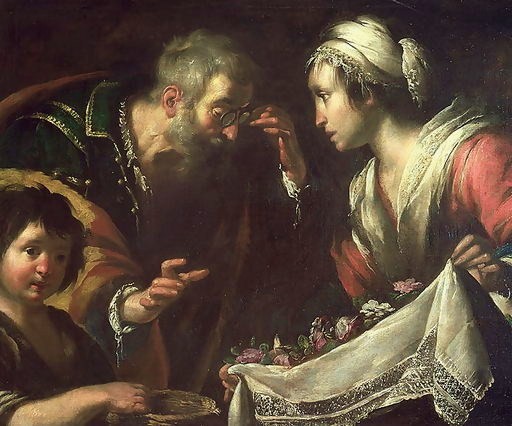
{ 0 comments }

Battle of Mühlberg 1547 and imprisonment of elector Johann Friedrich of Saxony. The pictorial report focuses on the end of the Battle of Mühlberg and the capture of the elector. On the right scenes from the five-year captivity are shown.

The Battle of Mühlberg took place near Mühlberg in the Electorate of Saxony in 1547, during the Schmalkaldic War. The Catholic princes of the Holy Roman Empire led by the Holy Roman Emperor Charles V decisively defeated the Lutheran Schmalkaldic League of Protestant princes under the command of Elector John Frederick I of Saxony and Landgrave Philip I of Hesse.

The battle ended the Schmalkaldic war and led to the dissolution of the Schmalkaldic League.

What was the Schmalkaldic League?

Philip I, Landgrave of Hesse

A politico-religious alliance formally concluded on 27 Feb., 1531, at Smalkalden in Hesse-Nassau, among German Protestant princes and cities for their mutual defence. The compact was entered into for six years, and stipulated that any military attack made upon any one of the confederates on account of religion or under any other pretext was to be considered as directed against them all and resisted in common. The parties to it were: the Landgrave Philip of Hesse; the Elector John of Saxony and his son John Frederick; the dukes Philip of Brunswick-Grubenhagen and Otto, Ernest, and Francis of Brunswick-Lünenburg; Prince Wolfgang of Anhalt; the counts Gebhard and Albrecht of Mansfeld and the towns of Strasburg, Ulm, Constance, Reutlingen, Memmingen, Lindau, Biberach, Isny, Magdeburg, and Bremen. The city of Lübeck joined the league on 3 May, and Bavaria on 24 Oct., 1531. The accession of foreign powers, notably England and France, was solicited, and the alliance of the latter nation secured in 1532. The princes of Saxony and Hesse were appointed military commanders of the confederation, and its military strength fixed at 10,000 infantry and 2000 cavalry. At a meeting held at Smalkalden in Dec., 1535, the alliance was renewed for ten years, and the maintenance of the former military strength decreed, with the stipulation that it should be doubled in case of emergency. In April, 1536, Dukes Ulrich of Würtemberg and Barnim and Philip of Pomerania, the cities of Frankfort, Augsburg, Hamburg, and Hanover joined the league with several other new confederates. An alliance was concluded with Denmark in 1538, while the usual accession of the German Estates which accepted the Reformation continued to strengthen the organization. Confident of its support, the Protestant princes introduced the new religion in numerous districts, suppressed bishoprics, confiscated church property, resisted imperial ordinances to the extent of refusing help against the Turks, and disregarded the decisions of the Imperial Court of Justice.

John Frederick I of Saxony

In self-defence against the treasonable machinations of the confederation, a Catholic League was formed in 1538 at Nuremberg under the leadership of the emperor. Both sides now actively prepared for an armed conflict, which seemed imminent. But negotiations carried on at the Diet of Frankfort in 1539 resulted, partly owing to the illness of the Landgrave of Hesse, in the patching up of a temporary peace. The emperor during this respite renewed his earnest but fruitless efforts to effect a religious settlement, while the Smalkaldic confederates continued their violent proceedings against the Catholics, particularly in the territory of Brunswick-Wolfenbüttel, where Duke Henry was unjustly expelled, and the new religion introduced (1542). It became more and more evident as time went on that a conflict was unavoidable. When, in 1546, the emperor adopted stern measures against some of the confederates, the War of Smalkalden ensued. Although it was mainly a religious conflict between Catholics and Protestants, the denominational lines were not sharply drawn. With Pope Paul III, who promised financial and military assistance, several Protestant princes, the principal among whom was Duke Marice of Saxony, defended the imperial and Catholic cause. The beginning of hostilities was marked nevertheless by the success of the Smalkaldic allies; but division and irresoluteness soon weakened them and caused their ruin in Southern Germany, where princes and cities submitted in rapid succession. The battle of Mühlberg (24 April, 1547) decided the issue in favour of the emperor in the north. The Elector John Frederick of Saxony was captured, and shortly after the Landgrave Philip of Hesse was also forced to submit. The conditions of peace included the transfer of the electoral dignity from the former to his cousin Maurice, the reinstatement of Duke Henry of Wolfenbüttel in his dominions, the restoration of Bishop Julius von Pflug to his See of Naumburg-Zeitz, and a promise demanded of the vanquished to recognize and attend the Council of Trent. The dissolution of the Smalkaldic League followed; the imperial success was complete, but temporary.

The Battle

Charles was suffering from gout at that time and his army had to face the desertion of the Papal soldiers that had helped him in the first part of the campaign. In addition the Saxon Elector’s army was larger than Charles’ forces. However, hoping to encourage a Protestant and anti-imperial uprising in Bohemia, John Frederick took the decision to split his forces and he deployed a large portion of his troops there.

Read More Here

{ 0 comments }

St. Fidelis of Sigmaringen

Born in 1577, at Sigmaringen, Prussia, of which town his father Johannes Rey was burgomaster; died at Sevis, 24 April, 1622.

St. Fidelis

On the paternal side he was of Flemish ancestry. He pursued his studies at the University of Freiburg in the Breisgau, and in 1604 became tutor to Wilhelm von Stotzingen, with whom he travelled in France and Italy. In the process for Fidelis’s canonization Wilhelm von Stotzingen bore witness to the severe mortifications his tutor practised on these journeys. In 1611 he returned to Freiburg to take the doctorate in canon and civil law, and at once began to practise as an advocate. But the open corruption which found place in the law courts determined him to relinquish that profession and to enter the Church.

He was ordained priest the following year, and immediately afterwards was received into the Order of Friars Minor of the Capuchin Reform at Freiburg, taking the name of Fidelis. He has left an interesting memorial of his novitiate and of his spiritual development at that time in a book of spiritual exercises which he wrote for himself. This work was re-edited by Father Michael Hetzenauer, O.F.M. Cap., and republished in 1893 at Stuttgart under the title: “S. Fidelis a Sigmaringen exercitia seraphicae devotionis”. From the novitiate he was sent to Constance to finish his studies in theology under Father John Baptist, a Polish friar of great repute for learning and holiness.

Saint Fidelis of Sigmarigen with Saint Joseph of Leonessa

Saint Fidelis of Sigmarigen with Saint Joseph of Leonessa

At the conclusion of his theological studies Fidelis was appointed guardian first of the community at Rheinfelden, and afterwards at Freiburg and Feldkirch. As a preacher his burning zeal earned for him a great reputation.

From the beginning of his apostolic career he was untiring in his efforts to convert heretics nor did he confine his efforts in this direction to the pulpit, but also used his pen. He wrote many pamphlets against Calvinism and Zwinglianism though he would never put his name to his writings. Unfortunately these publications have long been lost. Fidelis was still guardian of the community at Feldkirch when in 1621 he was appointed to undertake a mission in the country of the Grisons with the purpose of bringing back that district to the Catholic Faith. The people there had almost all gone over to Calvinism, owing partly to the ignorance of the priests and their lack of zeal. In 1614 the Bishop of Coire had requested the Capuchins to undertake missions amongst the heretics in his diocese, but it was not until 1621 that the general of the order was able to send friars there. In that year Father Ignatius of Bergamo was commissioned with several other friars to place himself at the disposal of this bishop for missionary work, and a similar commission was given to Fidelis who however still remained guardian of Feldkirche. Before setting out on this mission Fidelis was appointed by authority of the papal nuncio to reform the Benedictine monastery at Pfafers. He entered upon his new labours in the true apostolic spirit. Since he first entered the order he had constantly prayed, as he confided to a fellow-friar, for two favours: one, that he might never fall into mortal sin; the other, that he might die for the Faith. In this Spirit he now set out, ready to give his life in preaching the Faith. He took with him his crucifix, Bible, Breviary, and the book of the rule of his order; for the rest, he went in absolute poverty, trusting to Divine Providence for his daily sustenance.

St. Fidelis

He arrived in Mayenfeld in time for Advent and began at once preaching and catechizing; often preaching in several places the same day. His coming aroused strong opposition and he was frequently threatened and insulted. He not only preached in the Catholic churches and in the public streets, but occasionally in the conventicles of the heretics. At Zizers one of the principal centres of his activity, he held conferences with the magistrates and chief townsmen, often far into the night. They resulted in the conversion of Rudolph de Salis, the most influential man in the town, whose public recantation was followed by many conversions.

Throughout the winter Fidelis laboured indefatigably and with such success that the heretic preachers were seriously alarmed and set themselves to inflame the people against him by representing that his mission was political rather than religious and that he was preparing the way for the subjugation of the country by the Austrians. During the Lent of 1622 he preached with especial fervour. At Easter he returned to Feldkirch to attend a chapter of the order and settle some affairs of his community.

By this time the Congregation of the Propaganda had been established in Rome, and Fidelis was formally constituted by the Congregation, superior of the mission in the Grisons. He had, however, a presentiment that his laborers would shortly be brought to a close by a martyr’s death. Preaching a farewell sermon at Feldkirch he said as much.

Statue of St. Fidelis of Sigmaringen

Statue of St. Fidelis of Sigmaringen

On re-entering the country of the Grisons he was met everywhere with the cry: “Death to the Capuchins!” On 24 April, being then at Grusch, he made his confession and afterwards celebrated Mass and preached. Then he set out for Sevis. On the way his companions noticed that he was particularly cheerful. At Sevis he entered the church and began to preach, but was interrupted by a sudden tumult both within and without the church. Several Austrian soldiers who were guarding the doors of the church were killed and Fidelis himself was struck. A Calvinist present offered to lead him to a place of security. Fidelis thanked the man but said his life was in the hands of God. Outside the church he was surrounded by a crowd led by the preachers who offered to save his life if he would apostatize. Fidelis replied: “I came to extirpate heresy, not to embrace it”, whereupon he was struck down. He was the first martyr of the Congregation of Propaganda.

His body was afterwards taken to Feldkirch and buried in the church of his order, except his head and left arm, which were placed in the cathedral at Coire. He was beatified in 1729, and canonized in 1745. St. Fidelis is usually represented in art with a crucifix and with a wound in the head; his emblem is a bludgeon. His feast is kept on 24 April.

FATHER CUTHBERT (Catholic Encyclopedia)

{ 0 comments }

Mother Mary Euphrasia Pelletier, foundress of the Sisters of Our Lady of Charity of the Good Shepherd and canonized May 2, 1940 by Pope Pius XII.

Rose Virginie Pelletier before joining the Order.

Rose Virginie Pelletier before joining the Order.

The aim of this institute is to provide a shelter for girls and women of dissolute habits, who wish to do penance for their iniquities and to lead a truly christian life. Not only voluntary penitents but also those consigned by civil or parental authority are admitted. Many of these penitents desire to remain for life; they are admitted to take vows, and form the class of “Magdalens”, under the direction of the Sisters of the Good Shepherd. They are an austere contemplative community, and follow the Rule of the Third Order of Mount Carmel. Prayer, penance and manual labour are their principal occupations. Many of these “Magdalens” frequently rise to an eminent degree of sanctity. Besides girls and women of this class, the order also admits children who have been secured from danger, before they have fallen or been stained by serious crime. They are instructed in habits of industry and self-respect and in all the duties they owe to themselves and to society. The “penitents”, “Magdalens” and “preservates” form perfectly distinct classes, completely segregated from one another.

Mother Marie-Euphrasie Pelletier

Mother Marie-Euphrasie Pelletier

The Good Shepherd is a cloistered order and follows the Rule of St. Augustine. The constitutions are borrowed in great part from those given by St. Francis of Sales to the Visitation Sisters, but are modified to suit the nature of this work. Besides the three ordinary vows of poverty, chastity and obedience, the Sisters of the Good Shepherd take a fourth vow, namely, to work for the conversion and instruction of “penitents”,—a vow which makes this order one of the most beautiful creations of Christian charity. The vows are renewed every year, for five years, before becoming perpetual. The order is composed of choir sisters, and lay or “converse” sisters. The choir sisters recite every day the Little Office of the Blessed Virgin. The habit is white, with white scapulars reminding them of the innocence of the life they should lead. The choir sisters wear a black veil; the “converse” sisters a white veil. Around their necks, they wear a silver heart, on one side of which is engraved an image of “The Good Shepherd” and on the other, the blessed virgin holding the Divine Infant, between a branch of roses and a branch of lilies. The heart represents that of the sister, consecrated to Mary and to her Divine Son and the roses and lilies are symbolical of the virtues of charity and purity. The order is dedicated in an especial manner to the Holy Heart of Mary and to the Sacred Heart of Jesus, which are its two patrons. Besides the choir sisters and the “converse” sisters, the order also admits “Tourière” Sisters, who attend to the door and perform necessary duties outside the cloister. Their habit is black, and they take only the three ordinary vows.

St. John Eudes with fathers and sisters of the congregation founded by himself. Painted for the ceremony of beatification of Eudes, 1909

St. John Eudes with fathers and sisters of the congregation founded by himself. Painted for the ceremony of beatification of Eudes, 1909

The Institute of the Good Shepherd is a branch of “Our Lady of Charity of the Refuge”, founded by Blessed John Eudes, at Caen, France, in 1641, and approved by Alexander VII, 2 January, 1666, its constitutions being approved by Benedict XIV, in 1741. The order as primitively organized by blessed John Eudes still exists in a flourishing state, under the first title of “Our Lady of Charity of the Refuge”, and counts about thirty-nine houses and about 1893 sisters. The distinction between the primitive order and its branch, the Institute of “Our Lady of Charity of the Good Shepherd”, consists mainly in the administration. According to the custom of his time, the Blessed John Eudes ordained that “Our Lady of the Refuge” should have no mother-house, but that every house founded by this order should be a distinct community, having its own administration, and being united to the other houses only by bonds of fraternal charity.

St. Mary Euphrasia Pelletier

St. Mary Euphrasia Pelletier

Among the noble women who entered the ranks of the Sisters of the refuge in the nineteenth century was one whose name will be long remembered, Mother Mary Euphrasia Pelletier. She was born in the island of Noirmoutier of pious parents, on 31 July 1796, and received in baptism the name of Rose Virginia. She entered the community of “The Refuge” of Tours, in 1814, and made her profession in 1816, taking the name of Mary St. Euphrasia. She became first mistress of the penitents, a short time after her profession, and about eight years later was made superioress of the house of Tours. Desirous of extending the benefits of her order to the very extremities of the earth, she clearly saw that a central government, a mother-house, should be established.

St Mary-Euphrasia Pelletier

St Mary-Euphrasia Pelletier

The house of Angers, which she had founded, seemed destined by God for grand designs. He would decide, by the voice of His pontiff. Like many of God’s elect, she was treated by her adversaries as an innovator, an ambitious person, impatient of authority. Only after incessant labours and formidable opposition did her cause triumph. The Brief in approval of the mother-house at Angers was signed 3 April, 1835, and published by Gregory XVI. The official title of the institute was henceforth “Our Lady of Charity of the Good Shepherd of Angers”. It is directly subject to the Holy See, and Cardinal Odescalchi was its first cardinal-protector. Angers is authorized to send its sisters to the extremities of the earth. Mother Euphrasia heartily devoted herself to the work entrusted to her. She had been accused of ambition, of innovation, and of disobedience. Her sole ambition was to extend God’s kingdom, and to offer the benefits of her institute to the whole world. Her innovations, in harmony with the spirit of the Gospel, with the fourth vow of her order, were approved by the Church, and gave in thirty-three years one hundred and ten soul-saving institutions to the Church and to society. Her institutions were all founded in obedience to the requests of ecclesiastical authorities in every part of the world. Thirty-three years she was mother-general of the Good Shepherd, and at her death 29 April 1868, she left 2067 professed sisters, 384 novices, 309 Touriere sisters, 962 “Magdalens”, 6372 “penitents”, and 8483 children of various classes. Angers had seen great changes since 1829, when Mother Euphrasia had come with five sisters to found the house. Within thirty-three years one hundred and ten convents had been founded, sixteen provinces established, in France, Belgium, Holland, Rome, Italy, Germany, Austria, England, Scotland, Ireland. Asia, Africa, the United States and Chili. Under her successor, Mother Mary St. Peter Coudenhove, in twenty-four years, eighty-five houses were founded, and thirteen new provinces established, making eleven in Europe, two in Africa, nine in North America, five in South America and one in the Oceania.

Subscription20

The cause of the beatification of Mother Euphrasia was inscribed by the postulator of the cause, 17 Nov., 1886. The preliminary examination terminated in 1890. Leo XIII received supplications from numerous cardinals, archbishops, bishops, several cathedral chapters, rectors of colleges, and universities, hundreds of priests, and many noble families, begging him to dispense from ordinary ten years’ interval required before the continuation of the cause. On 11 Dec., 1897, Leo XIII declared her “Venerable”, to the great joy of the whole world, and to the honour and glory of all the convents of the Good Shepherd.

Sister Mary of the Divine Heart, was a religious Sister of the Good Shepherd who requested, in the name of Christ Himself, that Pope Leo XIII consecrate the entire World to the Sacred Heart of Jesus.

Sister Mary of the Divine Heart, was a religious Sister of the Good Shepherd who requested, in the name of Christ Himself, that Pope Leo XIII consecrate the entire World to the Sacred Heart of Jesus. Her Incorrupt body resides in Ermesinde, Portugal.

The order glories also in the name of Mother Mary of the Divine Heart, who has been compared to the Blessed Margaret Mary Alacoque. The consecration of the universe to the Sacred Heart, 9 June, 1899, which Leo XIII referred to as the greatest act of his pontificate, was brought about by her suggestion. She died on the eve of the consecration (8 June, 1899), at Porto, Portugal, and already preparations are being made for her beatification.

CHARLES LEBRUN (Catholic Encyclopedia)
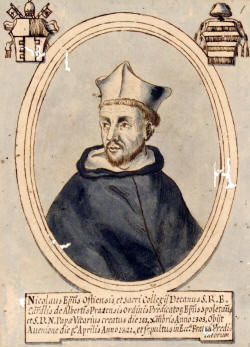
She was Beatified April 30, 1933 by Pope Pius XI and Canonized May 2, 1940 by Pope Pius XII.

Old Age, Decrepitude, or Height?

{ 0 comments }

April 25 – Builder

April 23, 2026

Blessed Meinwerk Tenth Bishop of Paderborn, d. 1036: Meinwerk (Meginwerk) was born of the noble family of the Immedinger and related to the royal house of Saxony. His father was Imad (Immeth), Count of Teisterbant and Radichen, and his mother’s name was Adela (Adala, Athela). In early youth he was dedicated by his parents to […]

Read the full article →

April 26 – His ears were nailed to the pillory

April 23, 2026

Venerable Edward Morgan Welsh priest, martyr, b. at Bettisfield, Hanmer, Flintshire, executed at Tyburn, London, 26 April, 1642. His father’s Christian name was William. Of his mother we know nothing except that one of her kindred was Lieutenant of the Tower of London. From the fact that the martyr was known at St. Omer as […]

Read the full article →

April 26 – Pope St. Cletus

April 23, 2026

Pope St. Cletus This name is only another form for Anacletus, the second successor of St. Peter. It is true that the Liberian Catalogue, a fourth-century list of popes, so called because it ends with Pope Liberius (d. 366), contains both names, as if they were different persons. But this is an error, owing evidently […]

Read the full article →

April 26 – She inspired the Albanians to resist the Turks

April 23, 2026

Our Lady of Good Counsel January of 1467 saw the death of the last great Albanian leader, George Castriota, better known as Scanderbeg. Raised by an Albanian chief, he placed himself at the head of his own people. Subsequently, Scanderbeg inflicted stunning defeats on the Turkish army and occupied fortresses all over Albania. With Scanderbeg’s […]

Read the full article →

April 20 – “I beg your Lordship…that my lips and…fingers may be cut off…”

April 20, 2026

Blessed Fr. James Bell Priest and martyr, born at Warrington in Lancashire, England, probably about 1520; died 20 April, 1584. For the little known of him we depend on the account published four years after his death by Bridgewater in his “Concertatio” (1588), and derived from a manuscript which was kept at Douay when Challoner […]

Read the full article →

April 20 – Blessed John Finch

April 20, 2026

Bl. John Finch A martyr, born about 1548; died 20 April, 1584. He was a yeoman of Eccleston, Lancashire, and a member of a well-known old Catholic family, but he appears to have been brought up in schism. When he was twenty years old he went to London where he spent nearly a year with […]

Read the full article →

April 21 – Pioneer missionary of Kentucky

April 20, 2026

Stephen Theodore Badin The first Catholic priest ordained within the limits of the original thirteen States of the Union, pioneer missionary of Kentucky, b. at Orléans, France, 17 July, 1768; d. at Cincinnati, Ohio, 21 April, 1853. Educated at Montaigu College, Paris, he entered the Sulpician Seminary of his native city in 1789. He was […]

Read the full article →

April 21 – The emperor placed unlimited confidence in him

April 20, 2026

Garcia de Loaisa Cardinal and Archbishop of Seville, b. in Talavera, Spain, c. 1479; d. at Madrid, 21 April, 1546. His parents were nobles; at a very early age he entered the Dominican convent at Salamanca. Its severe discipline, however, affected his delicate constitution and he was transferred to the convent of St. Paul in […]

Read the full article →

April 21 – Traveller in the Orient

April 20, 2026

Pietro della Valle Italian traveller in the Orient, b. at Rome, 2 April, 1586; d. there, 21 April, 1652. He belonged to a noble family and received an excellent education. As a young man he was a poet, orator, a soldier in the papal service, and a member of the Roman Academy of the Umoristi. […]

Read the full article →

April 21 – Preacher to the King

April 20, 2026

Nicolas Coeffeteau Preacher and controversialist, born 1574, at Château-du-Loir, province of Maine, France; died Paris, 21 April, 1623. He entered the Dominican convent of Sens, 1588, and after his profession, 1590, was sent to St-Jacques, the house of studies at Paris. There in 1595 he began to teach philosophy. On 4 May, 1600, he received […]

Read the full article →

April 21 – The Noble Saint who tamed William the Conqueror, abolished slavery in England, and founded Scholasticism; his prayer to Saint Mary Magdalene

April 20, 2026

Saint Anselm, Confessor, Archbishop Of Canterbury (A. D. 1109) If the Norman conquerors stripped the English nation of its liberty and many temporal advantages, it must be owned that by their valor they raised the reputation of its arms and deprived their own country of its greatest men, both in church and state, with whom […]

Read the full article →

The Pizza That Was Named For A Queen – Recipe

April 20, 2026

  Margherita Teresa Giovanna, Princess of Savoy, was born in Turin, on November 20, 1851. On April 21, 1868, when just sixteen years old, she married her first cousin, Umberto, Crown Prince of Italy. Pizza Margherita was named after her. This is how it happened… In June 1898, Margherita accompanied her husband, now Umberto I, King […]

Read the full article →

April 22 – Cabral and the Discovery of Brazil

April 20, 2026

Pedralvarez Cabral (Pedro Alvarez.) A celebrated Portugese navigator, generally called the discoverer of Brazil, born probably around 1460; date of death uncertain. Very little is known concerning the life of Cabral. He was the third son of Fernao Cabral, Governor of Beira and Belmonte, and Isabel de Gouvea, and married Isabel de Castro, the daughter […]

Read the full article →

April 22 – Father of Origen

April 20, 2026

St. Leonidas (Or LEONIDES.) The Roman Martyrology records several feast days of martyrs of this name in different countries. Under date of 28 January there is a martyr called Leonides, a native of the Thebaid, whose death with several companions is supposed to have occurred during the Diocletian persecution (Acta SS., January, II, 832). Another […]

Read the full article →

New Buckingham Palace Exhibition Celebrates the Fashion of Elizabeth II: Sparkling Tiaras to Pastel Hats

April 16, 2026

h/t smithsonianmag.com King’s Gallery at Buckingham Palace is showcasing 300 selections drawn from a collection of 4,000 items she owned. The collection also highlights the queen’s talent for melding fashion with diplomacy. Some notable pieces she sported while meeting with leaders abroad include a cherry blossom dress from her 1975 trip to Japan, the green-and-white […]

Read the full article →

Mary Queen of Scots: Catholic Martyr?

April 16, 2026

by Byron Whitcraft h/t tfp.org After almost five centuries, the legendary Queen Mary of Scotland is now again in the spotlight. The last letter she penned just six hours prior to her execution is on display in Perth, Scotland. The exhibit is on display at the Perth Museum until April 26, 2026, and the letter […]

Read the full article →

April 16 – Martyred in the name of Equality

April 16, 2026

Just a few of the many martyrs during the French Revolution († 1792-1799) 16 April 1794 in Avrillé, Maine-et-Loire (France) Pierre Delépine layperson of the diocese of Angers born: 24 May 1732 in Marigné, Maine-et-Loire (France) Jean Ménard layperson of the diocese of Angers; married born: 16 November 1736 in Andigné, Maine-et-Loire (France) Renée Bourgeais […]

Read the full article →

April 17 – Martyred at Tyburn

April 16, 2026

Ven. Henry Heath English Franciscan and martyr, son of John Heath; christened at St. John’s, Peterborough, 16 December, 1599; executed at Tyburn, 17 April, 1643. He went to Corpus Christi College, Cambridge, 1617, proceeded B.A. in 1621, and was made college librarian. In 1622 he was received into the Church by George Muscott, and, after […]

Read the full article →

April 17 – Mother of Fr. Gallitzin

April 16, 2026

Adele Amalie Gallitzin (Or GOLYZIN). Princess; b. at Berlin, 28 Aug., 1748; d. at Angelmodde, near Münster, Westphalia, 17 April, 1806. She was the daughter of the Prussian General Count von Schmettau, and educated in the Catholic faith, though she soon became estranged from her religion. In 1768, she married the Russian Prince Dimitry Alexejewitsch […]

Read the full article →

April 17 – Controversial Pope

April 16, 2026

Pope Benedict III Date of birth unknown; d. 17 April, 858. The election of the learned and ascetic Roman, Benedict, the son of Peter, was a troubled one. On the death of Leo IV (17 July, 855) Benedict was chosen to succeed him, and envoys were despatched to secure the ratification of the decree of […]

Read the full article →

April 17 – He saved countless souls from apostasy

April 16, 2026

Thomas of Jesus (THOMAS DE ANDRADA). Reformer and preacher, born at Lisbon, 1529; died at Sagena, Morocco, 17 April, 1582. He was educated by the Augustinian Hermits from age of ten, entered the order at Lisbon in 1534, completed his studies at Coimbra, and was appointed novice-master. In his zeal for primitive observance he attempted […]

Read the full article →

April 17 – He rescued his country from crushing debt, yet waged incessant war

April 16, 2026

Maximilian I Duke of Bavaria, 1598-1622, Elector of Bavaria and Lord High Steward of the Holy Roman Empire, 1623-1651; born at Munich, 17 April, 1573; died at Ingolstadt, 27 September, 1651. The lasting services he rendered his country and the Catholic Church justly entitle him to the surname of “Great”. He was the son of […]

Read the full article →

April 19 – The saintly warrior pope

April 16, 2026

Pope St. Leo IX Pope St. Leo IX earnestly spread the Cluny reform Born at Egisheim, near Colmar, on the borders of Alsace, 21 June, 1002, Pope St. Leo IX died on 19 April, 1054. He belonged to a noble family which had given or was to give saints to the Church and rulers to […]

Read the full article →

April 19 – Hostage of the Danes

April 16, 2026

St. Alphege (or Elphege), Saint, born 954; died 1012; also called Godwine, martyred Archbishop of Canterbury, left his widowed mother and patrimony for the monastery of Deerhurst (Gloucestershire). After some years as an anchorite at Bath, he there became abbot, and (19 Oct., 984) was made Bishop of Winchester. In 994 Elphege administered confirmation to […]

Read the full article →

April 18 – St. Willigis

April 16, 2026

St. Willigis Archbishop of Mainz, d. 23 Feb., 1011. Feast, 23 February or 18 April. Though of humble birth he received a good education, and through the influence of Bishop Volkold of Meissen entered the service of Otto I, and after 971 figured as chancellor of Germany. Otto II in 975 made him Archbishop of […]

Read the full article →

April 18 – Blessed Marie de l’Incarnation

April 16, 2026

Bl. Marie de l’Incarnation Known also as Madame Acarie, foundress of the French Carmel, born in Paris, 1 February, 1566; died at Pontoise, April, 1618. By her family Barbara Avrillot belonged to the higher bourgeois society in Paris. Her father, Nicholas Avrillot was accountant general in the Chamber of Paris, and chancellor of Marguerite of […]

Read the full article →

April 13 – Pope St. Martin I

April 13, 2026

Pope St. Martin I Martyr, born at Todi on the Tiber, son of Fabricius; elected Pope at Rome, 21 July, 649, to succeed Theodore I; d at Cherson in the present peninsulas of Krym, 16 Sept., 655, after a reign of 6 years, one month and twenty six days, having ordained eleven priests, five deacons […]

Read the full article →

April 13 – This Prince Defied His Family

April 13, 2026

St. Hermengild Date of birth unknown; died 13 April, 585. Leovigild, the Arian King of the Visigoths (569-86), had two sons, Hermengild and Reccared, by his first marriage with the Catholic Princess Theodosia. Hermengild married, in 576, Ingundis, a Frankish Catholic princess, the daughter of Sigebert and Brunhilde. Led by his own inclination, and influenced […]

Read the full article →

April 13 – Henry James Coleridge

April 13, 2026

Henry James Coleridge A writer and preacher, b. 20 September 1822, in Devonshire, England; d. at Roehampton, 13 April 1893. He was the son of Sir John Taylor Coleridge, a Judge of the King’s Bench, and brother of John Duke, Lord Coleridge, Chief Justice of England. His grandfather, Captain James Coleridge, was brother to Samuel […]

Read the full article →

April 14 – Apostle of the Detroit Hurons

April 13, 2026

Jean Baptiste Marchand Second principal in order of succession of the Sulpician College of Montreal and missionary of the Detroit Hurons at Sandwich, Ont.; b. at Verchères, Que., 25 Feb. 1760, son of Louis Marchand and Marguerite de Niverville; d. at Sandwich, 14 Apr., 1825. Marchand was ordained 11 March, 1786, affiliated to the Sulpician […]

Read the full article →

April 14 – She suffered for the moral corruption and decay of her time

April 13, 2026

Saint Lydwine In 1380, Saint Lydwine was born in the small town of Schiedam in Holland. Her father was a wealthy noble named Peter, and her mother was from a poor family who worked their own farm. Her father’s family lost their fortune, and the whole family was reduced to poverty. At that time, all […]

Read the full article →

April 14 – St. Peter Gonzalez (aka St. Elmo)

April 13, 2026

St. Peter Gonzalez Popularly known as St. Elmo, b. in 1190 at Astorga, Spain; d. 15 April, 1246, at Tuy. He was educated by his uncle, Bishop of Astorga, who gave him when very young a canonry. Later he entered the Dominican Order and became a renowned preacher; crowds gathered to hear him and numberless […]

Read the full article →

April 15 – The Notkers of St. Gall

April 13, 2026

Notker.—Among the various monks of St. Gall who bore this name, the following are the most important: (1) Notker Balbulus (Stammerer), Blessed, monk and author, b. about 840, at Jonswil, canton of St. Gall (Switzerland); d. 912. Of a distinguished family, he received his education with Tuotilo, originator of tropes, at St. Gall’s, from Iso […]

Read the full article →

A Democratic Constitution Should Assume and Protect the Values of the Christian Faith, Without Which It Will Not Be Able to Survive

April 13, 2026

[previous] In view of the peculiar circumstances of our day, it is opportune to quote a judicious analysis of Joseph Cardinal Ratzinger, Prefect of the Congregation for the Doctrine of the Faith [Nobility.org: and presently, the Sovereign Pontiff, Pope Benedict XVI], in an interview to the newspaper El Mercurio of Santiago, Chile (June 12, 1988): […]

Read the full article →

A Requiem for Manners

April 9, 2026

by Stephen M. Klugewicz On April 9, 1865, General Robert E. Lee met General Ulysses S. Grant at the McLean House in Appomattox, Virginia, for the purpose of surrendering the Army of Northern Virginia. Lee had asked for the meeting and had prepared by putting on his finest uniform: a new, long dress coat with […]

Read the full article →

April 9 – She persuaded her husband the Count to become a monk

April 9, 2026

St. Waudru She was daughter to the princess St. Bertille, elder sister to St. Aldegondes, and wife to Madelgaire, count of Hainault, and one of the principal lords of King Dagobert’s court. After bearing him two sons and two daughters, she induced him to embrace the monastic state at Haumont, near Maubeuge, taking the name […]

Read the full article →

April 9 – Mary of Cleophas

April 9, 2026

Mary of Cleophas This title occurs only in John, xix, 25. A comparison of the lists of those who stood at the foot of the cross would seem to identify her with Mary, the mother of James the Less and Joseph ( Mark, xv, 40; cf. Matt., xxvii, 56). Some have indeed tried to identify […]

Read the full article →

April 10 – Friend of Cluny

April 9, 2026

St. Fulbert of Chartres Bishop, born between 952 and 962; died 10 April, 1028 or 1029. Mabillon and others think that he was born in Italy, probably at Rome; but Pfister, his latest biographer, designates as his birthplace the Diocese of Laudun in the present department of Gard in France. He was of humble parentage […]

Read the full article →

April 10 – Pope Gregory XIII

April 9, 2026

Pope Gregory XIII (UGO BUONCOMPAGNI). Born at Bologna, 7 Jan., 1502; died at Rome, 10 April, 1585. He studied jurisprudence at the University of Bologna, from which he was graduated at an early age as doctor of canon and of civil law. Later, he taught jurisprudence at the same university, and had among his pupils […]

Read the full article →

April 11 – His donations helped build the first California missions

April 9, 2026

Juan Caballero y Ocio Born at Querétaro, Mexico, 4 May, 1644; died there 11 April, 1707. A priest remarkable for lavish gifts to the Church and for charity. While still a layman he was a mayor of his native city. After taking Holy Orders he held several high offices. He gave large sums of money […]

Read the full article →